Drafting a CQC Action Plan: A Manager's Guide for 2026

Updated: 5 days ago
What if receiving a draft report from the Care Quality Commission wasn't a signal of failure, but rather your most significant opportunity to demonstrate high-level leadership? For many managers, the days following a site visit are defined by a sense of dread and the weight of regulatory jargon. You likely feel the pressure of an impending rating downgrade whilst trying to decipher how to dispute findings that don't reflect the reality of your care setting. It's a period where uncertainty can easily lead to paralysis, yet this is precisely when a calm, methodical approach is most vital.
We understand that a CQC action plan after inspection is more than just a bureaucratic requirement; it's a strategic document that can secure your service's future. This guide provides you with a professional framework to master the post-inspection process, offering the steady hand you need to challenge inaccuracies and draft a compliant response. You'll gain a clear 28-day roadmap that replaces panic with precision, ensuring your submission demonstrates proactive governance and sets the stage for improved ratings. We will explore exactly how to structure your evidence and articulate your improvements to satisfy the regulator's highest standards.
Table of Contents
Understanding the CQC Action Plan Request and Post-Inspection Timeline
Receiving the initial feedback from a site visit often feels like the start of a race against time. Under the 2026 Single Assessment Framework, the CQC issues an action plan request when they identify a breach of regulations that requires correction but does not necessitate immediate, high-level enforcement. This document is your first formal opportunity to demonstrate that you possess the governance and leadership capacity to rectify issues internally. It's a structured request for you to show exactly how you'll bring the service back into compliance.
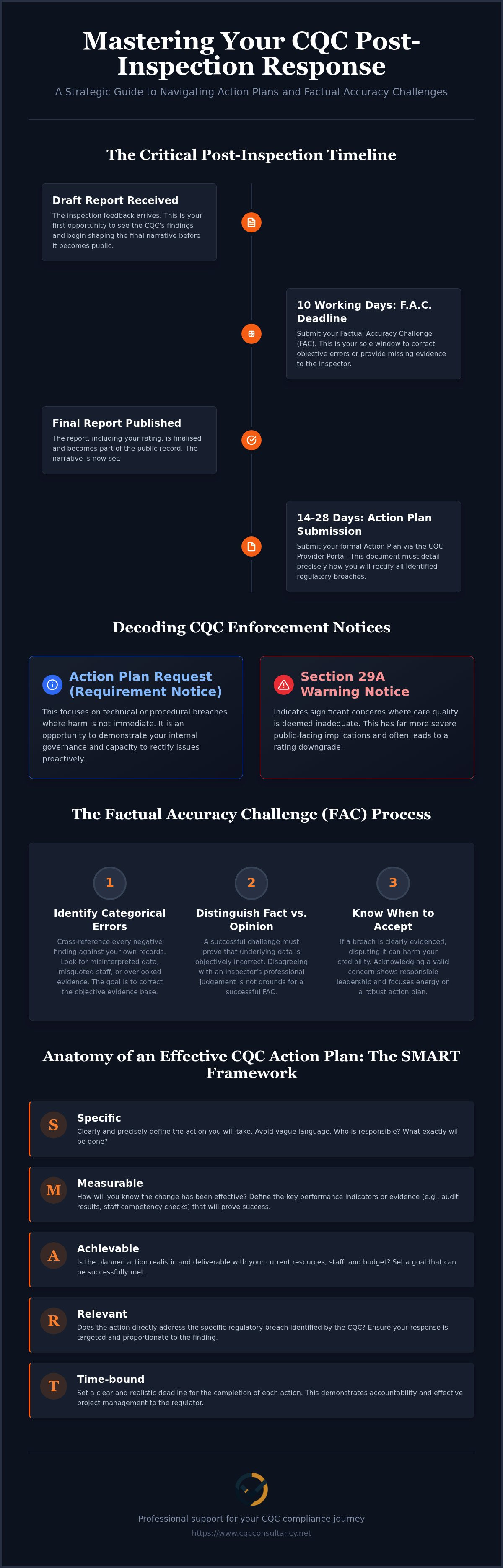
The timeline from the end of the site visit to the publication of your final report is a critical window, often spanning roughly 28 days. During this phase, the draft report serves as a working document. It's the most influential period for any manager, as it allows you to shape the final narrative before it becomes part of the public record. Failing to engage effectively at this stage can result in a permanent rating that doesn't truly reflect your service's quality or the hard work of your team. Managing a CQC action plan after inspection requires a calm, methodical approach to ensure every milestone is met with precision.
The Distinction Between Requirement Notices and Warning Notices
Understanding the severity of CQC enforcement actions is essential for your response strategy. Requirement notices, now frequently framed as Action Plan Requests, focus on technical or procedural breaches where harm isn't immediate. In contrast, a Section 29A Warning Notice indicates more significant concerns where the CQC believes the quality of care is fundamentally inadequate. Whilst you must submit a CQC action plan after inspection for both, the public-facing implications of a Warning Notice are far more severe. It often leads to a 'Requires Improvement' rating that can damage your reputation amongst service users and commissioners alike.
Key Deadlines You Cannot Afford to Miss
Precision is paramount when dealing with regulatory timescales. Once the draft report arrives, you have exactly 10 working days to submit a Factual Accuracy Challenge (FAC). This is your only chance to correct errors or provide missing evidence before the report is finalised. Following the publication of the final report, the standard timescale for submitting your formal action plan is typically 14 to 28 days. Missing these deadlines isn't merely a procedural lapse; it signals a lack of professional oversight and can trigger further, more restrictive enforcement actions. Maintaining a steady hand during this countdown is the best way to ensure a compliant and successful submission.
How to Challenge a CQC Inspection Report: The Factual Accuracy Process
Receiving a draft report that contains inaccuracies can feel like a personal affront to your hard work. However, the Factual Accuracy Challenge (FAC) is the primary mechanism for correcting regulatory oversight. It's your opportunity to ensure the public record is precise. Approaching this process requires a shift in mindset; you aren't entering into a debate, but rather providing a professional correction of the evidence base. You must distinguish between errors of fact and differences of professional opinion. Whilst you might disagree with an inspector's judgment, a challenge is only successful when you can prove that the underlying data or observations are objectively incorrect.
There are instances where accepting a finding is the most strategic path forward. If a breach is clearly evidenced and your internal records support the inspector's claim, disputing it can undermine your credibility. In these cases, your energy is better spent on drafting a robust CQC action plan after inspection that demonstrates immediate remedial action. Acknowledging a valid concern shows the CQC that you are a responsible, self-aware provider with strong leadership oversight.
Step 1: Identifying Categorical Errors
Begin by cross-referencing every negative finding against your contemporaneous records. Look for staff members who may have been misquoted or data points that were misinterpreted during the site visit. It's common for inspectors to overlook evidence that was provided in a digital format or tucked away in a specific folder. Under the 2026 framework, you must also ensure the inspector has applied the correct Quality Statement to their finding. If a shortfall in record-keeping is being used to justify an 'Inadequate' rating for 'Caring' rather than 'Well-led', you have a strong procedural ground for a challenge.
Step 2: Drafting the Response and Providing Evidence
Your response must be submitted using the CQC’s specific template for factual accuracy comments. To be successful, you should link your evidence directly to the disputed paragraph number in the draft report. Be concise and objective. Avoid defensive language; instead, use phrases like "Our records indicate" or "The evidence provided on the day showed". If the process feels overwhelming, seeking compliance guidance from an external expert can provide the objective perspective needed to filter out emotional responses and focus on the facts. This meticulous approach ensures that your CQC action plan after inspection addresses only the valid remaining concerns, protecting your service's reputation and your final rating.
The Anatomy of an Effective CQC Action Plan: Beyond Simple Compliance
Once the draft report is finalised, your focus must shift from disputing facts to demonstrating a proactive commitment to change. A high-quality CQC action plan after inspection is not merely a list of tasks; it is a strategic roadmap that provides the regulator with absolute confidence in your leadership. It must detail exactly how you intend to bridge the gap between your current performance and the required standards, moving from the 'what' of the breach to the 'how' of the remedy. This document serves as your primary evidence that you have grasped the scale of the challenge and possess the professional oversight to resolve it.
Clarity is your greatest ally here. Every action within your plan requires a named lead and a definitive completion date. Vague assignments like "all staff" or "ongoing" suggest a lack of internal control and are frequently rejected by inspectors. Instead, specify who is responsible for the outcome and what documentation will serve as evidence of completion. Whether it is revised policy signatures, audit results, or training certificates, you must define the proof that the breach is resolved. This methodical approach removes uncertainty and provides a clear audit trail for future site visits.
Developing SMART Objectives for Quality Improvement
Professional plans rely on the SMART framework: Specific, Measurable, Achievable, Relevant, and Time-bound. For instance, if the CQC identified gaps in medication records, a weak objective would be "to improve record keeping." A sophisticated objective would be "to implement a weekly medication administration record (MAR) audit by the Deputy Manager, achieving 100% accuracy by 30th June 2026." This level of detail aligns your objectives with the Single Assessment Framework’s Quality Statements, proving you understand the specific regulatory requirements whilst setting timescales that the CQC will judge as reasonable and realistic.
Integrating Governance and Oversight
An action plan only succeeds if it is embedded into your daily operations. The Registered Manager must act as the steady hand, overseeing the delivery of every objective and verifying that improvements are sustainable. Use internal audits to test your new systems; don't wait for the CQC to return to find out if a change has failed to take root. By linking your CQC action plan after inspection to your wider Quality Assurance (QA) programme, you demonstrate that compliance is a continuous process of improvement rather than a one-off reaction to a site visit. This integration ensures that high standards are maintained long after the initial pressure of the inspection has faded.
Step-by-Step: Drafting and Submitting Your Action Plan to the CQC
The final stage of the process involves the formal submission of your documentation through the CQC Provider Portal. By 2026, this digital interface has become the mandatory conduit for all regulatory correspondence. It's essential to approach this task with a sense of calm preparedness. Before you begin uploading individual actions, draft a compelling executive summary. This section isn't merely a formality; it's where you frame your response, demonstrating that you haven't just ticked boxes but have truly internalised the feedback. A strong summary emphasises your commitment to quality and safety, providing a narrative that binds your specific technical responses together and sets the tone for your CQC action plan after inspection.
Effective submission requires you to cross-reference every part of your plan with the latest regulatory expectations. For a deeper understanding of how these requirements fit into the current oversight model, you should consult our guide on Professional CQC Consultancy Services: Navigating the Single Assessment Framework in 2026. This ensures your response remains aligned with the Quality Statements the regulator uses to judge your service, providing a seamless transition from identification of needs to the assurance of a positive outcome.
Writing the Response for Each Requirement Notice
When addressing specific requirement notices, precision is your most valuable asset. Start by clearly citing the regulation that was breached. Your response should follow a logical sequence: first, summarise the immediate remedial actions you took within 24 to 48 hours of the inspection. Next, outline your long-term strategy for preventing a recurrence. This might include changes to staff training, revised auditing schedules, or new governance structures. By showing both immediate reaction and sustainable planning, you prove that your service is in safe hands and that you've grasped the scale of the challenge.
Submission Best Practices and Portal Tips
Digital submissions can be temperamental, so meticulous organisation is vital. Ensure all supporting evidence documents are clearly labelled with the relevant regulation and paragraph number from the report. This makes it easier for the inspector to verify your claims and reduces the chance of unnecessary follow-up queries. Keep a timestamped copy of every document and a screenshot of the submission confirmation for your own records. If you encounter technical issues with the portal, contact the CQC helpdesk immediately and document the interaction. This provides a professional trail if deadlines are at risk.
Before hitting the final submit button, conduct a thorough internal review. A fresh set of eyes can often spot minor errors or inconsistencies that might undermine the professional weight of your submission. If you feel the need for expert validation to secure your service's future, our team can provide the compliance guidance required to ensure your CQC action plan after inspection is beyond reproach. This final check is the bridge between a simple administrative task and a successful regulatory outcome.
Securing Future Ratings: Why Professional Oversight Matters
Completing your CQC action plan after inspection is a significant milestone, yet it's merely the beginning of your journey toward a 'Good' or 'Outstanding' rating. A well-crafted plan demonstrates that you can identify and resolve immediate breaches; however, true excellence requires embedding these changes into the very fabric of your service. Many managers find themselves so close to daily operations that they naturally develop blind spots. This is where professional oversight becomes invaluable. A fresh set of eyes identifies subtle gaps in governance that might otherwise go unnoticed until the regulator returns for a follow-up visit.
Stress-testing your new systems is the only way to ensure they'll withstand the scrutiny of future assessments. By investing in Comprehensive CQC Mock Inspection Services: The 2026 Readiness Guide, you can simulate the inspection experience in a safe, supportive environment. This proactive approach allows you to identify any lingering weaknesses in your CQC action plan after inspection before they become permanent marks on your public record. It moves your service from a defensive posture to one of quiet, prepared confidence, ensuring that your improvements are not just temporary fixes but sustainable standards of care.
Embedding Continuous Improvement
Transitioning away from a culture of 'firefighting' compliance is essential for long-term success. Your action plan shouldn't sit on a shelf once it's been submitted to the portal. It must remain a live document that informs staff training and professional development. When your team recognises that improvements are part of a wider commitment to excellence, their daily behaviour shifts. For the Registered Manager, the psychological benefit of this preparedness is immense. Knowing that your systems are robust and your evidence is ready alleviates the chronic stress that often accompanies regulatory oversight, allowing you to lead with a steady hand.
Leveraging Former Inspector Expertise
There is no substitute for internal knowledge of the regulatory system. Former inspectors, such as our lead consultant with 12 years of experience, understand the specific nuances of what their colleagues look for during follow-up visits. They know which evidence carries the most weight and how to articulate progress in a way that resonates with the CQC's current priorities. This specialised insight can often de-escalate potential enforcement actions, protecting your registration and your professional reputation. If you're ready to secure your service’s future and move toward your next rating with certainty, consider booking a consultation with our former CQC inspector today. Having an expert guide ensures that your next inspection is a celebration of your success rather than a source of anxiety.
Reclaiming Control of Your Regulatory Future
Managing the aftermath of an inspection is undoubtedly demanding, but it doesn't have to be a period of uncertainty. You now have the framework to navigate the critical 28-day window, from mounting a precise Factual Accuracy Challenge to drafting a robust CQC action plan after inspection. By adopting the SMART methodology and integrating these improvements into your daily governance, you demonstrate the high-level leadership that regulators expect.
Success lies in the details and the ability to view your service with objective clarity. We provide national coverage across the UK, offering the steady hand of a former CQC inspector with over 12 years of experience. Our expertise is specifically tailored to de-escalating enforcement actions and identifying the blind spots that can hinder your progress toward a 'Good' or 'Outstanding' rating.
Received a breach or requirement notice? See my Breach Response Action Plan.
If you're ready to secure your service's reputation and move forward with absolute confidence, book a call with a former CQC inspector to review your action plan. You've worked hard to build your service; now, let's ensure your regulatory record reflects that dedication. You're not alone in this process, and a brighter rating is well within your reach.
Frequently Asked Questions
How long do I have to submit a CQC action plan?
You typically have between 14 and 28 days to submit your response once the final report is published. The specific deadline for your service will be clearly stated in the covering letter that accompanies your final report. It's vital to respect this timeframe to demonstrate professional oversight and avoid triggering further regulatory intervention or site visits.
Can I challenge a CQC inspection report if I disagree with the rating?
You cannot challenge a rating simply because you are unhappy with the outcome. Instead, you must use the Factual Accuracy Challenge process to dispute the specific evidence or data that informed that rating. If you successfully correct inaccuracies in the draft report, the inspector may adjust the final rating before it becomes part of the public record.
What happens if the CQC does not accept my action plan?
If your CQC action plan after inspection is deemed insufficient or vague, the regulator will typically request further information or more robust evidence of improvement. In more serious instances, a rejected plan can lead to the CQC issuing a Warning Notice or escalating toward other enforcement actions to ensure the safety of service users.
Is a Requirement Notice the same as a Warning Notice?
These notices represent different levels of regulatory concern. A Requirement Notice is issued for breaches where there is no immediate risk of harm, whereas a Warning Notice indicates more significant failings that require urgent attention. Both require a formal response, but a Warning Notice carries far heavier implications for your service's public reputation and future rating.
Do I have to display my CQC action plan publicly?
You aren't legally required to display the action plan itself on your website or at your premises. However, you must display your current CQC rating posters prominently for all service users and visitors to see. Whilst the action plan remains a private document between you and the regulator, you should share it with your staff to ensure collective responsibility for improvements.
How much detail does the CQC expect in an action plan?
The CQC expects a high level of granular detail that moves beyond broad promises of improvement. Every regulatory breach must be addressed with a specific methodology, a named individual responsible for the change, and a clear deadline. You must also define the exact documentation, such as audit results or training logs, that will prove the breach has been resolved.
Can the CQC take further action after I submit my plan?
Submitting a CQC action plan after inspection does not provide immunity from further enforcement. The CQC will monitor your progress closely and may conduct unannounced follow-up visits to verify that changes have been embedded into your daily practice. If they find that improvements aren't being sustained, they can escalate their response to protect the quality of care provided.
Should I hire a consultant to help with my CQC action plan?
Engaging an expert provides the objective distance needed to identify blind spots in your governance. A consultant with former inspector experience brings a steady hand to the process, helping you to de-escalate enforcement and ensure your plan meets the regulator's sophisticated requirements. This professional oversight often makes the difference between a continued downgrade and a successful return to compliance. Related reading: CQC compliance support, Free CQC Mock Inspection Checklist: 100 Checks and an Action Plan, What Are the CQC Fundamental Standards?.


Comments