CQC Check List for General Practice: Prep for Success

Updated: 5 days ago
The 14-day notice period shouldn't feel like a countdown to a crisis, yet for many GP surgeries, it triggers a frantic scramble through outdated folders. You’ve likely felt the mounting pressure as the CQC transitions from the familiar KLOEs to the more nuanced Quality Statements. It is entirely natural to feel overwhelmed by the sheer volume of documentation required to prove your practice is safe, effective, and well-led under the 2026 standards. This article provides you with a definitive cqc check list for general practice, meticulously designed by a former inspector to ensure your evidence folders are beyond reproach.
We understand that compliance in 2026 is no longer a static folder on a shelf; it's a dynamic demonstration of patient outcomes across six specific evidence categories. By following this roadmap, you'll transform that initial anxiety into a sense of calm, steady confidence. We will break down the 14-day countdown into manageable segments, clarify exactly how to map your evidence to the new framework, and give your entire team the clarity they need to succeed. You'll gain a clear path forward, ensuring that every protocol is organised and every potential red flag is addressed before the inspection begins.
Table of Contents
Understanding the 2026 CQC Single Assessment Framework for GP Practices
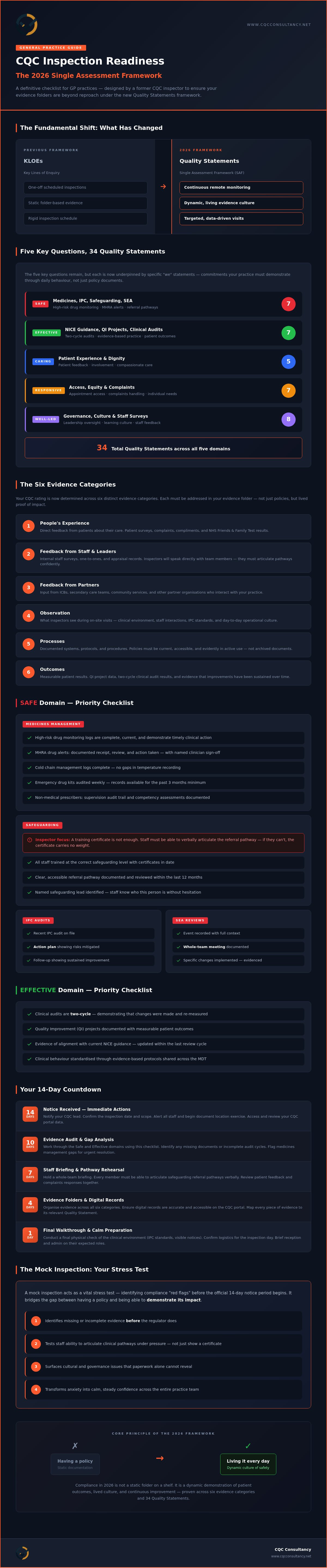
The Single Assessment Framework (SAF) represents a fundamental shift in how the Care Quality Commission (CQC) evaluates primary care. It's no longer enough to prepare for a one-off visit; instead, the regulator now employs a unified approach across all health and social care services. This move away from a rigid inspection schedule means your surgery is subject to continuous assessment. For your practice, this means the five key questions you've always known, Safe, Effective, Caring, Responsive, and Well-led, are now underpinned by 34 specific Quality Statements. Developing a robust cqc check list for general practice **** requires a deep understanding of these shifts, as the CQC now determines your rating based on six distinct evidence categories: people’s experience, feedback from staff and leaders, feedback from partners, observation, processes, and outcomes.
Quality Statements: The New Language of Compliance
The old Key Lines of Enquiry (KLOEs) have been replaced by "we" statements. These aren't just administrative markers; they're commitments that your practice must demonstrate through daily behaviour and culture. Compliance isn't a static achievement but a continuous narrative of how you support your patient population. When you audit your practice, you must ensure your evidence directly reflects these statements, proving that your team doesn't just have a policy but actually lives it. It's about showing, not just telling, how you deliver high-quality care.
The Move Towards Data-Driven Regulation
Regulation in 2026 is increasingly digital. The CQC portal has become the central hub for your relationship with the regulator, facilitating a move towards remote monitoring. On-site visits haven't disappeared, but they're now more targeted, focusing on evidence that can't be gathered through data alone. This means your cqc check list for general practice must include digital preparedness, ensuring your records are accurate and accessible for remote review at any time. Maintaining a steady hand on your data ensures that when the CQC looks at your practice from afar, they see a service that is meticulous, organised, and consistently safe.
Essential Checklist: The "Safe" and "Effective" Domains
Building a truly robust cqc check list for general practice requires moving beyond a simple tick-box exercise. Inspectors aren't just looking for the presence of a policy; they're looking for tangible evidence of its impact on patient safety. Within the "Safe" domain, your priority must be medicines management. This involves more than just checking expiry dates. You must demonstrate meticulous monitoring for high-risk drugs and a clear, documented process for acting on MHRA alerts. Safeguarding follows a similar logic. Whilst every staff member likely holds a training certificate, an inspector will ask them to describe the referral pathway. If they can't articulate how to raise a concern, the certificate carries little weight.
Infection Prevention and Control (IPC) audits are standard, but the CQC focuses on the subsequent action plan. They want to see that identified risks were mitigated and that improvements were sustained over time. Similarly, Significant Event Analysis (SEA) should reflect a whole-team learning culture. Don't just record the event; document the meeting where it was discussed and the specific changes implemented as a result. If you feel uncertain about how these processes would hold up under scrutiny, a professional mock inspection can identify these clinical "red flags" before the regulator arrives.
Medicines Management and Clinical Oversight
Meticulous documentation is your best defence. Verify that cold chain management logs are complete and that emergency drug kits are audited weekly without fail. For practices utilising non-medical prescribers, ensure there's a clear audit trail of supervision and regular competency assessments. This level of oversight provides the reassurance that clinical standards are being maintained across the entire multidisciplinary team, ensuring every prescriber operates within their scope of practice.
Demonstrating Effective Patient Outcomes
To satisfy the "Effective" domain, you must prove that your care aligns with the latest NICE guidance. Organise your evidence to showcase Quality Improvement (QI) projects and two-cycle clinical audits. These projects demonstrate that your practice doesn't just monitor outcomes but actively works to improve them. When clinical behaviour is standardised through evidence-based practice, patient safety becomes a measurable reality rather than a vague ambition. Your cqc check list for general practice should always prioritise these high-impact clinical areas.
The Six Evidence Categories: Organising Your GP Practice Data
Organising your evidence according to the CQC’s six categories ensures that your cqc check list for general practice isn't just a pile of papers but a structured narrative of quality. The first category, People’s Experience, requires more than just a high volume of Friends and Family Test (FFT) responses. You must demonstrate how you’ve "closed the loop" by acting on patient suggestions. Similarly, the Staff Feedback category is a vital window into your surgery's culture. Inspectors look for evidence of a supportive environment in staff surveys and meeting minutes, seeking proof that your team feels safe to raise concerns without fear of retribution.
The Processes category forms the traditional core of your compliance work. This includes your standard operating procedures, risk assessments, and recruitment checks. Whilst these are essential, the Outcomes category provides the clinical proof that these processes actually work. By presenting clear clinical data and strong QOF performance, you prove that your practice delivers effective care that meets national benchmarks. If you're finding the volume of data overwhelming, our team can provide expert compliance guidance to help you categorise your evidence with precision.
Gathering Feedback from Partners and Stakeholders
Collaboration is a key indicator of a well-led practice. You should identify and document how you work with your Primary Care Network (PCN) and local specialists to improve patient pathways. Collaborative working isn't just about attending meetings; it's about showing how these partnerships have directly benefited your patient population. Keep records of joint initiatives or shared learning events, as these serve as powerful evidence for both the "Responsive" and "Well-led" domains.
Observation and On-Site Evidence
Preparation for the on-site "walkthrough" is just as important as your digital submissions. Ensure the physical environment, from the waiting area to the clinical rooms, reflects the high standards written in your policies. A well-maintained and compliant physical environment serves as the primary visual indicator of a practice's commitment to patient safety and operational thoroughness. Check that all signage is clear, clinical waste is stored correctly, and that the surgery presents a professional, safe atmosphere for every visitor.
Beyond the Checklist: How Mock Inspections Bridge the Gap
Whilst a comprehensive cqc check list for general practice provides a necessary structural foundation, it cannot fully account for the human element of a 2026 assessment. A perfect folder on a shelf often fails to translate into success if your staff struggle during the interview phase. Inspectors look for a living culture of safety, not just a set of signed policies. By engaging a former CQC inspector to conduct a mock inspection, you benefit from a "fresh set of eyes" capable of spotting hidden risks that a practice team might overlook amongst the pressures of daily clinical work. This external perspective identifies compliance "red flags" before they can impact your formal rating.
This process serves as a strategic investment in your surgery’s future and reputation. It replaces the inherent anxiety of the 14-day notice period with a sense of calm, steady confidence. When your team has already experienced the rigour of professional questioning in a supportive environment, the actual inspection becomes a manageable process rather than a source of panic. Securing a "Good" or "Outstanding" rating requires this level of meticulous preparation, ensuring that every member of the practice can speak authoritatively about their contribution to patient safety and well-led care.
Simulating the Registered Manager Interview
The Registered Manager holds a pivotal role in the Single Assessment Framework. They must be able to articulate the practice’s strategic vision and demonstrate a profound, hands-on understanding of risk management. Practising these responses in a safe, simulated environment is essential to ensure clarity and professional poise. To prepare your leadership team effectively, you can review our CQC Registered Manager interview tips for expert guidance tailored to the current framework.
Actionable Insights from a Mock Inspection Report
A professional gap analysis offers a bespoke roadmap that no generic online tool can replicate. Our CQC mock inspection services provide a detailed report that identifies specific weaknesses and provides clear, actionable steps for resolution. This targeted approach ensures your cqc check list for general practice is fully realised in your daily operations. It moves your team beyond simple administrative compliance and towards a state of genuine inspection readiness, leaving nothing to chance when the regulator finally arrives at your door.
Securing Your Practice’s Future Under the 2026 Framework
Mastering the Single Assessment Framework requires a shift from administrative compliance to a culture of continuous improvement. You've seen how a structured cqc check list for general practice serves as your foundation, ensuring that every Quality Statement is backed by robust, clinical evidence. By organising your data across the six evidence categories and prioritising high-risk areas like medicines management, you move closer to inspection readiness with every step. This methodical approach ensures your surgery isn't just prepared on paper but is delivering safe, effective care in every patient interaction.
Want an expert to check your compliance? See my CQC mock inspection service.
Preparation is the most effective antidote to the stress of a 14-day notice period. To ensure your surgery is truly prepared for the rigours of 2026, book a professional mock inspection for your GP practice. Our services are led by a former CQC inspector with over 12 years of regulatory experience, providing bespoke support tailored specifically to the 2026 Single Assessment Framework. With national coverage across the UK, we help you identify and resolve compliance red flags before the regulator arrives. You have the tools and the roadmap to succeed. With meticulous preparation and the right expert guidance, your team can face their next assessment with clarity and pride in the high-quality care you provide.
Frequently Asked Questions
How much notice does a GP practice get for a CQC inspection in 2026?
GP practices typically receive 14 days' notice before an on-site CQC inspection. This period is intended for you to finalise your evidence folders and ensure your team is fully briefed on the latest Quality Statements. Whilst much of the assessment data is now gathered remotely through the CQC portal, the notice period remains a vital window for on-site preparation and staff simulation exercises.
What are the six evidence categories in the CQC Single Assessment Framework?
The six evidence categories are people’s experience, feedback from staff and leaders, feedback from partners, observation, processes, and outcomes. Utilising a structured cqc check list for general practice helps you map your existing documentation to these specific categories. This ensures you aren't just focusing on administrative processes but are also proving positive patient outcomes and a supportive staff culture.
Does our GP practice still need a Statement of Purpose for 2026?
Yes, the Statement of Purpose remains a mandatory legal requirement for all GP practices. It must accurately describe the services you provide, your practice objectives, and your current leadership structure. It's often the first document an inspector reviews to understand your surgery's identity and ethos, so keeping it updated is a fundamental step in your compliance journey.
How often will GP practices be assessed under the new framework?
Assessment is now a continuous process rather than a fixed cycle every few years. The CQC monitors data and evidence throughout the year, meaning your rating can be reviewed and updated at any time based on the information gathered. This shift requires a constant state of readiness where your cqc check list for general practice is reviewed regularly rather than just before a scheduled visit.
What are the most common "red flags" inspectors look for in General Practice?
Common red flags include gaps in high-risk drug monitoring, staff being unable to articulate safeguarding referral pathways, and infection control audits that lack completed action plans. Inspectors also look for a lack of a "learning culture" where significant events are recorded but never discussed amongst the wider team. Addressing these clinical and cultural gaps early ensures your practice remains safe and well-led.


Comments