CQC Inspection Compliance Checklist: Prepare with Confidence
Updated: 5 days ago
The transition to sector-specific regulation is more than a simple update; it's a major reset that demands a total rethink of your evidence. You're likely concerned that the move to 34 new quality statements might leave gaps in your preparation or risk an unexpected rating downgrade. It's exhausting to keep pace with a regulator that targeted 9,000 assessments by September 2026, especially when the fear of enforcement action hangs over your daily operations.
We understand that the volume of documentation required can feel insurmountable, but you don't have to face the inspector alone. This guide provides a clear, manageable compliance check list for an upcoming CQC inspection, designed by a former CQC inspector with 12 years of experience. By following this structured approach, you'll master the new Rating Characteristics and gain the steady confidence needed to secure a Good or Outstanding rating. We'll show you how to organise your evidence and empower your staff to excel during their interviews, ensuring your service is truly inspection-ready.
Table of Contents
Understanding the 2026 Single Assessment Framework Checklist
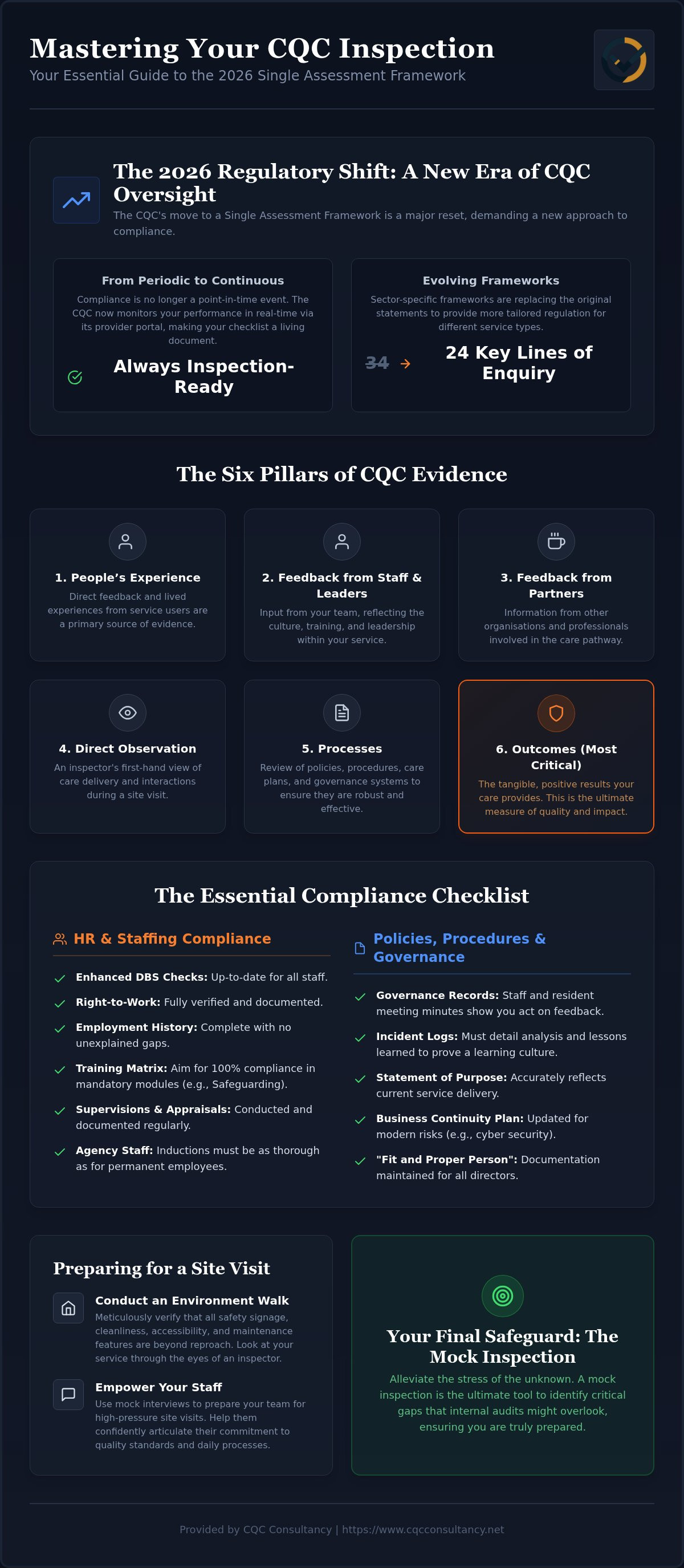
The Care Quality Commission (CQC) has initiated a major reset of its regulatory approach, moving toward a model of continuous provider oversight. For 2026, the Single Assessment Framework (SAF) remains the foundation, though it is currently evolving into sector-specific frameworks that replace the 5 Key Lines of Enquiry (KLOEs) with 34 Quality Statements. This shift ensures that regulation is tailored to specific service types whilst maintaining the core five key questions: Safe, Effective, Caring, Responsive, and Well-led.
To succeed, your compliance check list for an upcoming CQC inspection must move beyond static policies. The regulator now assesses quality through six distinct evidence categories: people’s experience, feedback from staff and leaders, feedback from partners, direct observation, processes, and outcomes. Relying on a dusty manual on a shelf is no longer sufficient; you must demonstrate "live" evidence that shows these standards are active and effective in your daily operations. A robust compliance check list for an upcoming CQC inspection helps you bridge the gap between having a policy and proving its impact.
Mapping Your Evidence to the 34 Quality Statements
Despite the transition to new KLOEs, your current preparation should focus on categorising evidence under the existing Quality Statements, such as "Safeguarding" and "Involvement in care". This organisation ensures that your data is current, relevant, and formatted for seamless digital upload when requested. Proving Outcomes is the most critical evidence category for 2026 because it demonstrates the tangible, positive results your care provides for service users.
The Shift from Periodic Inspections to Continuous Monitoring
Compliance is no longer a point-in-time event but a permanent state of readiness. Your checklist must be a living document, updated monthly to reflect your latest audits and feedback loops. The CQC now uses its provider portal to monitor your performance in real-time, meaning your digital evidence is just as vital as the physical site visit. By maintaining a steady hand on your documentation, you can respond to the regulator's enquiries with calm, methodical precision.
The Essential Documentation and Personnel Checklist
Meticulous record-keeping is the backbone of a successful assessment. When building your compliance check list for an upcoming CQC inspection, you must ensure that every personnel file is beyond reproach. This includes up-to-date Enhanced DBS checks, verified right-to-work documentation, a full employment history with no unexplained gaps, and robust, professional references. Whilst a single missing signature might seem minor, it can signal a lack of oversight to an inspector.
Your training matrix serves as a primary indicator of safety and competence. Aim for 100% compliance in mandatory modules such as Safeguarding and the Mental Capacity Act. Beyond training, your governance records, including minutes from staff and resident meetings, should demonstrate that you listen to feedback and act upon it. Robust incident and accident logs are equally vital. They shouldn't just record what happened; they must provide a detailed analysis of lessons learned to prove a proactive "learning culture" exists amongst your team.
HR and Staffing Compliance
Regular staff supervisions and annual appraisals are non-negotiable. You must also maintain "Fit and Proper Person" documentation for all directors and senior leads to meet regulatory requirements. Don't overlook agency staff; their inductions must be as thorough as those for permanent employees to ensure consistency of care. For deeper insights into these requirements, you may find our guide on Professional CQC Consultancy Services: Navigating the Single Assessment Framework in 2026 particularly useful.
Policies, Procedures, and Governance
Review your Statement of Purpose to ensure it accurately reflects your current service delivery. Your Business Continuity Plan should also be updated for 2026, addressing modern risks like cyber security threats and climate-related factors. When preparing for a CQC inspection, verify that these documents are not just present but understood by the staff who implement them. If you feel overwhelmed by the volume of evidence required, seeking expert compliance guidance can provide the steady hand needed to ensure nothing is missed.
Preparing Staff and Environment for a Site Visit
Whilst documentation provides the regulatory framework, the site visit is where an inspector validates your service's actual culture. Your compliance check list for an upcoming CQC inspection must extend beyond the filing cabinet to include the physical environment and the confidence of your team. Inspectors now place significant weight on direct observation; they aren't just looking at what you do, but how you do it. A staff member who hesitates when asked about safeguarding procedures can undermine even the most perfect policy folder.
Observation as evidence is a cornerstone of the 2026 assessment methodology. Inspectors will watch how staff interact with service users, looking for genuine warmth, respect, and the promotion of independence. They want to see that your "Well-led" values are lived by every member of the team, from the manager to the domestic staff. Preparing your service users is equally vital; they should understand that an inspector might speak with them and feel comfortable sharing their honest experiences of the care they receive.
Staff Interview Preparation and Behaviours
Conducting "mock interviews" is a vital exercise to alleviate staff anxiety and ensure they can articulate care standards clearly. Your team should be comfortable discussing how they identify risks and the specific steps they take for whistleblowing. To foster a "Well-led" culture, encourage transparent communication where staff feel empowered to speak up. For those in leadership roles, reviewing CQC Registered Manager Interview Tips: Expert Guidance for 2026 can provide the specialised preparation needed for high-level scrutiny.
The Physical Environment and Safety Checks
The "Environment Walk" is your opportunity to view your service through an inspector's eyes. Check that fire safety logs, legionella testing, and equipment maintenance records are up to date and easily accessible amongst your service areas. Beyond safety, ensure the environment reflects a culture of dignity. Personalised touches in communal spaces and clear, accessible signage demonstrate that you prioritise the service user's experience. If you want to ensure your team and facility are truly ready, book a professional mock inspection to identify any hidden risks before the regulator arrives.
Why a Mock Inspection is Your Final Safeguard
Even the most meticulous management teams can succumb to "operational blindness" over time. Familiarity with your own service often masks subtle risks that an external eye would immediately flag as a concern. Whilst internal audits are a vital starting point, a professional mock inspection serves as the definitive stress-test for your compliance check list for an upcoming CQC inspection. It moves beyond simple box-ticking to simulate the rigorous, evidence-based methodology of the Single Assessment Framework.
By replicating the pressure of a real site visit, you can identify precisely where your systems might falter under scrutiny. This professional gap analysis allows you to prioritise urgent remedial actions with surgical precision. Ultimately, CQC mock inspection services act as the essential bridge between being merely "prepared" and feeling truly "confident" when the regulator arrives.
Identifying Hidden Risks with an Expert Eye
A former inspector brings a unique perspective, identifying subtle red flags amongst care notes and staff morale that internal teams often overlook. With over 12 years of experience in the field, our specialists can spot the systemic governance issues that often keep services trapped in a "Requires Improvement" rating. Addressing these nuances is the most reliable way to elevate your service and demonstrate the high standards required for a "Good" or "Outstanding" result.
Creating a Robust Post-Audit Action Plan
Once the mock inspection is complete, the findings should form the basis of a targeted action plan. This document is powerful evidence in itself; it proves to the CQC that you are proactive in identifying and resolving your own weaknesses. As you enter the final 30-day countdown to your inspection window, this plan ensures every remaining gap is closed. This methodical approach replaces the anxiety of the unknown with a steady, professional poise that reflects your commitment to excellence.
Achieving Excellence in Your Next Assessment
The journey toward a Good or Outstanding rating requires more than just a compliance check list for an upcoming CQC inspection; it demands a cultural shift toward continuous quality improvement. We've explored how the move to the Single Assessment Framework necessitates "live" evidence and why staff behaviours are now weighed as heavily as your documentation. By meticulously organising your personnel files and conducting thorough environment walks, you build a foundation of safety and transparency that inspectors value.
Want an expert to check your compliance? See my CQC mock inspection service.
The final step in your preparation is removing the uncertainty that internal audits can't always reach. Led by a former CQC inspector with over 12 years of experience, our team provides bespoke compliance guidance tailored to your specific service type with full national UK coverage. We offer the steady hand you need to identify hidden risks and empower your staff to speak with clarity and confidence.
Book a professional mock inspection to secure your CQC rating and approach your next visit with absolute peace of mind. You've worked hard to build a quality service, and with the right guidance, you can ensure the regulator sees exactly what makes your care exceptional.
Frequently Asked Questions
What triggers a CQC inspection in 2026 under the new framework?
Inspections in 2026 are primarily triggered by risk-based data rather than a fixed calendar. The regulator monitors various information sources, including service user feedback, staff whistleblowing, and data from local authorities. If these indicators suggest a decline in quality, it prompts an assessment. Maintaining a compliance check list for an upcoming CQC inspection ensures you stay ready for these data-driven triggers, which can occur at any time without a traditional warning period.
How often will my service be assessed by the CQC now?
Under the current framework, your service is under continuous oversight rather than waiting for a periodic visit every few years. The CQC aims to update ratings more frequently by reviewing specific Quality Statements throughout the year. This means your compliance status is dynamic. A steady, methodical approach to evidence collection is essential because the regulator can refresh your score based on the information you provide through their digital portal.
What are the 5 key questions the CQC asks during an inspection?
The five key questions remain the foundation of every assessment: Is the service Safe, Effective, Caring, Responsive, and Well-led? Whilst the underlying 34 Quality Statements provide the specific "test" for compliance, these five pillars categorise the overall findings. Your compliance check list for an upcoming CQC inspection should map every piece of evidence to one of these questions to ensure a balanced demonstration of high-quality care across all areas.
Can the CQC inspect my service remotely without a site visit?
Remote assessments are now a standard part of the regulator's methodology. The CQC can review your policies, training records, and feedback data via their digital portal without ever stepping foot on-site. However, site visits remain a critical tool for observing the "lived culture" of a service and staff interactions. You should expect a hybrid approach where digital evidence is validated by physical observations and face-to-face interviews with your team.
What happens if I fail to meet a Quality Statement during assessment?
Failing to meet a Quality Statement typically results in a requirement to improve or, in more serious cases, enforcement action and a rating downgrade. You'll be issued a report detailing the areas of non-compliance. It is then your responsibility to submit a comprehensive action plan. Demonstrating a proactive "learning culture" by identifying these gaps yourself through mock inspections can often mitigate the severity of the regulator's response.


Comments