CQC Dental Practice Registration: Essential Success Tips

Updated: 18 hours ago
What if your dental practice's opening date wasn't merely a date on a calendar, but a milestone secured by clinical leadership rather than a "tick-box" exercise? For many providers, the journey toward registration feels like navigating a fog of regulatory jargon where one wrong turn leads to a rejected application and a delayed launch. It's perfectly natural to feel a sense of trepidation when faced with the new Single Assessment Framework or the pressure of a Fit and Proper Person interview.
We understand that you've invested significant time and resources into your new venture, and the last thing you need is the uncertainty of a stalled process. This article is designed to replace that anxiety with a sense of calm, steady confidence. By following these expert tips for registering a new dental practice with CQC, you'll gain the insider perspective necessary to master the complexities of the portal and the assessment process. We will examine how to align your surgery’s DNA with the latest Quality Statements and how to approach the Registered Manager interview with the poise of a seasoned professional.
Table of Contents
Prerequisites for a Seamless Dental CQC Registration
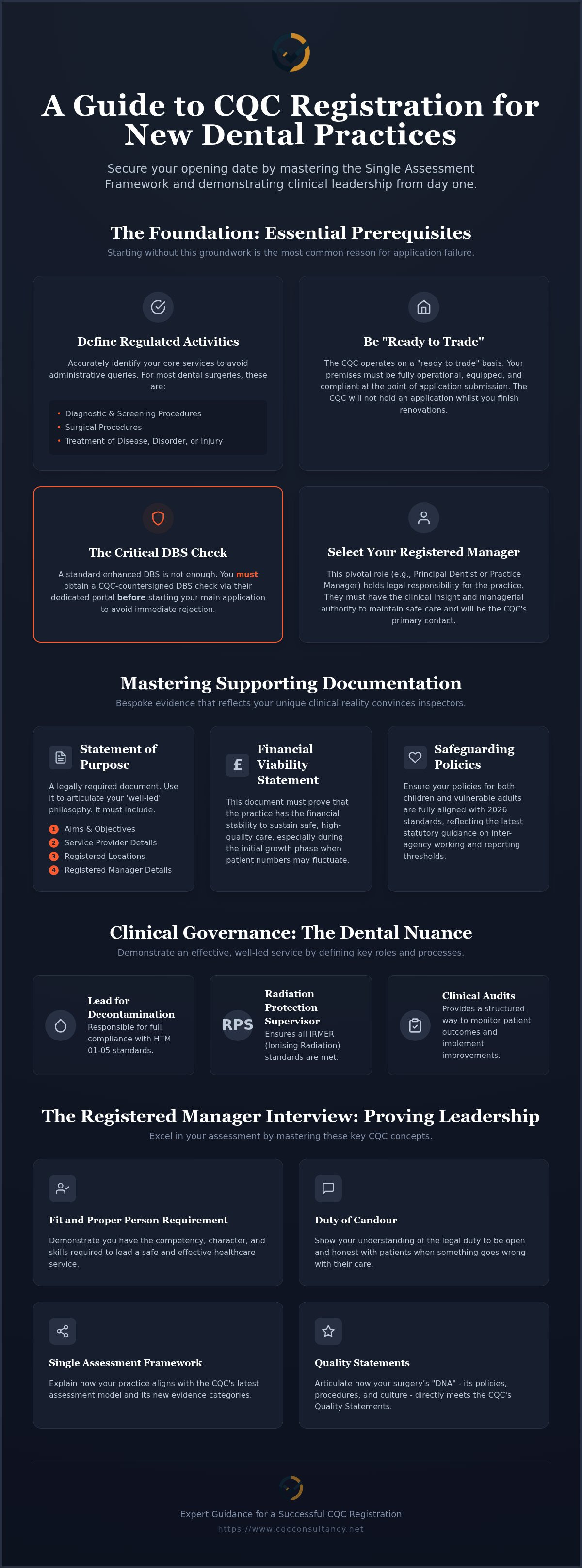
Starting the registration process without the correct groundwork is the most common reason for application failure. To ensure a smooth journey, you must first define which regulated activities your practice will perform. For most dental surgeries, this involves three core areas: diagnostic and screening procedures, surgical procedures, and the treatment of disease, disorder, or injury. Identifying these correctly from the outset ensures your application is processed without administrative queries. It's about demonstrating that you understand the scope of your clinical responsibilities from day one.
One of the most valuable tips for registering a new dental practice with CQC is to understand that the Commission operates on a "ready to trade" basis. They won't hold an application whilst you finish a renovation or wait for equipment delivery. Your premises must be fully operational, equipped, and compliant at the point of submission. This level of preparedness reflects a commitment to safety and provides the CQC with the evidence they need to approve your registration without delay.
The DBS Check: A Critical First Step
Many providers mistakenly believe a standard enhanced DBS check is sufficient for their application. However, for a CQC registration, you require a check that is specifically countersigned by the CQC itself. This is a common stumbling block that leads to immediate rejection. You must use the CQC’s dedicated portal to apply for this specific document before you even think about starting the main application. This ensures your background checks meet the precise regulatory standards required for healthcare oversight and establishes a foundation of trust.
Selecting Your Registered Manager
Choosing who will hold the legal responsibility for your practice is a pivotal decision. This role carries significant weight and requires a person who can balance patient safety with operational efficiency. Whether you appoint the Principal Dentist or a dedicated Practice Manager, that individual must possess both the clinical insight and the managerial authority to maintain safe care. They will be the primary point of contact for the Commission and must be prepared to demonstrate their competency. For those preparing for this stage, reviewing CQC Registered Manager interview tips can provide the necessary clarity to approach the assessment with confidence and poise.
Mastering the Supporting Documentation: Evidence that Convinces
Your application's success hinges on the quality of your evidence. Whilst it might be tempting to use generic templates to save time, the CQC looks for documents that reflect your practice's unique clinical reality. A bespoke approach demonstrates that you aren't just ticking boxes; you're building a culture of safety. This meticulousness is what separates a successful application from one that is returned for further clarification.
One of the most effective tips for registering a new dental practice with CQC is to treat your Financial Viability Statement with as much weight as your clinical policies. This document must prove that the practice can sustain safe care during the initial growth phase when patient numbers may be fluctuating. Alongside this, you must ensure your safeguarding policies are fully aligned with the 2026 standards for both children and vulnerable adults, reflecting the latest statutory guidance on inter-agency working and reporting thresholds.
Writing the Statement of Purpose
The Statement of Purpose (SoP) is a legally required document that must include four specific sections: your aims and objectives, service provider details, registered locations, and information regarding your Registered Manager. To truly stand out, use this document to articulate your "well-led" philosophy. Explain how your leadership will foster a culture of transparency and continuous improvement, turning a dry administrative form into a compelling narrative of clinical excellence. If you find this process daunting, our CQC registration support can help you refine your narrative to meet the Commission's expectations.
Clinical Governance: The Dental Nuance
Dental practices face specific regulatory hurdles that general primary care does not. Your documentation must clearly define roles such as the Lead for Decontamination, responsible for HTM 01-05 compliance, and the Radiation Protection Supervisor (RPS), ensuring IRMER standards are met. These aren't just titles; they are pillars of your governance framework. Clinical audits demonstrate an effective service to the CQC by providing a structured mechanism to monitor patient outcomes and implement evidence-based improvements. This level of oversight provides the "steady hand" that inspectors look for during the assessment phase.
Aligning with the Single Assessment Framework in 2026
The regulatory landscape has undergone a significant transformation. The transition from the old Key Lines of Enquiry (KLOEs) to the new Single Assessment Framework (SAF) represents a fundamental shift in how the Commission evaluates quality. One of the most critical tips for registering a new dental practice with CQC is to move away from the mindset of static inspections and toward a continuous demonstration of quality. You must frame your registration responses around the new Quality Statements, which act as the bridge between the five key questions and the evidence categories the CQC now prioritises.
To satisfy the "Safe" and "Effective" statements, you should demonstrate a commitment to clinical best practice, such as the latest NICE guidelines or GDC standards. There's also a renewed focus on "Equity in Experience." You'll need to show how your practice intends to identify and tackle health inequalities within your local community, ensuring that every patient receives the same high standard of care regardless of their background. This proactive stance provides the reassurance that your practice is built on a foundation of fairness and clinical excellence.
The Five Key Questions in 2026
While the core questions of Safe, Effective, Caring, Responsive, and Well-led remain, their application in a modern dental setting is more nuanced. For instance, being "Responsive" isn't just about answering the phone. It's about how you manage emergency dental access and how you've designed feedback loops to listen to patient concerns before they become complaints. This approach shows the CQC that you're ready to adapt to patient needs from the moment you open your doors.
Evidence Categories for New Providers
As a new provider, you won't have a track record of patient outcomes yet. Instead, your evidence must focus on your intended culture, recruitment processes, and robust clinical policies. The CQC will look at how you plan to gather staff feedback and people's experiences once you're operational. If you're unsure how your current plans align with these new requirements, our CQC consultancy services provide a comprehensive SAF gap analysis to ensure your application is airtight. To ensure your documentation meets these rigorous 2026 standards, our team offers expert CQC registration support to guide you through every step.
The Registered Manager Interview: Proving Clinical Leadership
The Registered Manager interview is often the most daunting stage of the registration journey. It isn't merely a check of your clinical qualifications; it's a rigorous assessment of your ability to lead a safe, compliant practice. You must be prepared to discuss the Fit and Proper Person Requirement (FPPR) in detail, demonstrating that you possess the character and competence to hold such a significant legal responsibility. This is your opportunity to show the Commission that you aren't just a clinician, but a leader who understands the weight of regulatory oversight.
One of the most essential tips for registering a new dental practice with CQC is to develop a profound understanding of Regulation 20: Duty of Candour. Inspectors will expect you to articulate exactly how you would manage a clinical error or patient harm with total transparency. This isn't just about following a procedure; it's about proving you have the integrity to put patient safety above professional reputation. You should also be fluent in the Health and Social Care Act 2008 (Regulated Activities) Regulations 2014, as these form the legal backbone of your practice's operations. To ensure you are fully prepared, many providers utilise a CQC mock inspection service to simulate the interview environment and bridge any knowledge gaps before the actual assessment.
Common Interview Pitfalls for Dental Managers
A frequent mistake is providing overly technical or clinical answers. While your dental expertise is vital, the CQC is looking for leadership. When asked about staff training, don't just list courses. Instead, explain how you verify ongoing competency and how you'll foster a culture where staff feel safe to speak up about concerns. It's about oversight and the "steady hand" that ensures every team member operates within the safe boundaries of the regulations. Clarity and professional poise here are far more persuasive than jargon.
Final Steps: The Site Visit and Decision
The pre-registration site visit is the physical validation of your application. The inspector will verify that your surgery is "ready to trade," checking everything from decontamination room layouts to the accessibility of emergency drugs whilst ensuring the environment matches your documented policies. In 2026, you should anticipate a timeline of several weeks from your submission to receiving the final Notice of Decision. Maintaining professional confidence during this waiting period is easier when you know every prerequisite has been meticulously addressed with expert guidance.
Securing Your Practice's Regulatory Future
Mastering the CQC registration process is less about completing paperwork and more about embedding a culture of clinical leadership into your surgery's foundation. You've learned that success requires meticulous preparation, from securing the correct countersigned DBS check to aligning your clinical governance with the 2026 Single Assessment Framework. By applying these tips for registering a new dental practice with CQC, you're not just aiming for a positive Notice of Decision; you're building a resilient practice that prioritises patient safety from the very first appointment.
Need hands-on support for your dental practice? See my CQC support for dental practices.
Navigating these regulatory complexities doesn't have to be a stressful or uncertain endeavour. Our team provides bespoke support tailored specifically to the nuances of the dental sector. With over 12 years of experience as a former CQC inspector, we offer a proven track record in securing successful registrations through expert guidance and mock assessments. Book a consultation with our former CQC inspectors to secure your registration and move forward with the steady hand of a trusted advisor. We're here to ensure your vision for a new dental practice becomes a compliant reality with total peace of mind.
Frequently Asked Questions
How long does CQC registration take for a new dental practice in 2026?
CQC registration for a new dental practice typically takes between 10 and 12 weeks from the point your application is validated. However, this timeframe depends heavily on the accuracy of your submission and the current volume of applications being processed by the Commission. Following expert tips for registering a new dental practice with CQC can help you avoid common errors that lead to avoidable delays or requests for further information.
Can I open my dental practice whilst the CQC application is being processed?
No, you cannot provide any regulated activities until you have received your final Notice of Decision and your registration is active. Carrying out dental treatments before this point is a criminal offence under the Health and Social Care Act. You may use this period to finalise your staff training, organise your administrative systems, and ensure your premises are fully equipped, but patient care must wait until legal approval is granted.
What is the most common reason for a dental CQC application to be rejected?
The most frequent cause for immediate rejection is the submission of an incorrect DBS check. Many providers mistakenly provide a standard enhanced check rather than one specifically countersigned by the CQC. Incomplete documentation, such as a generic Statement of Purpose that doesn't reflect the practice's actual clinical scope, is another primary reason for failure. Ensuring every document is bespoke and meeting the 2026 standards is vital for a successful outcome.
Do I need a separate CQC registration if I am buying an existing dental practice?
Yes, you must apply for a new registration because CQC provider status is not transferable between different legal entities. Even if the practice is already operational and has a positive rating, the new owner must prove their own fitness and competence to lead the service. It is essential to coordinate your application with the seller's cancellation to ensure a seamless transition of care and avoid any period where the practice is unregistered.
What is the Fit and Proper Person Test for dental practice managers?
The Fit and Proper Person Requirement (FPPR) is a legal standard that ensures those in leadership roles are of good character, have the necessary qualifications, and are physically and mentally fit for the role. During your assessment, the CQC will review your professional history, references, and conduct. They want to see that you have the integrity and clinical oversight required to manage a safe and effective dental service for your patients. Related reading: CQC registration application support and How to Register a Dental Practice With CQC: A Step-by-Step Guide.
Want to talk it through? Book a free 15-minute call


Comments