How to Prepare Staff for CQC Inspection Interviews

Updated: 5 days ago
What if the success of your next rating didn't depend on how well your team memorised the staff handbook, but on how comfortably they could describe their daily routine? It's a common fear amongst managers that staff interviews during a CQC inspection might lead to contradictions or nervous silences that don't reflect the true quality of care provided. You've likely spent months refining your processes, yet the thought of an inspector pulling a junior staff member aside can still feel like a significant risk to your "Well-Led" evidence.
We understand that the transition to the Single Assessment Framework has added a new layer of complexity to these interactions. This article will show you how to master the art of staff preparation by moving away from scripted answers and toward authentic, confident communication. You'll learn how to demystify the inspection process for your team, reduce management stress, and ensure that every verbal testimony serves as powerful evidence of your commitment to high standards. By the end, you'll have a clear roadmap to turn potential anxiety into a calm, professional showcase of your service's excellence.
Table of Contents
The Evolution of CQC Staff Interviews under the Single Assessment Framework
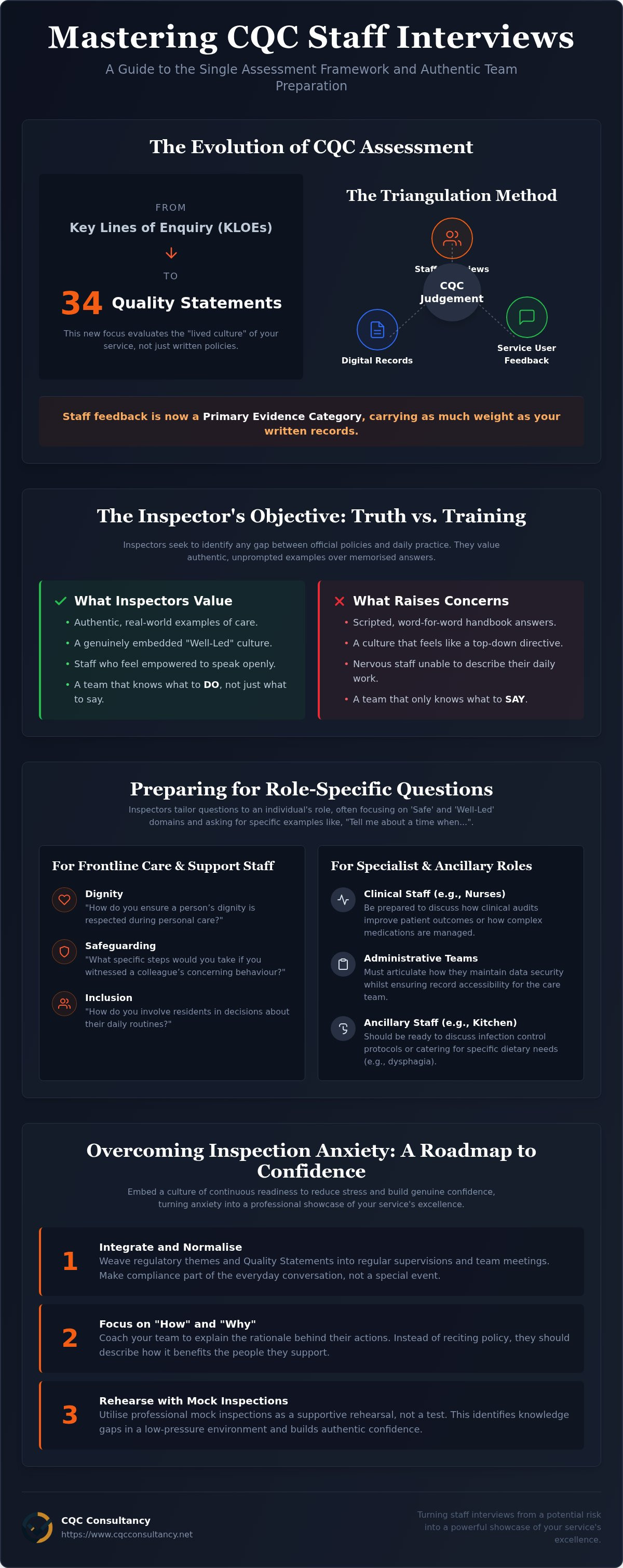
The regulatory horizon has shifted. Under the 2026 Single Assessment Framework, the CQC has moved away from the traditional Key Lines of Enquiry (KLOEs) toward 34 specific Quality Statements. This change isn't merely semantic; it represents a deeper focus on the "lived culture" of your service. In this new era, staff interviews during a CQC inspection are no longer supplementary. They are now classified as a core Evidence Category, meaning the verbal testimony of your team carries as much weight as your written records.
Inspectors now utilise a method known as "triangulation" to form their judgements. They meticulously compare verbal accounts from your team against your digital records and the direct feedback provided by service users. If a policy states that your service is person-centred, but staff cannot articulate how they support individual choices during their daily routines, the evidence falls apart. The objective is to ensure that high-quality care isn't just a document in a folder, but a consistent reality across every shift and every interaction.
Why "Staff Feedback" is Now a Primary Evidence Category
The CQC views your team as the most reliable barometer of safety and leadership. By elevating staff feedback to a primary evidence category, inspectors can verify if your "Well-Led" culture is genuinely embedded or simply a top-down directive. When staff feel empowered to speak openly about their roles and the support they receive, it signals a healthy, transparent environment. This consistency is vital. Inspectors want to see that safety and quality standards remain high, whether the manager is on-site or it's the middle of a weekend night shift.
The Inspector’s Objective: Truth vs. Training
An inspector’s primary goal is to identify any existing gap between your official policies and the actual daily practice of your team. They aren't looking for staff who have memorised the handbook word-for-word. Instead, they seek unprompted, authentic examples of care. This organic evidence proves that your values are ingrained in the team's professional behaviour. It's the difference between a team that knows what to say and a team that knows what to do.
Role-Specific Questions: What Your Team Should Expect in 2026
In the current regulatory climate, generic preparation is no longer sufficient. Inspectors tailor their enquiries to the specific responsibilities of the person they are speaking with. During staff interviews during a CQC inspection, the focus often gravitates toward the 'Safe' and 'Well-Led' domains. Inspectors aren't looking for a recital of your Statement of Purpose; they want to hear how your team applies your values when no one is watching. They'll use probing questions to test the depth of a staff member's understanding, often asking "can you tell me about a time when..." to elicit real-world evidence.
Questions for Frontline Care and Support Staff
For your care assistants and support workers, the conversation will likely centre on the dignity and autonomy of the people they support. Expect questions such as:
Dignity: How do you ensure a person’s dignity is respected whilst you're assisting with personal care?
Safeguarding: What specific steps would you take if you witnessed a colleague’s behaviour that caused you concern?
Inclusion: How do you involve residents in decisions about their daily routines to ensure care remains person-centred?
Expectations for Clinical, Administrative, and Ancillary Roles
Specialist roles face a different set of enquiries that reflect their unique impact on service quality. Nurses may be asked how clinical audits directly lead to improved patient outcomes or how they manage complex medication regimes. Domestic and kitchen staff should be prepared to discuss infection control protocols or how they cater to specific dietary requirements, such as those for people with dysphagia. Meanwhile, administrative teams must articulate how they maintain data security whilst ensuring that records remain accessible to the care team. To ensure your team feels ready for these nuances, seeking expert compliance guidance can provide the structured framework needed for effective internal preparation.
Overcoming Inspection Anxiety: Preparing Your Team with Confidence
The prospect of an inspector arriving on-site often triggers a wave of anxiety throughout the workforce. This "site visit stress" isn't just uncomfortable; it can lead to uncharacteristic errors or hesitant responses during staff interviews during a CQC inspection. To mitigate this, you must transform compliance from a looming event into a familiar, everyday conversation. Integrating CQC themes into your regular team meetings and monthly supervisions ensures that the language of quality becomes second nature. It shifts the focus from "passing a test" to "showcasing excellence."
One effective method is the "Question of the Week" approach. By focusing on a single Quality Statement or safety protocol for seven days, you allow staff to absorb information in manageable segments. Using flashcards in communal areas or during handovers can also keep key concepts fresh without the pressure of a formal training session. This steady, rhythmic preparation builds the calm confidence your team needs to represent your service accurately and professionally.
The Danger of Scripted Answers
Inspectors are highly trained to distinguish between a genuine culture of care and a rehearsed performance. When responses sound overly robotic or identical across the team, it sends a red flag regarding your "Well-Led" evidence. It suggests a lack of authentic engagement or even a fear-based culture. Instead, encourage your staff to use their own vocabulary and share their favourite examples of positive outcomes they've achieved for residents. This authenticity is far more persuasive than a perfectly memorised policy, as it proves the care is lived, not just read.
Creating a Culture of Continuous Readiness
True readiness comes from helping your team understand the "why" behind their daily tasks. When a staff member understands how their specific behaviour links to the broader Quality Statements, they're better equipped to explain their actions to an outsider. For those seeking a deeper dive into these requirements, our Professional CQC Consultancy Services provide a comprehensive guide to the Single Assessment Framework. If you want to ensure your team is fully prepared for the emotional and practical demands of a visit, consider booking our expert compliance guidance to help stabilise your preparation process and provide peace of mind for your management team.
The Mock Inspection Advantage: Rehearsing for Success
Preparation is the foundation of confidence. Whilst internal reviews are valuable, a professional mock inspection offers an unparalleled level of rigour by simulating the actual site visit experience. It provides a secure environment where your team can practice their responses to staff interviews during a CQC inspection, allowing them to refine their delivery and overcome initial nerves. This process transforms a high-pressure encounter into a familiar exercise, ensuring that when the official inspector arrives, your staff feel supported rather than scrutinised.
The insight provided by a former CQC inspector is particularly significant. With over 12 years of regulatory experience, our consultants can identify subtle red flags in staff testimony that might otherwise go unnoticed by internal management. Beyond the immediate benefit to your team, the detailed report generated from a mock inspection serves as objective evidence of your commitment to Quality Monitoring and Improvement. It demonstrates to the CQC that you're proactive in identifying gaps and dedicated to maintaining high standards through continuous, meticulous self-assessment.
Simulating the Inspector’s Probing Technique
The current assessment framework requires a specific style of questioning that moves beyond simple "yes" or "no" answers. An expert consultant understands these nuances and can challenge your team with the same probing techniques used by the regulator in 2026. This rehearsal is vital for ensuring that staff can articulate their knowledge clearly and naturally under pressure. For a deeper look at how this process works, explore our Comprehensive CQC Mock Inspection Services.
Identifying Knowledge Gaps Before the Official Visit
Mock interviews act as a final safety net for your compliance strategy. They often reveal whether your team truly understands recent policy updates or if there's a disconnect in safeguarding protocols. By identifying these gaps early, you can provide targeted support and training long before the formal assessment begins. This proactive approach not only protects your rating but also reinforces a culture of transparency and safety. If you're ready to provide your team with the ultimate preparation tool, book a call with our expert consultants today to organise your mock inspection and secure your peace of mind.
Securing Your Service’s Future with Confidence
Preparing for the Single Assessment Framework is about more than just refining your paperwork; it's about fostering a culture where every team member feels empowered to share their story. We've explored how staff interviews during a CQC inspection now serve as a primary evidence category, requiring a shift from scripted answers to authentic, lived examples of care. By integrating these themes into your daily routines and addressing role-specific questions early, you remove the element of surprise that so often leads to site visit stress.
Want an expert to check your compliance? See my CQC mock inspection service.
Achieving this level of readiness requires a steady hand and expert insight. Our bespoke mock inspections, led by a former CQC inspector with 12 years of regulatory experience, provide the precise guidance your team needs to navigate the Single Assessment Framework. Whether you manage a care home, a GP surgery, or a domiciliary service, we offer specialist support tailored to your unique environment. Book a Mock Inspection to prepare your team for 2026 and turn regulatory uncertainty into a professional showcase of your high standards. You've built a quality service; now it's time to ensure your team can speak about it with the clarity and pride they deserve.
Frequently Asked Questions
Can an inspector interview any member of staff they choose?
Yes, CQC inspectors have the statutory power to speak with any individual involved in the delivery of care. This includes frontline carers, domestic staff, kitchen teams, and even agency or bank staff who happen to be on shift. They may also request to speak with staff members who aren't currently on the premises if they feel their testimony is vital for triangulating evidence.
What happens if a staff member gives the wrong answer during a CQC interview?
A single incorrect or nervous response during staff interviews during a CQC inspection is unlikely to result in a poor rating on its own. Inspectors aren't looking for perfection; they're looking for consistency across the service. If a staff member provides an answer that contradicts your policies, the inspector will usually seek further evidence from other staff or records to determine if the issue is an isolated mistake or a systemic failure.
Are CQC staff interviews always conducted in private?
Inspectors typically prefer to conduct interviews in private to ensure that staff feel comfortable speaking openly without fear of judgement from their peers or managers. These conversations might take place in a quiet office or whilst walking through the service. Whilst the inspector aims for a confidential setting, they'll always remain mindful of the need to maintain safe staffing levels and won't disrupt essential care tasks.
How long do CQC staff interviews typically last?
The duration varies significantly depending on the role and the specific focus of the assessment. Formal sit-down interviews with senior staff or nurses can last between 30 and 45 minutes. However, many interactions with frontline staff are shorter, lasting approximately 10 to 15 minutes. These brief "on-the-go" conversations are designed to capture the reality of daily life in the service without causing undue disruption to the care schedule.
Do staff have the right to have a manager present during their CQC interview?
Staff don't have a legal right to have a manager present during their interview, and inspectors generally discourage this practice. The presence of a supervisor can inadvertently influence the staff member's responses or lead to a perception of intimidation, which undermines the validity of the evidence. Inspectors need to hear the staff member's authentic voice to verify that your "Well-Led" culture is genuinely embedded at every level.


Comments