CQC Registration: Step-by-Step Guide for New Providers 2026

Updated: 5 days ago
Embarking on the journey to become a new healthcare or social care provider in England is both an exciting and a formidable endeavour. Central to this process is securing your registration with the Care Quality Commission (CQC), the independent regulator. This is not merely an administrative task; it is the legal gateway to providing care and a foundational test of your readiness to deliver safe, effective, and high-quality services.
Many aspiring providers approach CQC registration as a paperwork exercise, only to face frustrating delays or even refusal due to avoidable errors. The key to success lies in understanding that the CQC is assessing your competence and your service's safety culture from the very first interaction. This guide, informed by over a decade of former CQC inspector experience, will walk you through the strategic steps required to build a robust application and demonstrate your fitness to provide care in 2026.
Table of Contents
Understanding the Scope of CQC Registration for New Providers
Before you complete a single form, you must have absolute clarity on what your service will do and how it fits within the CQC’s regulatory framework. CQC registration is your legal licence to operate, granted under the Health and Social Care Act 2008. It is an offence to provide any regulated services without it. Your first task is to define the precise nature of your service, as any ambiguity at this stage can undermine your entire application.
Define Your Regulated Activities: These are the specific health or social care activities that require CQC registration. Choosing the correct ones is critical; selecting the wrong activities or failing to include a necessary one can lead to significant application delays.
Establish Your Legal Entity: You must decide whether you will operate as an Individual (sole trader), a Partnership, or an Organisation (e.g., a limited company). This choice has legal and structural implications for your application and governance.
Prepare for DBS Checks: All individuals involved in the registration (such as directors and the proposed registered manager) must have an enhanced Disclosure and Barring Service (DBS) check. This is a non-negotiable prerequisite.
Understand the Single Assessment Framework: As of 2026, all applications are assessed through the lens of the CQC's Single Assessment Framework. This means your evidence and interview answers must align with its quality statements and the five key questions: Are you Safe, Effective, Caring, Responsive, and Well-led?
Determining Your Regulated Activities
The term "Scope of Registration" defines the legal boundaries of your service. It clarifies who you will provide care to (service users), what specific care you will provide (regulated activities), and where you will provide it (locations). For instance, a domiciliary care agency providing help with washing and dressing will register for "Personal Care," whilst a care home with nurses on staff will also need to register for "Nursing Care." It is vital that your business plan, policies, and Statement of Purpose are perfectly aligned with your chosen regulated activities and service types. Misalignment is a common red flag for CQC assessors.
For a deeper dive into this crucial first step, our guide on the CQC Scope of Registration provides further detailed clarification.
Meeting the Enhanced DBS Check Requirement
The CQC requires assurance that the people running a service are of good character. An enhanced DBS check is a mandatory part of this process. You must have a valid DBS certificate number before you can submit your application.
Crucially, for most applicants who are not registered healthcare professionals (e.g., directors without a clinical registration, or new managers), you must obtain a CQC-countersigned enhanced DBS check. This is initiated through the CQC’s designated provider. However, if you are a registered healthcare professional (e.g., a doctor with a GMC number or a nurse with an NMC PIN), you may be able to use an existing enhanced DBS check from your professional body, provided it is for the correct workforce (adult and child) and is registered with the DBS Update Service. Always verify the latest guidance on the CQC website to ensure your check meets the specific requirements, as submitting an invalid DBS will halt your application.
Preparing the Essential Documentation for a Robust Application
A successful CQC registration application is built on a foundation of clear, comprehensive, and consistent documentation. These documents are not just formalities; they are the primary evidence the CQC uses to assess your understanding of regulatory requirements and your capability to run a safe and well-led service.
The Statement of Purpose (SoP): This is the most important document in your application. It is a legal document that details your service's aims, objectives, legal entity, locations, and the specific needs of the people you intend to support.
Financial Viability Statement: You must prove your business is financially sustainable. The CQC needs assurance that your service will not collapse, leaving vulnerable people without care.
Proof of Insurance: You must have appropriate indemnity and public liability insurance in place for the regulated activities you intend to provide.
Fit and Proper Person Evidence: All directors, partners, and managers must provide evidence of their good character, qualifications, and competency to run the service. This includes a full employment history, references, and the aforementioned DBS check.
Crafting a Robust Statement of Purpose
Your Statement of Purpose (SoP) is your service's constitution. It must be a clear, detailed, and accurate reflection of your operational plan. It should meticulously detail your aims and objectives, the regulated activities you will provide, and the specific needs of the people you will support. A generic or poorly written SoP is a significant red flag. In 2026, your SoP must implicitly and explicitly reflect the principles of the five key questions (Safe, Effective, Caring, Responsive, Well-led) and the Single Assessment Framework. It sets the standard against which the CQC will inspect you in the future.
Ensuring this cornerstone document is flawless is critical. Our professional CQC consultancy services include expert review and guidance to help you craft an SoP that meets the regulator's high standards.
Evidence of Financial Viability
You do not need to send bank statements, but you must provide credible evidence that your new venture is financially sound. This is typically achieved through a formal letter from a business banking manager or a qualified accountant. This letter should confirm that the business has sufficient funding and that robust financial systems are in place. The CQC's primary concern is the continuity and safety of care. They need confidence that financial instability will not suddenly disrupt the services provided to vulnerable people.
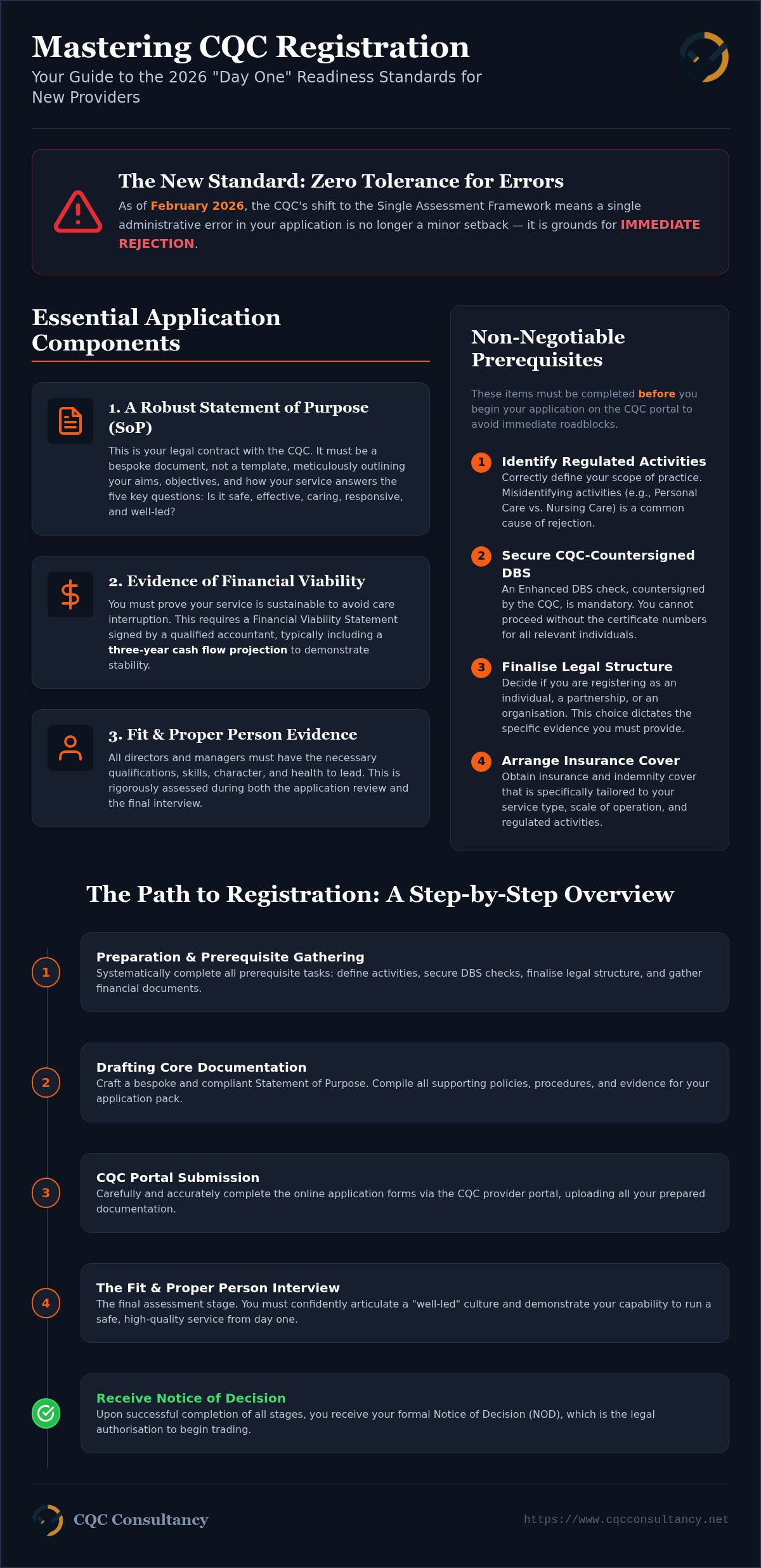
A Step-by-Step Guide to the CQC Provider Application Process
As of early 2026, the CQC requires new providers to apply using downloadable forms submitted via email, rather than through an online portal. This manual process places an even greater emphasis on meticulous preparation and accuracy. Follow these steps methodically to ensure a smooth submission.
Download the Correct Application Forms: Visit the CQC website and locate the correct application forms for your specific legal entity (Individual, Partnership, or Organisation) and the services you intend to provide. Ensure you have the most up-to-date versions.
Complete the Provider and Manager Applications: Fill out the provider application form and, if applicable, the Registered Manager application form. It is crucial to submit these simultaneously to avoid processing delays. Ensure every detail, from addresses to company numbers, is perfectly consistent across all documents, including your Statement of Purpose.
Collate All Supporting Evidence: Gather all your required documents: the completed forms, Statement of Purpose, financial viability evidence, DBS certificate numbers, CVs, and any other requested information. Create a clear and organised file structure.
Submit Your Application Pack via Email: Follow the CQC's instructions precisely for submitting your application. This typically involves emailing the complete pack of documents to their new provider applications team. Name your files clearly as instructed to help the assessor navigate your submission.
Managing the Registered Manager Application
For most service types, a provider cannot be registered without a suitable Registered Manager in place. This individual is legally responsible and accountable for the day-to-day running of the service and must also go through a rigorous assessment process. Their application, which details their qualifications, experience, and competency, must be submitted alongside the provider's application. The manager must meet the "Fit and Proper Person" requirements, demonstrating they have the skills and character to lead a high-quality care service. Preparing this candidate for their interview is a critical step that should not be overlooked.
We offer specialised support to help prospective managers prepare, including expert guidance for the CQC Registered Manager interview.
Common Submission Errors to Avoid
A simple mistake can cause weeks or even months of delay. From a former inspector's viewpoint, certain errors consistently undermine applications. These include inconsistent addresses between forms, missing signatures, providing an invalid DBS number, or a Statement of Purpose that contradicts the application form. Before you email your submission, perform a final, meticulous check of every single document. It is far better to spend an extra day reviewing than to face a lengthy delay or a potential refusal.
Beyond the Form: The CQC Fit and Proper Person Interview
Submitting your application is a major milestone, but it is not the end of the process. The next stage is the Fit and Proper Person interview, where a CQC inspector will rigorously assess your suitability to run a care service. This is where your leadership, knowledge, and commitment to quality are put to the test.
The Interview Validates Your Application: The inspector uses the interview to verify the information in your application and to probe your understanding of your regulatory responsibilities.
Demonstrate a "Well-led" Culture: Even before you open, you must be able to articulate your vision for a safe, person-centred, and well-led service. This includes your governance structures, quality assurance systems, and risk management processes.
What to Expect in 2026: Interviews may be conducted virtually or, for some services, involve a site visit. You should be prepared to answer in-depth questions about the Single Assessment Framework and how you will gather evidence to prove your service is compliant.
Simulate the Pressure: The interview can be intense. The best way to prepare is to simulate the experience and identify any gaps in your knowledge beforehand. A CQC mock inspection or interview preparation session can be invaluable in building your confidence and readiness.
Mastering the "Well-led" Domain
The "Well-led" key question is arguably the most important at the registration stage. The inspector needs to be convinced that the leadership of the service is capable, knowledgeable, and has the integrity to protect people from harm. Be prepared to discuss your quality monitoring systems, how you will manage risks, your processes for handling complaints, and your plans for staff training and support. You must be able to articulate the core message of your Statement of Purpose confidently and passionately, without simply reading from a script. This demonstrates true ownership and leadership.
Planning a CQC application? See my CQC registration support.
How CQC Consultancy Streamlines Your Journey
Navigating the CQC registration maze can be an overwhelming and stressful experience, with your investment on the line. Engaging an expert with a former inspector's perspective provides a steady hand to guide you through the complexities. We identify the gaps and red flags in your application before the CQC ever sees them, helping you to build a submission that is robust, compliant, and ready for scrutiny.
This proactive approach provides more than just a completed form; it offers the peace of mind that comes from knowing your application is in the hands of an expert dedicated to getting it right the first time. If you are ready to begin your journey as a new provider, we are here to ensure you start on the strongest possible footing.
Take the first step towards a successful CQC registration. Book a no-obligation consultation with a former CQC inspector today to discuss your new provider support needs.


Comments