CQC Scope of Registration: A Guide for Providers

Updated: 5 days ago
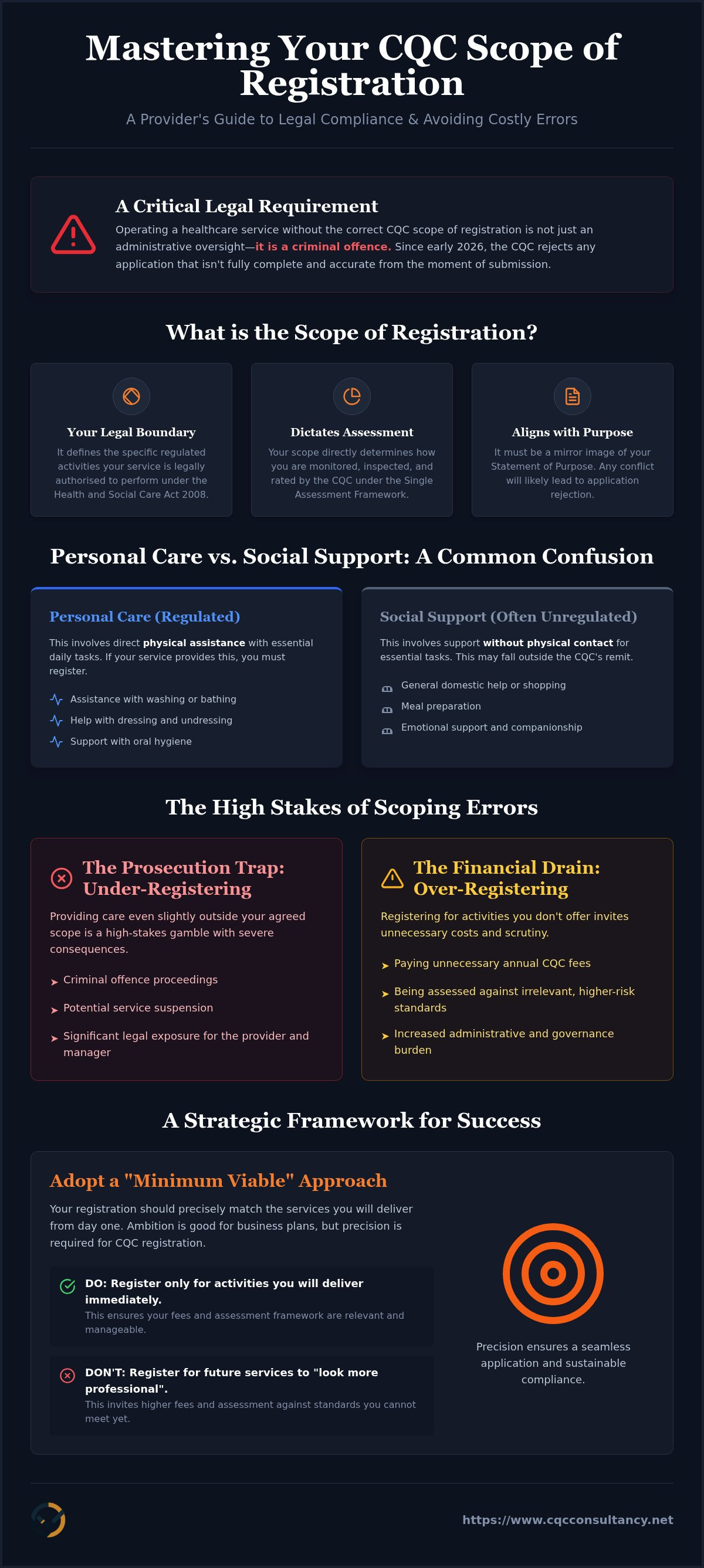
Operating a healthcare service without the correct CQC scope of registration isn't just an administrative oversight; it's a criminal offence that can halt your business before it even begins. It's understandable why so many providers feel overwhelmed by the technical jargon of the Health and Social Care Act 2008. Distinguishing between "personal care" and "social care" often feels like navigating a maze without a map, especially since the CQC began rejecting any application that isn't fully complete and accurate from the moment of submission in early 2026.
You deserve the peace of mind that comes with knowing your service is built on a solid regulatory foundation. This guide empowers you to master the complexities of regulated activities, ensuring your healthcare service is legally compliant and professionally organised from day one. We'll clarify exactly which activities apply to your business and show you how to align your Statement of Purpose with current CQC expectations. By the end, you'll have the clarity and confidence to move through the registration process without the frustration of avoidable delays or technical errors.
Table of Contents
Understanding the CQC Scope of Registration and Legal Obligations
Your scope of registration serves as the legal boundary for your clinical or social care practice. It defines the specific regulated activities that the Care Quality Commission has authorised you to perform. This isn't a mere administrative formality; it's a strict requirement under the Health and Social Care Act 2008 (Regulated Activities) Regulations 2014. Carrying on a regulated activity without the correct CQC licence is a criminal offence. Precision matters because your CQC scope of registration dictates how you are monitored, inspected, and rated from the moment you submit your application.
The Legal Entities: Who Needs to Register?
Every provider must register as a specific legal entity: an individual, a partnership, or an organisation such as a limited company. Whilst the provider holds the overall responsibility, the Registered Manager plays a pivotal role. They are legally accountable for ensuring the service operates within its defined scope on a day-to-day basis. If the manager oversees activities beyond what's registered, both the individual and the organisation face significant legal exposure. Choosing the correct entity at the start prevents complex and costly amendments later in your business journey.
The Single Assessment Framework Connection
Under the 2026 Single Assessment Framework, your scope directly influences your inspection profile. It dictates which Quality Statements the CQC will use to gather evidence and assess your performance. If your scope is misaligned, you might find yourself being assessed against clinical standards that don't apply to your actual service. This mismatch often triggers a "Requires Improvement" rating before an inspector even arrives, as your governance won't match the activities you've claimed to provide. Correct scoping ensures your evidence categories remain relevant, achievable, and reflective of the high-quality care you actually deliver.
Determining Your Regulated Activities: A Strategic Framework
Selecting your CQC scope of registration requires a "minimum viable" approach. You should only register for the activities you intend to deliver immediately. Registering for a wide range of activities, such as "Surgical procedures" or "Maternity services" when they aren't part of your core model, doesn't make your business look more professional. Instead, it invites unnecessary annual fees and a higher volume of Quality Statements to satisfy during assessments. Each activity must be tied to a specific location, whether that's a physical clinic or a central office for community-based care.
Your Statement of Purpose must be the mirror image of your scope. If these documents conflict, the CQC will likely reject your application under the stricter 2026 submission guidelines. This is where bespoke registration support becomes invaluable, as it ensures your paperwork is technically sound and aligned with your operational reality before you hit submit.
Personal Care vs. Social Care: The Common Confusion
The line between general social support and regulated personal care is often blurred. Personal care specifically involves physical assistance with essential tasks like washing, dressing, or oral care. If your supported living service provides this level of assistance, you must register for the "Personal care" activity. However, if your staff only provide general domestic help, meal preparation, or emotional support without physical contact, you might fall outside the CQC's remit entirely. Getting this distinction wrong can lead to either illegal operating or paying for a licence you don't actually need.
Specialist Activities: Nursing and Diagnostic Procedures
Specialist services, such as mental health clinics or community nursing, often trigger multiple regulated activities simultaneously. For instance, "Treatment of disease, disorder or injury" is a broad category that covers many clinical interventions. You must identify if your service crosses the threshold into "Nursing care," which requires a different level of clinical governance and a specifically qualified Registered Manager. Community-based clinics must also consider if they perform "Diagnostic and screening procedures," as this often requires separate authorisation even if it's part of a wider treatment plan.
Avoiding Costly Scoping Errors: Why Precision Matters
Under-registering is a high-stakes gamble that often leads to the "Prosecution Trap." If you provide care that falls even slightly outside your agreed CQC scope of registration, you risk immediate legal action and service closure. Conversely, many providers fall into the "Fee Trap" by registering for activities "just in case." Since CQC annual fees are calculated based on the number of locations and types of service, over-registering creates an unnecessary financial burden on your new business. Precision ensures you only pay for the oversight you actually require.
One of the most frequent reasons for application rejection is a mismatch between the digital CQC Portal submission and your Statement of Purpose. If your portal entry lists "Personal care" but your supporting documents describe complex clinical interventions, the regulator will view this as a lack of organisational oversight. Conducting a CQC mock inspection can reveal these technical inconsistencies before they become permanent records on your regulatory profile. To ensure your application is technically robust from the start, you may benefit from our professional CQC registration support.
Statement of Purpose: The Anchor of Your Scope
The Statement of Purpose is the most scrutinised document in your entire application. It acts as the legal contract between your service and the regulator. A common red flag for inspectors is the use of vague marketing language instead of precise CQC terminology. Your description of service users, locations, and clinical aims must align perfectly with the technical definitions of your chosen activities. If this document is poorly drafted, it suggests a lack of fundamental understanding of the regulatory framework.
The Fit and Proper Person Test
Your chosen scope directly dictates the focus and difficulty of the CQC registered manager interview. An inspector will test the manager's competence and skills against the specific risks associated with your registered activities. For instance, if you've registered for "Treatment of disease, disorder or injury," the manager must demonstrate a deep understanding of clinical governance and risk mitigation. If they cannot articulate how they will manage the specific requirements of your scope, the entire registration application is likely to fail.
Streamlining Your Registration with Expert Consultancy
Securing your CQC scope of registration is a meticulous process that leaves no room for ambiguity. Partnering with a former CQC inspector consultancy provides you with a steady hand to guide you through the complexities of the application. Our team brings 12 years of former inspector experience to your project, offering bespoke registration support that spans from initial document preparation to intensive interview coaching. As your business evolves, you'll need to manage changes to your scope effectively. Whether you're adding a new location or expanding into specialist nursing care, professional guidance ensures these transitions remain compliant and commercially viable.
Navigating the New CQC Provider Portal
The 2026 provider portal requires absolute technical accuracy. To avoid common errors, ensure all supporting evidence is uploaded in the correct format before you finalise your scope submission. You should monitor your account daily to respond to any Requests for Information (RFIs) promptly. A slow response to an RFI can stall your application for weeks, potentially delaying your opening date and impacting your revenue. Preparation is key; having your tailored policies and governance structures ready before you even log in will significantly reduce the risk of a rejected application.
Ongoing Compliance Monitoring
Your registration isn't a static document; it's a living framework. We recommend reviewing your scope annually as a core part of your quality assurance processes. This proactive approach identifies if you've unintentionally drifted into new regulated activities that aren't yet authorised. Regular mock inspections serve as an early warning system, keeping your registration accurate whilst providing the evidence needed for the Single Assessment Framework. It's much easier to update your scope through a planned notification than to explain a compliance breach during an unannounced inspection.
Before you submit your provider application in 2026, ensure you've ticked these essential boxes:
Is your legal entity (Individual, Partnership, or Organisation) correctly identified?
Does your Statement of Purpose match your portal entries word-for-word?
Is your Registered Manager's experience aligned with your specific CQC scope of registration?
Are all supporting documents, including financial viability statements, current and ready for upload?
Building a Secure Foundation for Your Healthcare Service
Establishing an accurate CQC scope of registration is the most critical step you'll take in your journey as a provider. By precisely defining your regulated activities and ensuring your Statement of Purpose reflects your daily operations, you protect your business from legal risks and unnecessary fees. Remember that the regulator's 2026 standards require absolute technical accuracy from the very first submission. Aligning your leadership team with these requirements isn't just about passing an interview; it's about embedding a culture of safety and excellence from day one.
Planning a CQC application? See my CQC registration support.
If you're feeling the pressure of complex portal applications or document preparation, you don't have to navigate this alone. We provide a steady hand to guide you through every stage of the process. With over 12 years of regulatory experience, we offer bespoke Statement of Purpose guidance and comprehensive mock inspection reports to ensure you're fully prepared. You can secure your CQC registration with expert support from a former inspector to remove the uncertainty from your application. Your commitment to high-quality care starts with a robust registration; we're here to help you achieve it with confidence.
Frequently Asked Questions
Do I need to register with the CQC if I only provide domestic help and companionship?
No, you don't need to register if your service is limited to domestic tasks such as cleaning, shopping, or companionship. Registration is only mandatory when your service includes "personal care," which involves physical assistance with washing, dressing, or toileting. If your staff's role expands to include these regulated tasks, you must secure the correct CQC scope of registration before those activities commence to avoid legal penalties.
Can I change my CQC scope of registration after my application has been approved?
Yes, you can modify your registered activities at any time by submitting a "variation" application through the CQC provider portal. Whether you're expanding into nursing care or removing a service you no longer offer, the process requires an update to your Statement of Purpose. It's essential to ensure your Registered Manager's qualifications still align with the new activities to prevent delays in the approval of your variation.
What happens if the CQC decides my service is operating outside of its registered scope?
Operating outside your registered remit is a criminal offence that can result in immediate prosecution or the forced closure of your service. The CQC has the power to issue fixed penalty notices or initiate legal proceedings under the Health and Social Care Act 2008. Beyond legal action, operating without the correct CQC scope of registration invalidates your insurance and significantly compromises the safety and trust of your service users.
How much does it cost to register a new regulated activity with the CQC in 2026?
There is no upfront application fee to register a new regulated activity or location with the CQC in 2026. Instead, providers pay an annual fee once the registration is finalised, which is calculated based on the type and scale of the service provided. For example, a community-based provider might pay a base rate of £239 plus an additional fee per service user, as the CQC fee scheme has remained largely stable for several years.
Is a Registered Manager required for every regulated activity in my scope?
Most regulated activities require a Registered Manager, though there are specific exceptions for individual providers who manage the service themselves. If you're registered as an organisation or partnership, you must appoint a manager who is "fit and proper" to oversee the activities in your scope. The regulator assesses their competence specifically against the risks associated with those activities, ensuring they have the clinical or managerial expertise required for safe oversight.


Comments