Emergency Medicines in General Practice: CQC Requirements

Updated: 5 days ago
What if the difference between a "Good" and an "Inadequate" CQC rating isn't your clinical skill, but a single expired vial of adrenaline tucked at the back of a drawer? Managing emergency medicines in general practice is often one of the most stressful aspects of surgery governance. You likely feel the weight of balancing constant stock rotation with the pressure of ensuring every staff member is up to date with the 2025 Resuscitation Council UK guidelines. It's a meticulous task that leaves no room for error, particularly when the safety of your patients and the reputation of your practice are on the line.
This article provides the clarity you need to navigate these requirements with total confidence, ensuring your practice is fully prepared for the "Safe" domain of your next assessment. We'll provide an audit-ready list of essential drugs, explain the latest February 2026 CQC expectations, and show you how to justify omissions through a robust risk assessment process. By the end, you'll have a clear map to move from regulatory uncertainty to a state of professional, audit-ready preparedness.
Table of Contents
Understanding CQC Expectations for Emergency Medicines in GP Practices
The Care Quality Commission (CQC) maintains a clear mandate: every surgery must possess the necessary skills, equipment, and drugs to manage medical emergencies effectively. This requirement isn't merely a suggestion; it's a fundamental component of the "Safe" domain assessment. For General Practitioners in the UK, this means demonstrating that the practice can respond rapidly to life-threatening situations without delay. If an inspector finds gaps here, it often signals wider systemic issues in your governance.
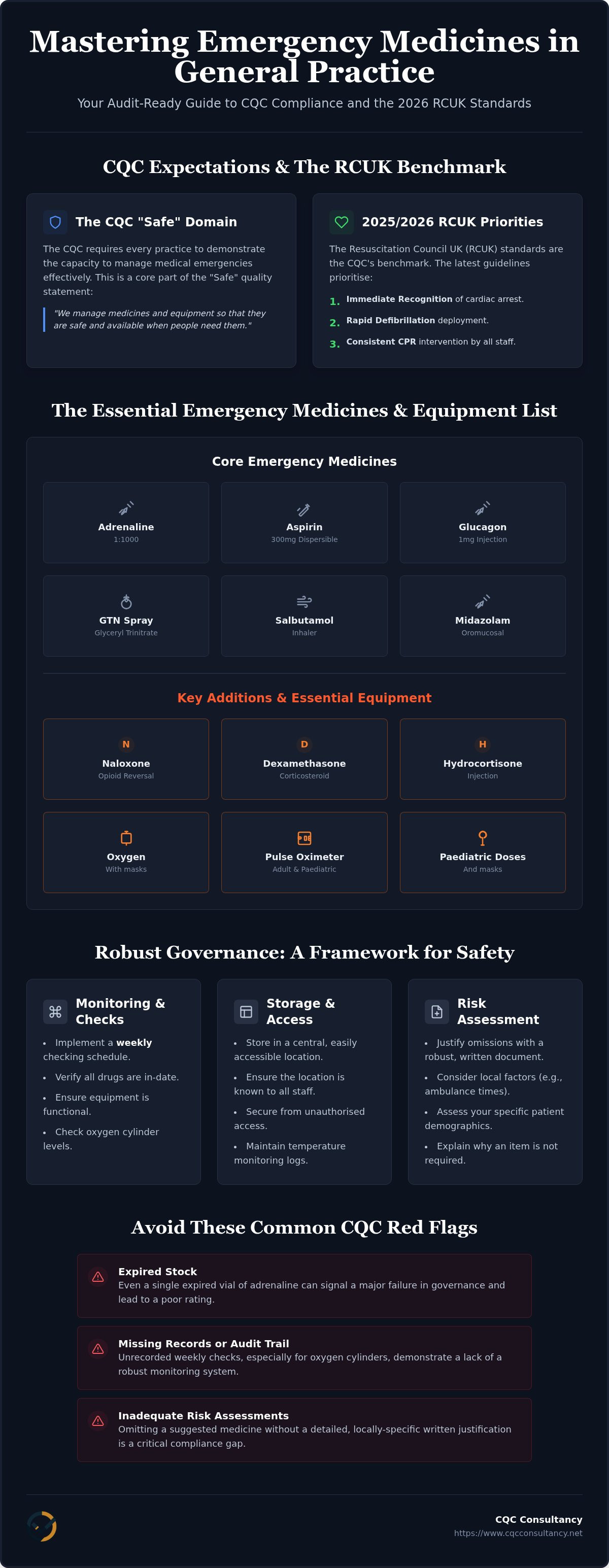
Within the Single Assessment Framework, the "Safe" quality statement specifically requires that "we manage medicines and equipment so that they are safe and available when people need them." Consequently, the management of emergency medicines in general practice serves as a direct indicator of your surgery's commitment to patient safety and operational thoroughness. It's about providing the assurance that, when a crisis occurs, your team has the tools to act decisively.
The Role of the Resuscitation Council UK (RCUK) Standards
The CQC adopts the Resuscitation Council UK (RCUK) Quality Standards as its primary benchmark for excellence. These standards dictate that resuscitation equipment and emergency drugs must be immediately accessible to all clinical areas. To maintain this, your practice should appoint a designated resuscitation lead. This individual is responsible for overseeing local risk assessments, ensuring that the stock reflects the specific needs of your patient population. The updated 2026 standards prioritise:
Immediate recognition of cardiac arrest.
Rapid deployment of early defibrillation.
Consistent CPR intervention by all staff.
Properly stocking emergency medicines in general practice proves that your team is prepared for these critical moments. It removes the friction of uncertainty during a crisis and ensures your practice remains audit-ready at all times.
The Essential Emergency Medicines List: Requirements and Risk Assessments
Ensuring your surgery stocks the correct emergency medicines in general practice is a matter of both clinical safety and regulatory compliance. While the CQC doesn't mandate a single fixed list, they expect practices to follow the Resuscitation Council UK guidelines. Core medicines typically include Adrenaline (1:1000), Aspirin (300mg), Glucagon, GTN spray, Salbutamol, and Midazolam. For 2026, the scope has widened to include Naloxone, Dexamethasone, and Hydrocortisone, reflecting evolving clinical needs. You must also maintain functional oxygen cylinders and pulse oximetry equipment, ensuring paediatric-specific doses and masks are available if you treat children.
Managing these supplies requires meticulous oversight to avoid the red flags of expired stock. Referencing an NHS checklist for CQC inspection can help you verify your current inventory against regional standards. If you're unsure if your cupboard meets the mark, our compliance guidance can provide a professional second opinion before an inspector arrives.
Justifying Deviations: The Critical Role of Risk Assessment
The CQC list is suggested, meaning you can omit certain items if you provide a robust, written justification. This is where many practices falter. Your risk assessment must be a living document that considers local factors such as ambulance response times, your proximity to the nearest A&E, and the specific demographics of your patient list. If you choose to exclude a medicine, such as IV fluids, you must document that your team's training level or the rapid arrival of paramedics makes their inclusion unnecessary. This level of detail transforms a simple list into a professional governance framework that stands up to scrutiny.
Robust Governance: Storage, Monitoring, and Staff Competency
Establishing a reliable system for managing emergency medicines in general practice is what separates an organised surgery from one at risk of failing the "Safe" domain. You must implement a weekly checking schedule for all drugs and equipment, including oxygen cylinders, to ensure everything is in-date and functional. These medicines should be stored in a central, easily accessible location known to all staff, yet remains secure from unauthorised access. For certain drugs, you must also maintain consistent temperature monitoring to ensure efficacy isn't compromised by environmental factors.
A robust audit trail is the tangible evidence of a "Well-led" practice, transforming routine checks into a powerful shield against regulatory scrutiny. To ensure your governance meets these high standards, you can book one of our expert-led mock inspections to identify potential gaps in your storage protocols before the regulator arrives.
Effective Expiry Date Management and Audit Trails
Relying on memory is a significant risk. Instead, use a digital tracker or a dedicated logbook to record batch numbers and expiry dates meticulously. Many practices now use tamper-evident seals on emergency bags; if the seal is intact, you only need to check the external expiry list, significantly reducing the daily administrative burden. This methodical approach ensures no drug ever slips through the cracks.
Staff competency is the final pillar of governance. All clinical and non-clinical staff must receive annual training updates in Basic Life Support (BLS) and anaphylaxis management. This ensures that every team member, from the receptionist to the senior partner, possesses the confidence to act when every second counts. Maintaining clear, individual training records is essential for demonstrating that your team isn't just equipped, but fully capable of using the emergency medicines in general practice they have on hand.
Preparing for Inspection: Identifying Compliance Gaps in Emergency Care
Under the Single Assessment Framework, the CQC evaluates emergency medicines in general practice through the lens of specific Quality Statements, particularly "Safe Systems, Pathways and Transitions" and "Safe and Effective Staffing." This shift means evidence of your preparedness must be continuous and readily available. A common red flag for former inspectors is an unrecorded oxygen cylinder check; even if the tank is full, a missing signature on a weekly log suggests a systemic breakdown in governance. Similarly, failing to cross-reference your drug list with a current risk assessment can trigger a deeper investigation into your "Well-led" domain. You should organise your digital evidence, such as fridge temperature logs, batch numbers, and training certificates, clearly within the CQC portal ahead of any site visit to demonstrate meticulous, proactive management.
How a Mock Inspection Secures Your Practice Rating
A professional audit removes the guesswork from your preparation and provides the peace of mind that only an expert perspective can offer. Our CQC mock inspection services are designed to simulate the pressure of a real regulatory visit, providing a rigorous stress-test of your emergency protocols. An independent pair of eyes often spots the minor details that internal teams overlook, such as an expired vial of Naloxone or a missing training certificate for a part-time staff member. Identifying these gaps early allows for calm correction rather than frantic, last-minute fixes. Ensure your practice is fully prepared and your team is confident by booking a CQC consultancy services review today. This proactive approach transforms the inspection process from a source of anxiety into a validation of your surgery's high standards.
Securing Your Practice Future Through Proactive Governance
Managing emergency medicines in general practice requires more than a well-stocked cupboard; it demands a culture of meticulous oversight and evidence-based risk assessment. By aligning your protocols with the latest 2026 Resuscitation Council UK standards and maintaining a robust audit trail, you transform a potential regulatory hurdle into a pillar of patient safety. You've seen how identifying red flags early and justifying deviations through formal risk assessments can protect your surgery's reputation and rating.
Want an expert to check your compliance? See my CQC mock inspection service.
The stress of an upcoming inspection doesn't have to be a burden your team carries alone. Our expert-led mock inspections, conducted by a former CQC inspector with 12 years of regulatory experience, provide a comprehensive gap analysis and bespoke guidance on the new Single Assessment Framework. Book a professional mock inspection to secure your compliance and gain the clarity needed to pass the "Safe" domain with total confidence. You have the skills to care for your patients; let us provide the map to navigate the regulations with ease.
Frequently Asked Questions
What emergency medicines are mandatory for GP practices in 2026?
No single mandatory list exists, but practices must stock medicines based on RCUK standards and a local risk assessment. Core items typically include Adrenaline, Aspirin, Glucagon, and Salbutamol. By 2026, CQC expectations include Naloxone and Dexamethasone. If you omit any, your risk assessment must clearly justify the decision based on your clinical setting and patient demographics.
Do we need to stock emergency medicines if we are close to an A&E department?
Yes, proximity to a hospital doesn't exempt a surgery from having essential emergency medicines in general practice. You must be able to manage a crisis until an ambulance arrives and transfers the patient. While your risk assessment might allow for fewer advanced supplies, you still need immediate access to life-saving drugs like Adrenaline and equipment like an AED to provide initial stabilisation.
How often should we check our emergency medicine kit and AED?
You should check your emergency medicines and equipment at least weekly to ensure everything is in date and functioning. Oxygen cylinders and AED battery status are critical points of failure that require regular verification. Keeping a meticulous log of these checks proves to the CQC that your governance is consistent. This proactive approach prevents the stress of discovering a dead battery during a real medical emergency.
Does the CQC require non-clinical staff to be trained in emergency medicine use?
Non-clinical staff aren't expected to administer complex emergency medicines in general practice, but they must receive annual Basic Life Support (BLS) training. They should know how to recognise a deteriorating patient, call for help, and locate the emergency kit or AED. This collective competency ensures that the entire team can support clinical staff effectively during a resuscitation attempt or an anaphylactic event.
What happens if the CQC finds an expired emergency drug during an inspection?
Finding an expired drug is a significant red flag that often leads to a breach of Regulation 12 regarding safe care and treatment. It suggests that your checking systems have failed, which could negatively impact your "Safe" domain rating. Inspectors will look for evidence of systemic oversight; a single error might be a minor point, but multiple expired items usually indicate a failure in your practice's governance.
Related reading: What Are the CQC Fundamental Standards?.


Comments