CQC Regulation 7: Registered Manager Requirements Guide

Updated: 5 days ago
The difference between a successful CQC registration and a disheartening refusal often has nothing to do with your clinical skill, but everything to do with how you evidence your character. It's completely natural to feel a sense of trepidation when facing the "Fit and Proper Person" interview, especially whilst trying to decipher the nuances of regulation 7: registered manager requirements. You're certainly not alone in feeling that "good character" is a frustratingly subjective standard to meet when your professional future and the launch of your service are on the line.
This guide is designed to remove that uncertainty and replace it with a steady, informed confidence. We'll help you master the complexities of Regulation 7 to ensure your registered manager meets every fitness and character requirement the commission demands. By breaking down the CQC's expectations into manageable steps, we'll provide a clear roadmap for your documentation. You'll discover exactly what evidence you need to provide and how to navigate the regulatory interview with the poise of a seasoned leader, ensuring your application moves forward without the risk of a costly rejection.
Table of Contents
Understanding Regulation 7: The Registered Manager Requirement
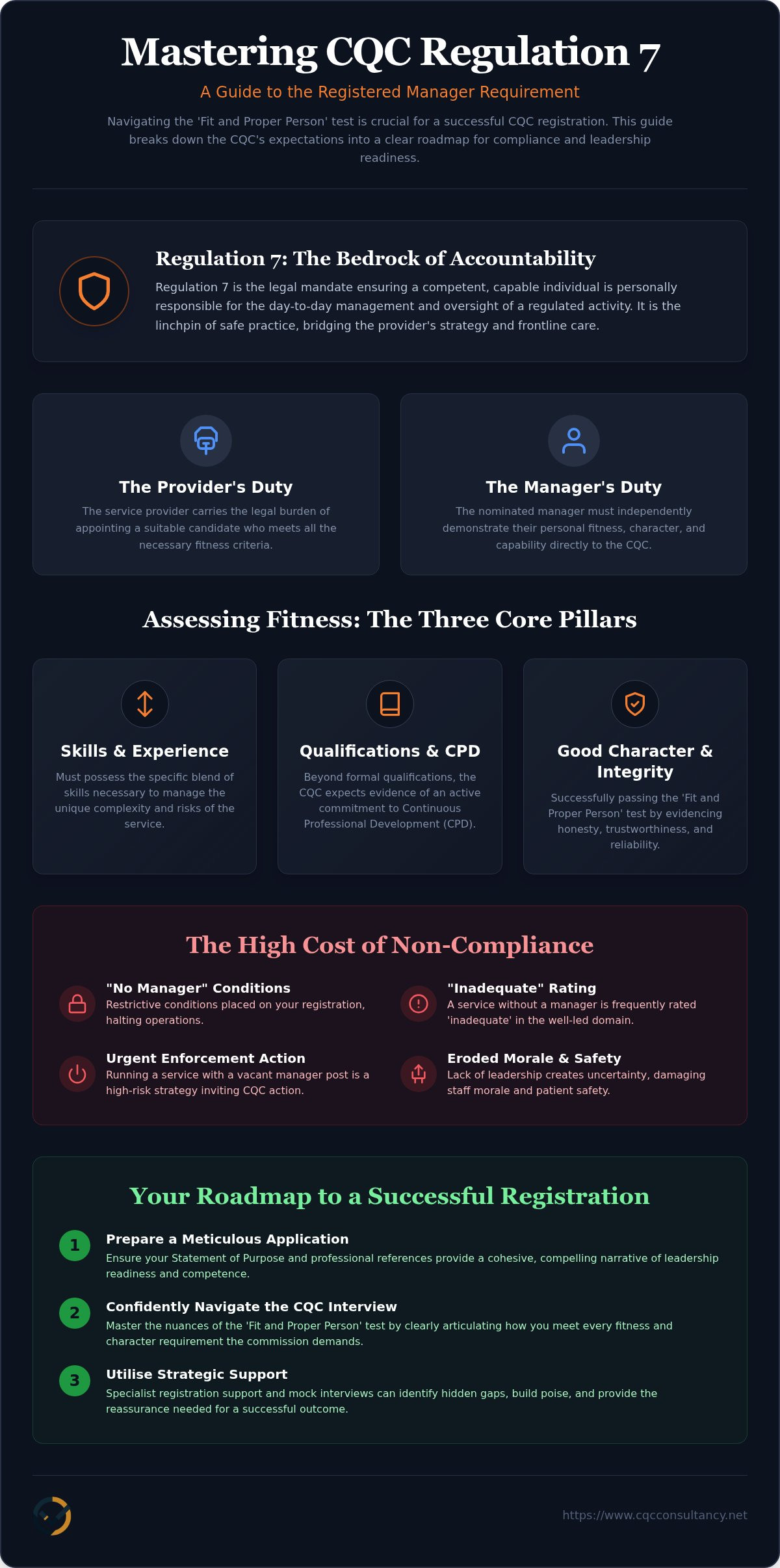
Regulation 7 is the bedrock of accountability within the health and social care sector. It's the legal mandate that requires almost every provider of a regulated activity to have a registered manager in place. This isn't a mere administrative hurdle; it's a structured safeguard designed to ensure that a competent, capable individual is personally responsible for the day-to-day oversight of care. When you apply for registration, you're essentially promising the regulator that your service has a steady hand at the helm to guide clinical and operational decisions.
There's a dual weight to this requirement. The service provider carries the burden of appointing a suitable candidate, whilst the manager must independently demonstrate their personal fitness to the Care Quality Commission (CQC). The commission views this role as the linchpin of safe practice. The manager acts as the vital bridge between the provider's high-level strategy and the frontline staff's daily actions. When a manager is absent or ill-equipped, the entire governance structure of a service begins to waver. Failing to satisfy regulation 7: registered manager requirements often results in restrictive "no manager" conditions being placed on your registration, which can effectively halt your operations before they've even begun.
The Legal Framework of the Health and Social Care Act
Regulation 7 sits within the 2014 Regulated Activities Regulations. It serves as a prerequisite for nearly all other standards. For instance, you can't realistically evidence compliance with Regulation 17 (Good Governance) or Regulation 12 (Safe Care and Treatment) if your leadership fails to meet the fitness criteria of Regulation 7. As we move through 2026, the CQC single assessment framework places even greater emphasis on leadership quality. The regulator now looks for ongoing evidence that a manager isn't just qualified on paper, but is actively driving the quality statements that define the new assessment model. This shift means your manager must be prepared to demonstrate their impact on service culture and safety during every interaction with the commission.
Who Needs a Registered Manager?
Most regulated activities, from domiciliary care and care homes to private clinics, require a registered manager to be in post whilst the service is operational. The only common exception involves individual providers who manage the service personally. Even in these rare cases, the provider doesn't escape scrutiny; they must still undergo a rigorous fitness assessment that mirrors the manager's process. Running a service whilst the manager's post is vacant is an incredibly high-risk strategy. It often leads to urgent enforcement action, as a service without a registered manager is frequently rated as "inadequate" in the well-led key question. This lack of leadership creates a culture of uncertainty that can quickly erode staff morale and patient safety.
Assessing Fitness: Skills, Qualifications, and Experience
Demonstrating personal suitability is a rigorous process that goes far beyond a simple CV review. To meet the regulation 7: registered manager requirements, a candidate must prove they possess the specific blend of skills and experience necessary to manage the unique risks of their service. The CQC doesn't apply a one-size-fits-all checklist; instead, they weigh a manager's background against the complexity of the regulated activity. For instance, managing a small domiciliary care startup requires a different toolkit than overseeing a large nursing facility with complex clinical needs. Seeking professional compliance guidance can help you articulate these nuances during the application phase.
According to the official Regulation 7 guidance, the onus is on the provider to ensure the manager is competent and able to perform their duties effectively. This includes maintaining an active commitment to continuous professional development (CPD). A static qualification from a decade ago is rarely enough; the regulator expects to see evidence that the manager stays abreast of current best practices, legislative changes, and the evolving needs of their service users. This proactive approach to learning is a key indicator of a manager who is truly fit to lead.
Evidence of Competence and Training
Whilst the CQC doesn't mandate a single specific qualification for every sector, the Level 5 Diploma in Leadership for Health and Social Care is the most widely recognised benchmark for excellence. When preparing your application, it's vital to map previous experience directly to your current service user group. If your manager's background is primarily in elderly care but they're now leading a learning disability service, you must document how their transferable skills have been supplemented with specialist training. A robust training matrix serves as a powerful piece of evidence here, demonstrating a meticulous approach to leadership readiness.
Physical and Mental Fitness for the Role
Fitness for the role also encompasses a manager's physical and mental capacity to meet the demands of the position. This is a protective measure for both the manager and the people they support. The CQC often requires a GP declaration or an occupational health assessment to confirm that the individual is capable of handling the significant responsibilities and inherent stresses of the role. It's about ensuring the manager has the resilience to maintain high standards even during challenging periods. Taking the time to verify this early in the recruitment process prevents future delays and provides peace of mind for the entire organisation.
The Fit and Proper Person Test: Good Character and Integrity
Whilst previous sections focused on clinical and managerial competence, this stage of the assessment examines the moral compass of the leader. Good character under Regulation 7 isn't merely the absence of a criminal record; it's a proactive demonstration of honesty, reliability, and trustworthiness. The CQC assesses whether an individual has the integrity to manage a service where vulnerable people rely on their decisions. This is often the area where applicants feel the most anxiety, yet it's also where transparency serves as your greatest protection in meeting the regulation 7: registered manager requirements.
The baseline for this assessment is the mandatory enhanced Disclosure and Barring Service (DBS) check and a thorough review of professional references. However, the commission also looks for signs of financial mismanagement or previous regulatory misconduct. Bankruptcy or involvement in a failed care business won't always lead to a refusal, but they do require a level of disclosure that many find daunting. Integrity is measured by your willingness to be open about these challenges before the regulator discovers them through their own due diligence. A steady, honest approach here builds the foundation of trust necessary for a successful partnership with the CQC.
Evidencing Integrity and Professional History
Providing a full, chronological employment history is essential. Any gaps, no matter how brief, must be accounted for with clear, factual explanations. The CQC values a narrative that shows professional growth and accountability rather than an edited version of your past. Obtaining robust, verifiable references from your most recent employers is equally critical, as these provide an external perspective on your conduct and leadership style. Understanding the CQC fit and proper person test is vital here; it's not just about passing a background check, but about presenting a cohesive history of professional integrity that aligns with the commission's standards.
Managing Disclosures and Past Issues
If you have historical issues, such as an old caution or a period of financial difficulty, the best approach is to provide a "fitness to practice" statement. This document allows you to explain the context of the issue, what you learned, and why it doesn't pose an ongoing risk to service users. As noted in the CQC guidance on Regulation 7, the regulator distinguishes between past mistakes and current risks. They often view non-disclosure as a more significant character flaw than the historical issue itself. By being upfront, you demonstrate the very transparency that the regulation 7: registered manager requirements are designed to uphold, turning a potential weakness into a demonstration of professional maturity.
Navigating the CQC Registered Manager Application and Interview
The application process is a multi-stage journey where administrative precision meets regulatory scrutiny. It begins with a meticulous submission via the CQC Portal. You must ensure every attachment, from professional references to enhanced DBS certificates, is present and correct. Whilst the CQC aims to process these applications within 12 weeks, any missing information can lead to frustrating delays or even an outright rejection of the file. Precision is your best ally during this initial phase.
Your Statement of Purpose must align perfectly with the manager’s actual experience and the service’s specific aims. If your documentation suggests one level of care whilst the manager’s background reflects another, the inspector will identify this inconsistency immediately. This alignment is a core component of regulation 7: registered manager requirements. Once the paperwork is accepted, you move to the most critical stage: the Fit and Proper Person interview. This is where your theoretical knowledge is tested against practical, real-world scenarios. If you're feeling the pressure of this final hurdle, our CQC Registration Support provides the expert guidance needed to submit a flawless application.
The Registered Manager Interview: What to Expect
The interview is a formal assessment of your leadership capability and regulatory knowledge. Inspectors typically structure their questions around the quality statements of the Single Assessment Framework. You'll be expected to explain how you'll ensure the service is safe, effective, and well-led from day one. They'll look for evidence that you can translate complex regulations into daily staff behaviours. Reviewing these CQC registered manager interview tips will help you articulate your vision with the calm confidence the regulator expects.
Common Pitfalls in Regulation 7 Applications
Many applications falter due to easily avoidable errors. Inconsistent employment dates or missing DBS numbers suggest a lack of attention to detail that may worry an inspector. However, the most significant red flag is often a lack of local knowledge. A manager must understand their local authority’s specific requirements and the role of their Integrated Care System (ICS). Generic answers that don't reflect the unique needs of your service user group are rarely successful. The CQC wants to see a manager who is deeply rooted in their local healthcare landscape and fully prepared for the responsibilities of the role.
Strategic Support for Regulation 7 Compliance
Meeting the regulation 7: registered manager requirements is a significant undertaking that demands more than just a basic understanding of the law. It requires a strategic approach to evidencing leadership. Professional consultancy serves as a protective layer for your business, significantly reducing the risk of a registration rejection that could delay your launch by months. By engaging with an expert who has seen both sides of the registration desk, you gain an invaluable perspective on how an inspector will likely interpret your evidence and your manager's performance during the interview.
A former inspector, bringing over 12 years of regulatory experience, can audit your documentation with a level of meticulousness that is difficult to achieve internally. This process identifies subtle gaps in a manager's professional history or training matrix before they become red flags for the CQC. It's about moving from a state of anxious preparation to one of steady, informed confidence. This partnership ensures that every aspect of your application is polished, articulate, and fully aligned with the high standards expected in 2026.
The Role of Mock Inspections in Manager Development
Mock inspections are far more than a simple dress rehearsal; they are a vital tool for ongoing professional development. By simulating the atmosphere and technical depth of a real assessment, CQC mock inspection services help a manager understand the specific pressures of the role. These sessions allow managers to practice articulating their vision for the "Well-Led" quality statement under the Single Assessment Framework. The resulting mock report acts as a clear roadmap, identifying specific areas where a manager might need further coaching or support to truly excel in their position.
Bespoke Registration Support for New Providers
For new healthcare providers, the complexity of the CQC portal and the volume of required attachments can feel overwhelming. Our support is never generic; it is tailored to the specific regulated activity and service user group you intend to support. We provide a steady hand through the entire process, ensuring that your Statement of Purpose and fitness declarations form a cohesive, persuasive narrative of quality and safety. If you're ready to ensure your leadership team is fully prepared for the rigours of Regulation 7, contact CQC Consultancy for a bespoke compliance review to secure your service's future.
Securing Your Future as a Registered Manager
Mastering the nuances of regulation 7: registered manager requirements is a transformative step for any healthcare leader. It moves your application beyond a simple administrative exercise and establishes a foundation of integrity and safety for your entire service. By carefully aligning your professional history with the CQC's fitness criteria and preparing meticulously for the regulatory interview, you remove the uncertainty that so often leads to registration delays. These requirements are not merely hurdles; they are the standards that define excellence in modern care leadership.
Preparing for your interview? See my registered manager support.
Success in this process is about more than avoiding a refusal; it's about demonstrating your readiness to lead under the Single Assessment Framework with absolute clarity. With national UK coverage and over 12 years of direct experience as a CQC inspector, we provide the steady hand and specialised insight needed to navigate these complexities with ease. Book a call with a former CQC inspector to secure your registration and take the final step toward a successful launch. You possess the skills to lead; we provide the map to ensure the regulator sees them too. Your journey toward a compliant, well-led service starts with this final preparation.
Frequently Asked Questions
What is Regulation 7 of the CQC?
Regulation 7 is the legal mandate within the Health and Social Care Act 2008 (Regulated Activities) Regulations 2014 that requires most care providers to appoint a registered manager. It ensures that a specific, competent individual is held personally accountable for the daily oversight and safety of a regulated activity. To satisfy regulation 7: registered manager requirements, the candidate must demonstrate they are of good character, possess the necessary qualifications, and are physically and mentally fit for the role.
Can a service operate without a Registered Manager?
No, a service cannot typically operate without a registered manager once it is registered for a regulated activity. Whilst there are rare exceptions for individual providers who manage their own service, most organisations must have a manager in post to remain compliant. Operating without one is a significant regulatory breach that often leads to "no manager" conditions or urgent enforcement action, as it leaves the service without clear leadership and oversight.
What qualifications does a CQC Registered Manager need?
The CQC does not mandate a single universal qualification, but the Level 5 Diploma in Leadership for Health and Social Care is the most commonly expected benchmark for excellence. The specific requirements often depend on the service type; for instance, a nursing home manager might need a valid nursing registration (PIN) in addition to management training. Inspectors look for evidence that the manager’s training and CPD align with the complexity of the service and the specific needs of the people being supported.
How does the CQC assess the "Fit and Proper Person" requirement?
The CQC assesses this requirement through a combination of documentary evidence and a formal interview. They review enhanced DBS checks, professional references, and full employment histories to verify "good character" and integrity. During the interview, inspectors evaluate the candidate’s clinical and managerial competence, ensuring they have the skills to lead a safe service. This process is designed to confirm that the individual is suitable to hold a position of significant responsibility and can handle the associated pressures.
What happens if a Registered Manager fails their CQC interview?
If a candidate fails their interview, the CQC will typically issue a "Notice of Proposal" to refuse the registration. The applicant then has a 28-day window to submit "representations" or provide further evidence to challenge the decision. If the refusal is finalised, the provider must either find a new candidate or support the existing one to address the identified gaps before reapplying. This highlights the value of thorough preparation and mock interviews to identify readiness before the formal assessment takes place.
Does a Registered Manager need a new DBS check for every application?
Yes, the CQC generally requires a new enhanced DBS check that has been countersigned by them, unless the manager is registered with the DBS Update Service. Even with the Update Service, the original certificate must be available for inspection. The CQC usually expects the DBS check to be no more than six to twelve months old at the time of the application to ensure the most current information is available for their assessment of the manager's fitness.
Can one person be a Registered Manager for two different locations?
Yes, it is possible for one individual to manage two locations, but they must provide a compelling business case to the CQC. The regulator will scrutinise how the manager intends to maintain effective oversight of both services simultaneously. You must demonstrate that the distance between locations is manageable and that there are robust deputy management structures in place at each site to ensure safety and quality aren't compromised by the split responsibility of the manager.
How long does the CQC Registered Manager registration process take in 2026?
In 2026, the CQC aims to process registered manager applications within 12 weeks, though actual timelines can vary based on the complexity of the service and current inspector workloads. Delays are often caused by incomplete documentation, missing DBS details, or slow responses from professional referees. Ensuring your submission is meticulous and fully meets regulation 7: registered manager requirements from the outset is the most effective way to avoid unnecessary delays and secure a timely registration. Related reading: CQC registration application support, CQC Registration: Step-by-Step Guide for New Providers 2026.


Comments