CQC Statutory Notifications: A Compliance Checklist

Updated: 5 days ago
Table of Contents
Understanding the Role of Statutory Notifications in CQC Oversight
In the complex landscape of health and social care regulation, statutory notifications are more than just administrative tasks; they are a legal requirement and a critical communication channel between your service and the Care Quality Commission (CQC). Defined as the mandatory reporting of specific incidents, events, and changes, these notifications provide the regulator with vital, real-time information. They function as a "temperature check" on your service's safety and governance between formal inspections, offering a continuous stream of insight into its operational health.
A culture of transparent and timely reporting is directly linked to the "Well-led" key question. Meticulousness in fulfilling your statutory duties demonstrates robust leadership and a commitment to learning from events. The CQC uses this data to build a risk profile for every provider, helping it to decide which services to prioritise for site visits or further scrutiny. A pattern of serious incidents, or a complete lack of notifications where they would be expected, can both act as significant red flags.
Notifications and the Single Assessment Framework
Under the CQC's Single Assessment Framework, the role of statutory notifications has become even more central. The shift towards continuous monitoring means the CQC gathers evidence on an ongoing basis, not just during inspections. Each notification you submit can provide direct evidence for specific Quality Statements, particularly those related to "Safe" and "Well-led." For example, a notification about a serious incident, coupled with evidence of the thorough investigation and learning that followed, can positively demonstrate your commitment to safety and quality improvement. To understand how this fits into the broader regulatory picture, providers should familiarise themselves with the nuances of the new assessment model. For further reading, explore our guide to navigating the Single Assessment Framework in 2026.
The Legal Consequences of Non-Compliance
It is essential to understand that failing to submit a required statutory notification to the CQC is a criminal offence under the Health and Social Care Act 2008 (Regulations for Service Providers and Managers) Regulations 2009. The CQC can, and does, pursue prosecution against providers and registered managers who deliberately conceal incidents or fail to report them. Beyond legal action, non-compliance will have a severe impact on your inspection report. Inspectors will view hidden incidents as evidence of a poor governance culture, which can lead to a lower rating and significant reputational damage.
The Essential Checklist: When You Must Notify the CQC
Knowing precisely what and when to report is the cornerstone of compliance. Whilst it is impossible to list every conceivable scenario, the CQC provides clear categories of notifiable events. A busy manager needs a clear, scannable reference to ensure nothing is missed. This checklist covers the primary triggers for submitting a statutory notification.
Events Affecting People Who Use the Service
These notifications relate to incidents that directly impact the safety and wellbeing of the people in your care.
Death of a person using the service: You must notify the CQC without delay when a person dies whilst care is being provided, including in transit to a hospital. This applies whether the death was expected or not.
Serious injuries: This requires professional judgement. A "serious injury" is typically one that results in a permanent loss of or change to a body function, requires hospital admission, or results in prolonged pain or psychological harm. This goes beyond minor cuts or bruises.
Abuse or allegations of abuse: Any instance where abuse is suspected or has been alleged must be reported. This includes physical, sexual, psychological, financial, or discriminatory abuse. Your internal investigation does not need to be complete before you notify the CQC.
Police involvement and safeguarding alerts: You must notify the CQC of any incident reported to or investigated by the police. This is a distinct notification and is critical for demonstrating transparency, especially where it concerns the safety of people using the service.
Applications under Deprivation of Liberty Safeguards (DoLS): You must notify the CQC when you make an application to the relevant authority for a DoLS authorisation or an urgent authorisation.
Events Affecting the Running of the Service
These notifications concern significant events that disrupt your ability to deliver safe and effective care.
Incidents that stop the service running safely: This includes events like a fire, flood, major utility failure, or a significant staffing crisis that compromises the safety of your service users.
Outbreaks of infectious disease: You must notify the CQC and the UK Health Security Agency (UKHSA) of any outbreak of a notifiable disease.
Changes to Your Registration Details
The CQC must be kept informed of any changes to the legal and managerial structure of your service.
Absence of a Registered Manager: If a Registered Manager plans to be, or is, absent for 28 consecutive days or more, you must submit a notification. This ensures the CQC is aware of who has oversight of the service.
Changes to your Statement of Purpose: Any changes to the services you provide, the service user bands you cater for, or other details within your Statement of Purpose require notification.
Changes to provider details: This includes notifying the commission about a change of Nominated Individual, the provider's registered address, or its legal entity (e.g., becoming a limited company). For a deeper understanding of these key roles, our article on the legal differences between a Registered Manager and Nominated Individual provides essential clarity.
Events affecting the provider's financial viability: You are required to notify the CQC of events such as insolvency, bankruptcy, or the appointment of administrators, as this can directly impact the continuity of care.
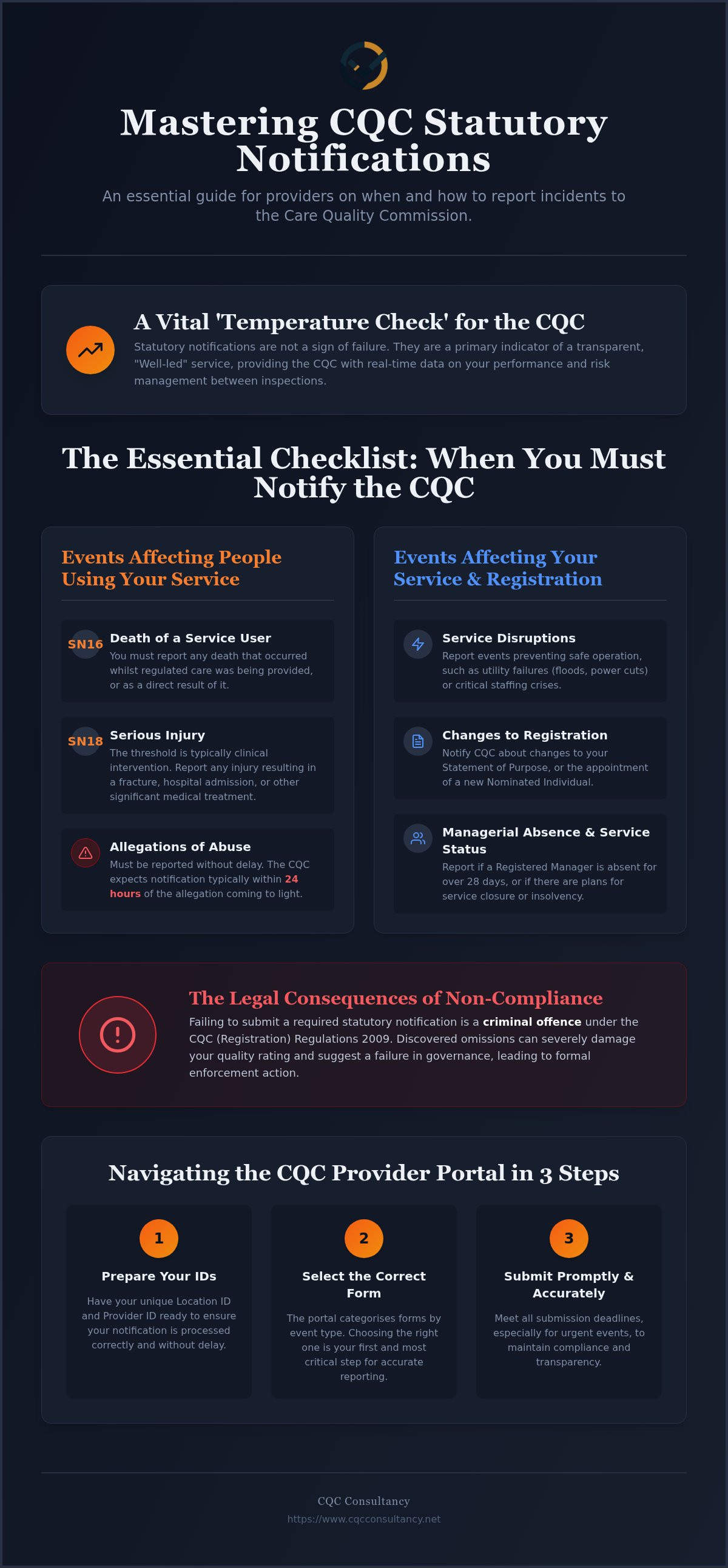
Step-by-Step: Navigating the CQC Provider Portal
The days of paper and Word forms are over. The CQC Provider Portal is now the mandatory platform for submitting statutory notifications. Navigating it efficiently is a key skill for any registered manager or compliance lead.
Set Up Your Account: If you are a new provider or manager, your first step is to register on the CQC Provider Portal. You will receive an invitation to create an account. Ensure you keep your login details secure.
Select the Correct Notification Form: Once logged in, the portal will present you with a list of notification types. It is crucial to select the one that most accurately reflects the event you are reporting (e.g., "Death of a person," "Serious injury," "Change to a registration").
Provide Accurate Details: You will be asked for key identifiers, including your Provider ID and Location ID. Quoting these correctly is vital to ensure the notification is linked to the right service. Double-check all details for factual accuracy before proceeding.
Complete the Form with Care: The forms will guide you through the required information. Provide a clear, factual, and concise summary of the event. Avoid speculation or opinion; stick to the known facts. State what happened, the immediate actions taken to keep people safe, and what you will do next.
Submit and Record the Reference Number: After submitting the form, you will receive an acknowledgement and a unique reference number. It is good practice to save this number in your own internal incident logs for future reference and to track your submission.
Common Pitfalls in the Submission Process
Even with a streamlined digital system, mistakes can happen. The most common pitfall is using old, saved Word forms from a desktop computer; these are no longer accepted and will be rejected. Another significant issue is a lack of factual accuracy within the notification itself. Ensure every statement is verifiable and precise. If the portal is down, you should have a business continuity plan in place. Take a screenshot of the error message, record the time, and contact the CQC's provider contact centre for advice on how to proceed.
Expert Advice for Registered Managers
When writing your incident summary, think like an inspector. They are looking for assurance that you have control of the situation and are taking it seriously. Be clear about the immediate steps you took to mitigate harm and the longer-term actions planned to prevent recurrence. This demonstrates a proactive and well-led approach. Honing your communication skills is an essential part of the manager's role, not just for notifications but for all regulatory interactions. Our expert guidance for the CQC Registered Manager interview can help you develop the confidence to articulate your competence effectively.
Strategic Compliance: Using Notifications to Improve Quality
Viewing statutory notifications solely as a regulatory burden is a missed opportunity. Instead, they should be treated as a valuable source of data that can drive quality improvement and demonstrate a learning culture within your service. By analysing patterns in your notifications—for example, a recurring theme of falls at a certain time of day—you can identify underlying systemic issues that need addressing before they escalate.
This data is also invaluable when preparing for inspections. You can use your notification history to anticipate the questions an inspector might ask and prepare evidence-based answers that show how you have learned and improved. This proactive approach transforms a reactive reporting duty into a powerful tool for demonstrating outstanding governance. The perspective of a former CQC inspector can be invaluable here, helping you to interpret your own data and see your service through the regulator's eyes.
The Value of a Mock Inspection Audit
How can you be certain your internal reporting thresholds align with CQC expectations? A comprehensive mock inspection is one of the most effective ways to audit your compliance framework. During a mock inspection, we often identify "missed" notifications—incidents that should have been reported but were not due to a misunderstanding of the criteria. This process helps you refine your internal incident reporting systems to ensure they are robust and meet CQC requirements, preventing non-compliance before it occurs. A mock inspection provides a safe environment to test and strengthen your processes. For more on this, see our guide to comprehensive CQC mock inspection services.
Building Peace of Mind in a Complex Environment
The pressure on registered managers is immense. Juggling operational demands with complex regulatory duties can be a significant source of stress. The key to building peace of mind is not to avoid incidents—they are an inevitable part of providing care—but to have robust, reliable systems in place to manage them. A clear understanding of statutory notification requirements, combined with a culture of transparency and learning, is fundamental to this. At CQC Consultancy, our goal is to provide the expert guidance and support you need to navigate your regulatory journey with confidence, allowing you to focus on what truly matters: delivering excellent care.
Want an expert to check your compliance? See my CQC mock inspection service.
Frequently Asked Questions (FAQs)
What happens if I forget to notify the CQC about an incident?
Forgetting to submit a legally required notification is a serious breach of regulations and a criminal offence. The CQC may take enforcement action, including issuing a fine or prosecution. It will also negatively impact your inspection rating, particularly under the "Well-led" key question, as it suggests a failure in governance and oversight.
Do I need to notify the CQC every time a resident has a fall?
No, not every fall is a notifiable event. You must notify the CQC only when a fall results in a "serious injury." This requires your professional judgement, but it typically means an injury that requires hospital treatment, results in a permanent change to a person's body, or causes prolonged pain.
How long do I have to submit a statutory notification after an event?
The regulations state that you must notify the CQC "without delay." Whilst not explicitly defined, this is generally understood to mean as soon as is reasonably practical, and typically within 24 to 48 hours of the incident occurring or you becoming aware of it.
Can I still use Word forms to notify the CQC in 2026?
No. The CQC has fully transitioned to its digital Provider Portal for all statutory notifications. Any submissions attempted using old Word or PDF forms will not be accepted. All providers must be registered and use the online system.
Does a high number of notifications automatically trigger an inspection?
Not necessarily. In fact, a healthy number of notifications can indicate a transparent and open culture. The CQC is more concerned by patterns of serious incidents, the nature of the events, and your response to them. A provider with no notifications can be as much of a red flag as one with many, as it may suggest under-reporting.


Comments