Legal Differences: Registered Manager & Nominated Individual

Updated: 5 days ago
If the CQC arrived at your service tomorrow to investigate a regulatory breach, would you know exactly where your personal legal liability ends and your colleague's begins? Understanding the legal difference between a registered manager and nominated individual is essential, yet many leaders feel a sense of trepidation regarding the "Fit and Proper Person" requirements. The pressure is significant, particularly as the commission transitions to sector-specific assessment frameworks by the end of 2026.
This article provides a clear breakdown of the distinct accountabilities under Regulation 6 and Regulation 7, helping you to define operational and strategic roles with confidence. We'll explore how these positions interact within a robust governance structure, the implications for Directors holding dual roles, and how to prepare for the return of structured Key Lines of Enquiry (KLOEs). By establishing clarity now, you can ensure your service remains compliant while protecting your professional standing and providing a steady hand for your team.
Table of Contents
Defining Legal Accountability: Registered Manager vs Nominated Individual
Understanding the legal difference between a registered manager and nominated individual is the first step toward building a resilient governance structure. While the Registered Manager (RM) holds legal responsibility for the day-to-day regulated activity at a specific location, the Nominated Individual (NI) serves as the official link between the provider organisation and the CQC. It's a relationship built on mutual accountability. The Nominated Individual acts as the supervisory guardian of the provider’s compliance obligations. Both roles require individuals to be "fit and proper persons," but their legal duties are defined by separate regulations within the Health and Social Care Act 2008.
The Legal Framework: Regulation 6 and Regulation 7
The CQC enforces a two-tiered system to provide necessary checks and balances. For corporate providers, this separation prevents a vacuum where operational failures go unnoticed by the board. It ensures that the legal difference between a registered manager and nominated individual is maintained through distinct regulatory requirements.
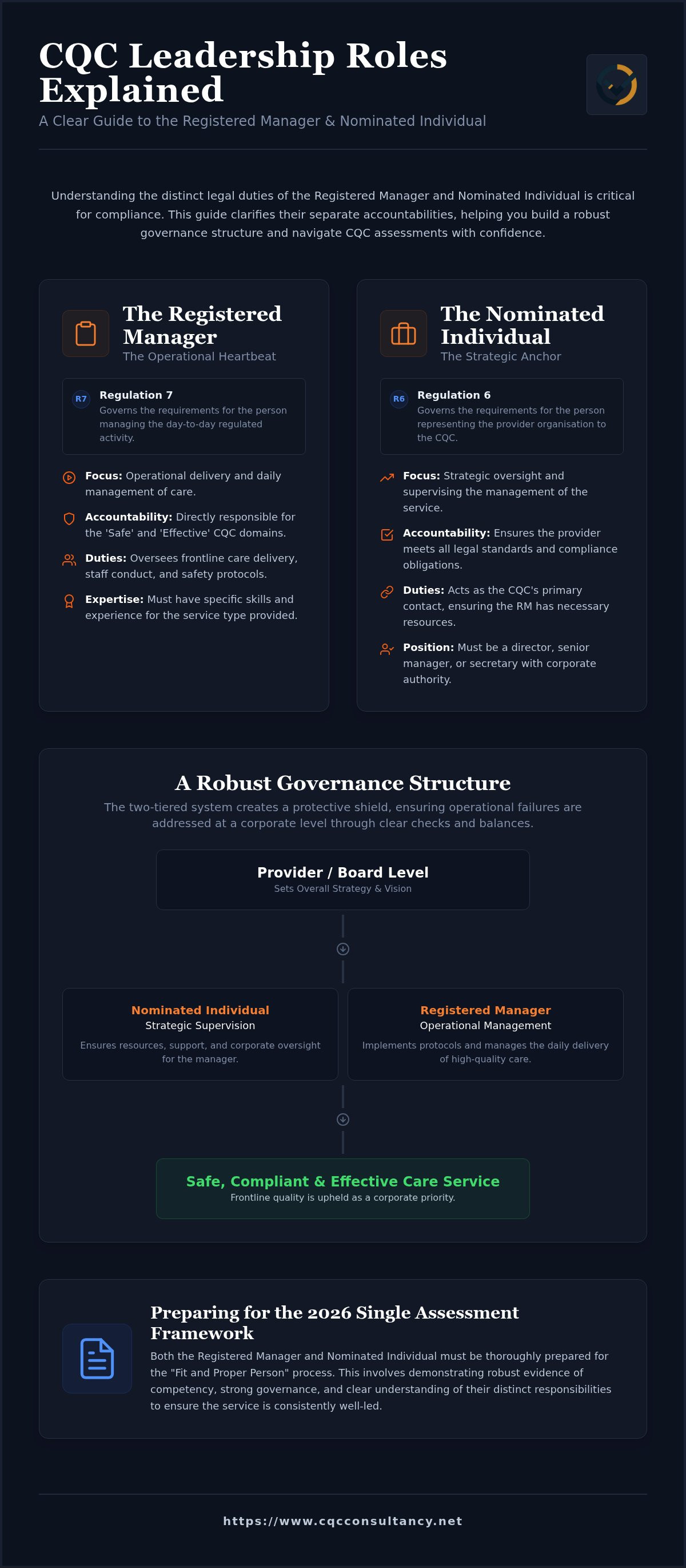
Regulation 6: This governs the Nominated Individual. They must be a director or senior manager with the authority to speak for the organisation. Their primary duty involves supervising the management of the regulated activity to ensure the provider meets all legal standards.
Regulation 7: This focuses on the Registered Manager. They're the person with the skills and experience to manage the service's daily care delivery, staff conduct, and safety protocols.
This regulatory split ensures that the RM isn't left to struggle in isolation. The NI must ensure the manager has the resources, support, and corporate oversight needed to succeed. When these roles function correctly, they create a protective shield for the service, ensuring that quality isn't just a frontline effort but a corporate priority.
The Registered Manager: Operational Responsibility and Regulation 7
The Registered Manager (RM) is the operational heartbeat of any care setting. Unlike the broader strategic role of the provider, the RM is the person whose name appears on the registration certificate for a specific site. This individual holds direct accountability for the "Safe" and "Effective" domains of the CQC Single Assessment Framework. Their remit involves the daily oversight of care delivery, maintaining staff conduct, and ensuring safety protocols are followed to the letter. It's a role that demands specific expertise; the RM must have the skills and experience to manage the specific regulated activity, such as nursing or domiciliary care, to ensure high standards are met.
The legal difference between a registered manager and nominated individual is most apparent in the level of granular detail required. While the NI looks at the "how," the RM owns the "what" of care delivery. If you're feeling uncertain about these distinctions, seeking expert compliance guidance can provide the clarity needed to lead with confidence. By focusing on the meticulous implementation of protocols, the RM ensures that the service remains a safe haven for those it supports.
The Registered Manager Interview: Proving Operational Fitness
Securing registration requires passing a rigorous Fit and Proper Person interview. Inspectors will probe your understanding of safeguarding, whistleblowing, and clinical governance to ensure you can protect vulnerable service users. You'll need to demonstrate a steady hand when managing complex care needs or navigating staff shortages. Preparation is key to showing you possess the required professional poise. For more detailed support, you can review these CQC registered manager interview tips to help you articulate your operational fitness effectively. This process isn't just about answering questions; it's about proving you have the meticulous attention to detail required to maintain a safe environment whilst upholding the dignity of those in your care.
The Nominated Individual: Strategic Oversight and Regulation 6
The Nominated Individual (NI) serves as the strategic anchor of a care organisation. To hold this position, you must be a director, manager, or secretary with the explicit authority to speak on behalf of the provider. Whilst the Registered Manager focuses on frontline delivery, the NI’s primary duty is to supervise the management of the regulated activity. This ensures the RM has the resources, budget, and corporate support required to succeed. The NI ensures Regulation 17: Good Governance is met at a board level by maintaining rigorous oversight systems. Legal liability for corporate failures, such as a lack of investment in safety or failing governance, rests with the NI. Understanding the legal difference between a registered manager and nominated individual helps clarify that the NI is accountable for the "Well-led" framework from a top-down perspective. If you need help defining these boundaries, our CQC registration support provides the expert guidance you need.
Can One Person Hold Both Roles?
Small organisations often ask if a single individual can hold both titles. This is known as the "Individual Provider" exception, where the owner also acts as the manager. While legal, this dual registration carries significant risks. It effectively removes the independent oversight that the CQC values, placing immense pressure on one person during inspections. Under the Single Assessment Framework, the CQC scrutinises dual roles more heavily to ensure that quality isn't compromised by a lack of internal challenge. You'll need to demonstrate how you maintain objectivity whilst wearing two hats. Failing to show a clear distinction between your operational and strategic duties can lead to registration delays or compliance red flags.
Navigating the Single Assessment Framework: Evidence for Both Roles
The 2026 Single Assessment Framework represents a fundamental shift from periodic inspections to a model of continuous evidence collection. This new landscape requires a meticulous approach to documenting compliance every day. The legal difference between a registered manager and nominated individual is highlighted by the specific "Quality Statements" each must satisfy during the assessment process. Whilst the Registered Manager focuses on providing evidence for frontline care delivery, safety protocols, and direct staff feedback, the Nominated Individual must demonstrate corporate oversight. Their evidence typically centres on leadership, organisational culture, and the effectiveness of governance systems. A CQC mock inspection can identify if these roles are working in synergy before a real assessment takes place.
Collaborative Governance: Strengthening the Provider-Manager Relationship
A high-performing service relies on a transparent partnership between the NI and the RM. To satisfy Regulation 17, you should organise regular, formal supervision sessions that are clearly documented. These records serve as vital evidence of strategic oversight, proving that the NI is actively monitoring the manager's performance and the service's safety. Your Statement of Purpose must also be precise, defining these roles with absolute clarity to prevent any regulatory ambiguity. When a breach occurs, the CQC will look for the exact point where governance failed. If the RM lacked resources or the NI lacked oversight, both may face scrutiny under Regulation 17. Engaging CQC consultancy services can help you refine your organisational structure to ensure these boundaries are robust. By aligning your operational and strategic efforts, you create a unified front that satisfies the regulator and provides peace of mind for your entire team.
Secure Your Service's Future through Regulatory Clarity
Establishing a clear boundary between operational management and strategic oversight is more than a regulatory requirement; it's the foundation of a safe, well-led service. Understanding the legal difference between a registered manager and nominated individual ensures that your organisation remains resilient under the scrutiny of the Single Assessment Framework. By aligning Regulation 6 and Regulation 7 duties, you create a robust structure that protects both your staff and those you support.
Preparing for your interview? See my registered manager support.
Navigating these complexities alone can feel overwhelming. With over 12 years of regulatory experience and nationwide compliance coverage, we provide bespoke registration support tailored to your unique needs. We help new providers secure their registration with confidence and precision. Book a call with a former CQC inspector to secure your registration and gain the peace of mind that comes from expert mentorship. You've built your service with care; let us help you protect it with professional poise and a steady hand.
Frequently Asked Questions
Does every care service need a Nominated Individual?
Corporate providers, partnerships, and organisations must appoint a Nominated Individual to act as the legal link to the CQC. Individual providers operating as sole traders don't require this role as they hold direct accountability themselves. For larger entities, this appointment ensures there's a clear point of contact for regulatory matters. It's a mandatory requirement that safeguards the flow of information between the regulator and the board.
Can a Nominated Individual be prosecuted by the CQC?
The CQC can prosecute a Nominated Individual if they fail to meet their legal duties under Regulation 6. This typically occurs when a lack of strategic oversight leads to systemic safety failures or when the provider fails to support the Registered Manager. Understanding the legal difference between a registered manager and nominated individual is vital here. Whilst the manager handles daily care, the NI is legally accountable for the corporate governance.
What is the "Fit and Proper Person Test" for healthcare directors?
Regulation 5 requires all health and social care directors to meet the Fit and Proper Person Test. This assessment ensures that those in control of organisations are of good character, possess the necessary qualifications, and are physically and mentally fit for the role. It prevents individuals with a history of serious misconduct from holding senior positions. The CQC uses this test to ensure leadership remains ethical and capable of maintaining high standards.
What happens if a Registered Manager leaves the service suddenly?
You must notify the CQC immediately if your Registered Manager leaves the service. The Nominated Individual then carries the responsibility for ensuring the service remains safe and compliant whilst a successor is recruited. Failing to have a manager in post for an extended period is a breach of registration conditions. It's essential to have a robust contingency plan in place to maintain continuity of care during these transitional periods.
Is the Nominated Individual higher in rank than the Registered Manager?
Legally, these roles have different scopes of accountability rather than a simple hierarchy. The Nominated Individual is typically a director or senior manager who oversees the organisation's strategic direction. The Registered Manager focuses on the operational delivery of care. Recognising the legal difference between a registered manager and nominated individual helps you understand that both roles are equally critical for compliance. They work as partners to ensure the service is safe. Related reading: CQC registration application support, CQC Registration: Step-by-Step Guide for New Providers 2026.


Comments