Mastering the Registered Manager Fit Person Interview

Updated: 5 days ago
The CQC Fit Person interview isn't a memory test; it's a rigorous demonstration of your leadership values and regulatory ownership. As the Commission shifts toward sector-specific frameworks, your registered manager interview - fit person interview now focuses on 34 quality statements rather than the previous 5 key lines of enquiry. It's completely understandable to feel a sense of trepidation regarding this 60 minute competency assessment, particularly as the CQC now rejects incomplete applications immediately. You want to ensure your professional standing is protected and your service is positioned for success from day one.
This guide provides the expert strategies you need to replace anxiety with steady, professional confidence. By drawing on the internal knowledge of a former inspector, you'll learn how to navigate the Single Assessment Framework terminology and articulate your approach to governance and safety with precision. We will examine the current interview structure and provide the logical roadmap required to secure your Registered Manager status without conditions.
Table of Contents
Understanding the CQC Registered Manager Interview
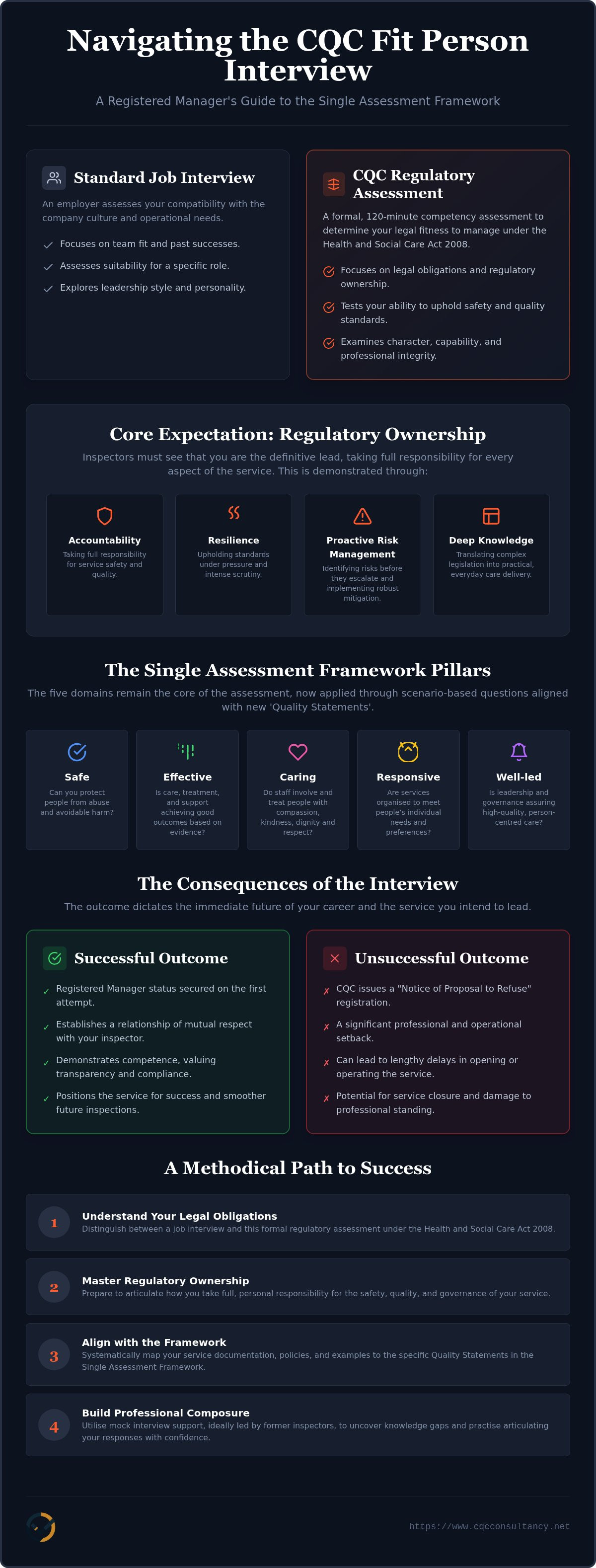
The "Fit Person" interview is a statutory requirement established under the Health and Social Care Act 2008. It serves as a formal gateway to ensure that those leading care services possess the necessary attributes to protect service users. You must recognise that this is not a standard job interview. Whilst an employer focuses on your fit within a company culture, the Care Quality Commission (CQC) conducts a regulatory assessment of your legal fitness to manage. In 2026, these assessments are frequently conducted via secure video platforms, though you may still be invited to a CQC regional office for a face-to-face meeting.
During your registered manager interview - fit person interview, the inspector isn't looking for coached answers or rehearsed scripts. They are assessing your fundamental understanding of the legal responsibilities that come with the role. The CQC's primary objective is to determine if you can maintain high standards of safety and quality whilst operating under intense regulatory scrutiny. You're effectively being tested on your ability to translate complex legislation into practical, everyday care delivery.
Fitness vs. Suitability
There's a critical distinction between being "suitable" for a job and being "fit" for registration. Your employer might believe you're the perfect candidate based on your leadership style or previous successes. However, the CQC focuses specifically on your "character and capability" to oversee a regulated service. They need evidence that you can act as the vital bridge between frontline care and the legal framework. This requires a deep level of professional integrity and a thorough grasp of the Single Assessment Framework. You're not just managing a team; you're safeguarding the rights and lives of those in your care.
The Consequences of the Interview
The outcome of this interview dictates the immediate future of your career and the service you intend to lead. If the inspector isn't satisfied, the CQC will issue a "Notice of Proposal to Refuse" your registration. This legal notice is a significant setback that can lead to lengthy delays and potential service closures. Securing your status on the first attempt is vital for maintaining momentum. Beyond the paperwork, a successful interview establishes a relationship of mutual respect with your inspector. It demonstrates that you're a competent professional who values transparency and compliance, making future inspections a much smoother process.
The Fit and Proper Person Criteria: What Inspectors Seek
Inspectors look for a specific quality during the assessment process: regulatory ownership. This means you must demonstrate that you aren't just a manager in name, but the definitive lead who takes full responsibility for every aspect of the service. Your registered manager interview - fit person interview will delve into your professional history, qualifications, and even your mental and physical health. This scrutiny ensures you possess the resilience required to uphold the CQC Regulations for Service Providers and Managers under pressure. The inspector needs to see that you can identify risks before they escalate and implement robust mitigation strategies whilst maintaining an unwavering standard of care.
Preparation is the only way to remove uncertainty. If you feel unsure about how your specific experience maps to these requirements, seeking bespoke registration coaching can provide the clarity you need to proceed with confidence.
Navigating the Single Assessment Framework
The regulatory landscape has evolved significantly. In 2026, the CQC uses "Evidence Categories" to judge your fitness, moving decisively away from the old KLOE structure. You must align your answers with the new "Quality Statements" to show you're current with modern standards. This shift requires you to articulate how you'll foster a "Well-led" culture from the very first day of your registration. It's about proving that your governance systems are meticulous, transparent, and designed for continuous improvement rather than just basic compliance.
The 5 Key Domains in a Modern Context
The five domains-Safe, Effective, Caring, Responsive, and Well-led-remain the pillars of the assessment, but their application is now more scenario-driven. You might be asked how you'll ensure a "Responsive" service by tailoring care to individual preferences or how you'll maintain "Effective" outcomes through evidence-based practice. Concrete examples are essential here. Don't just quote the regulations; describe the specific audits, staff meetings, or feedback loops you'll use to keep these domains active within your team.
When it comes to the safety of those you support, your role is clearly defined. I will act as the primary guardian of safety by maintaining a culture of transparency where safeguarding concerns are identified early, reported accurately, and managed in strict accordance with the Duty of Candour. This level of precision shows the inspector that you aren't just familiar with the terminology; you're ready to lead with authority.
Core Themes and Potential Interview Questions
Whilst some resources suggest that a basic overview of care is sufficient, a successful registered manager interview - fit person interview requires a nuanced grasp of how specific regulations interact to protect service users. Inspectors prioritise your approach to governance and oversight. They'll want to know exactly how you intend to monitor the quality of your service on a daily, weekly, and monthly basis. You shouldn't just mention that you'll perform audits; you must explain how you'll use the data from those audits to drive continuous improvement and mitigate emerging risks.
Safeguarding remains a high-priority theme, specifically regarding your duties when things go wrong. You'll likely face questions about the Duty of Candour and how you'll ensure a culture of openness within your team. The Fit and Proper Person Criteria establish the legal baseline for your accountability here. You must demonstrate that you can manage a safe and competent workforce through robust recruitment and ongoing supervision. This includes a commitment to equality, diversity, and inclusion, ensuring a fair culture that respects the rights of both staff and service users.
High-Weight Question Categories
Expect detailed questions regarding the Regulated Activities Regulations 2014. Inspectors often use scenario-based queries to test your instincts. They might ask what steps you'd take if a staff member raised a whistleblowing concern or how you'd handle a conflict of interest. It's also vital to articulate your relationship with the Nominated Individual. You need to show that whilst you have autonomy in daily operations, there is a clear line of communication and accountability to the provider's leadership.
Handling "Tricky" Regulatory Topics
Honesty is your greatest asset when discussing past failures or service gaps. If you've managed a service that faced challenges, focus on the lessons learned and the specific actions you took to rectify the situation. This shows the resilience and "regulatory ownership" discussed earlier. You must also prove you understand the Fundamental Standards; these are the levels of care that your service must never fall below. Finally, be ready to discuss your Statement of Purpose with clarity and passion. It's the blueprint for your service, and you must show that you're fully committed to delivering exactly what you've promised on paper.
Step-by-Step Preparation: The Inspector’s Perspective
Preparation for your registered manager interview - fit person interview should be as methodical as the governance systems you intend to lead. Inspectors appreciate a candidate who treats the process with the professional weight it deserves. By adopting an inspector's perspective, you can move from reactive anxiety to proactive readiness. This involves more than just reading through your notes; it requires a deep internalisation of your service's operational DNA. To ensure no detail is overlooked, many successful candidates choose to book a professional mock interview to stress-test their knowledge in a safe environment.
Follow these steps to build a robust foundation for your assessment:
Step 1: Review your application and Statement of Purpose. This document is your contract with the regulator; you must be able to defend every claim made within it.
Step 2: Study the Single Assessment Framework. Understand how the specific Quality Statements apply to your service type, whether you're in home care, a care home, or a clinical setting.
Step 3: Organise your evidence. Have your policies, recruitment files, and training records ready for reference. Even if the interview is remote, knowing exactly where your data sits demonstrates high-level oversight.
Step 4: Practice your "Why". You must be able to articulate your motivation for taking on this legal responsibility with clarity and professional passion.
Step 5: Conduct a mock interview. Identifying gaps in your delivery now is far better than being "caught out" during the actual assessment.
The 30-Day Preparation Countdown
A structured timeline prevents last-minute panic. During Week 1, focus on document review and aligning your current processes with the Single Assessment Framework. In Week 2, perform a deep dive into the Health and Social Care Act 2008 (Regulated Activities) Regulations 2014. Use Week 3 for intensive scenario planning and "Quality Statement" mapping. This phased approach ensures that complex information is broken down into manageable segments without losing its professional weight.
Communication Techniques for the Day
On the day of the interview, use the "STAR" method (Situation, Task, Action, Result) to frame your regulatory examples. This structure helps you remain concise whilst providing the evidence an inspector needs. Maintain professional poise by staying calm and confident; if a question is unclear, it's perfectly acceptable to ask for clarification. Simply say, "To ensure I provide the most relevant information, could you clarify which regulation you're referring to?" This shows authority and a commitment to accuracy rather than incompetence.
Ensuring Success with Professional Mock Interview Support
Self-study and digital toolkits have their place, but they cannot replicate the psychological pressure of a live registered manager interview - fit person interview. A mock interview provides a safe environment to fail, learn, and refine your approach before the legal stakes become real. It's the most effective method for identifying "blind spots" in your governance or safeguarding knowledge that might otherwise lead to a registration refusal. By working with a professional who understands the regulator's mindset, you build the confidence to speak authoritatively about compliance whilst maintaining your professional composure.
CQC Consultancy acts as a steady hand throughout this high-pressure process. We move beyond theoretical advice to provide practical, scenario-based training that mirrors the actual CQC experience. This ensures that you aren't just prepared on paper, but ready to lead a regulated service with genuine regulatory ownership.
The Advantage of Former Inspector Insight
Sitting across from someone who has spent years conducting these assessments offers an unparalleled advantage. You gain insight into the subtle cues and priorities that an assessor looks for during the conversation. This isn't just about the content of your answers; it's about the delivery and the depth of your understanding. You'll receive direct feedback on your communication style and your use of specialised regulatory vocabulary. For more specific advice on handling the day itself, you can explore CQC Registered Manager Interview Tips: Expert Guidance for 2026.
Bespoke Registration Support
Every service is unique, and your preparation must reflect the specific nuances of your care setting. Whether you're leading a Domiciliary Care agency or a specialised Care Home, your responses need to be tailored to the specific risks and quality statements relevant to your service type. We ensure that your documentation perfectly supports your verbal claims, creating a seamless narrative of competence that satisfies the inspector's requirements. This level of meticulousness is what separates a successful registration from one burdened with restrictive conditions. To learn more about our comprehensive approach, see our Professional CQC Consultancy Services: Navigating the Single Assessment Framework in 2026.
Secure Your Professional Future with Confidence
Mastering the registered manager interview - fit person interview requires a deliberate shift in mindset from simple service management to absolute regulatory ownership. You've seen that success rests on your ability to align your operational reality with the Single Assessment Framework; it's about proving you can translate the 2014 Regulations into daily practice. Preparation isn't merely about reading policies; it's about internalising the standards that protect those in your care.
Preparing for your interview? See my registered manager support.
At CQC Consultancy, we provide the steady hand you need to navigate this high-stakes process. With over 12 years of regulatory experience as a former CQC inspector, we offer bespoke support and a mentor-led approach to compliance. Our mock interviews are the ultimate stress-reducer, allowing you to refine your delivery and close knowledge gaps before the assessor arrives. Book a mock interview with a former CQC inspector today to ensure your registration is successful without delays or conditions. You have the expertise to lead; we're here to help you articulate it with poise and precision.
Frequently Asked Questions
How long does a CQC Registered Manager interview usually last?
The assessment typically lasts approximately 120 minutes. This duration ensures the inspector has sufficient time to conduct a rigorous, competency-based assessment of your ability to lead. It's a scenario-driven process that requires you to demonstrate how you'll apply regulations to real-world risks within your service.
Do I need to memorise all the CQC regulations for the interview?
You don't need to recite every regulation verbatim, but you must demonstrate a deep understanding of the Health and Social Care Act 2008 (Regulated Activities) Regulations 2014. The inspector is looking for your ability to implement these standards practically. It's about proving you can translate legal requirements into safe, high-quality care delivery.
What is the "Fit and Proper Person" test in care?
This is a statutory requirement under Regulations 5 and 19 of the 2014 Regulations. It's a formal evaluation of your character, qualifications, competence, and health. The CQC must be satisfied that you're a person of integrity who possesses the professional resilience to oversee a regulated service and protect service users from harm.
Can I have someone with me during the CQC interview?
The interview is almost always conducted on a one-to-one basis to assess your individual fitness. Whilst you might request a silent observer for support in exceptional circumstances, they aren't permitted to answer questions or intervene. The inspector needs to hear your professional voice and witness your personal understanding of the role's responsibilities.
What happens if I fail my CQC Fit Person interview?
If the inspector determines you haven't met the required standards, the CQC will issue a "Notice of Proposal to Refuse" your registration. This is a significant setback that can delay your service's start date or lead to a formal refusal. You'll have a specific period to make representations against this proposal before a final decision is made.
What are the most common questions asked in a Registered Manager interview?
Questions are structured around the five key domains: Safe, Effective, Caring, Responsive, and Well-led. You'll likely face queries regarding your safeguarding procedures, how you'll manage the Duty of Candour, and your specific systems for governance. Inspectors often use scenario-based questions to see how you'd handle staff whistleblowing or service failures.
How does the Single Assessment Framework change the interview process?
The Single Assessment Framework focuses on 24 Quality Statements that replace the previous 34 statements used under the old KLOE system. During your registered manager interview - fit person interview, you'll need to articulate how your leadership aligns with these new statements. The process is now more focused on continuous evidence and your ability to foster a transparent, well-led culture.
Can I record my CQC interview for my own records?
Recording is generally not permitted and is discouraged by the Commission to maintain the integrity of the assessment. If you have a specific need for a recording as a reasonable adjustment for a disability, you must request this in writing well before the interview. It's always best to take thorough notes immediately after the session instead.
Related reading: Registered Manager Interview: Key Questions & Answers.


Comments