Registered Manager Interview: Key Questions & Answers

Updated: 5 days ago
What if the secret to a successful CQC registration isn't just memorising the Fundamental Standards, but demonstrating the leadership narrative that brings them to life? It's entirely natural to feel a sense of trepidation when facing the Fit and Proper Person test, particularly whilst the CQC transitions toward new sector-specific frameworks by the end of 2026. You have likely spent hours worrying about the breadth of the Single Assessment Framework and whether you can recall every detail under the pressure of a formal assessment. Understanding the common questions during registered manager interview stages is the first step toward replacing that uncertainty with a calm, steady confidence.
This guide will help you master this critical milestone by providing expert strategies for demonstrating regulatory compliance and professional suitability. You'll gain access to a clear list of potential questions and learn exactly how to frame your answers to satisfy inspectors' expectations. We provide a preview of the core themes, from safety to being well-led, ensuring you can articulate your vision and walk into your interview feeling like the capable, prepared leader your service deserves.
Table of Contents
Understanding the CQC Registered Manager Interview and the Fit and Proper Person Test
The Registered Manager interview is a pivotal moment in any healthcare leader's career. It serves as a rigorous assessment to verify that you possess the necessary skills and integrity required to lead a regulated service. As the legal lynchpin of your organisation, you are personally responsible for ensuring the delivery of safe, high-quality care. The Care Quality Commission (CQC) uses this process to ensure that those in charge are capable of upholding the standards that protect vulnerable individuals.
In 2026, these assessments are typically conducted through a blend of virtual platforms and face-to-face meetings. Inspectors focus heavily on "intrinsic tasks," which are the core duties you must perform to maintain compliance. They aren't merely looking for textbook answers. They want to see professional competence and a clear leadership narrative. Preparing for common questions during registered manager interview sessions allows you to transition from a nervous candidate to a confident, authoritative leader who can speak fluently about their service.
What is the Fit and Proper Person Requirement?
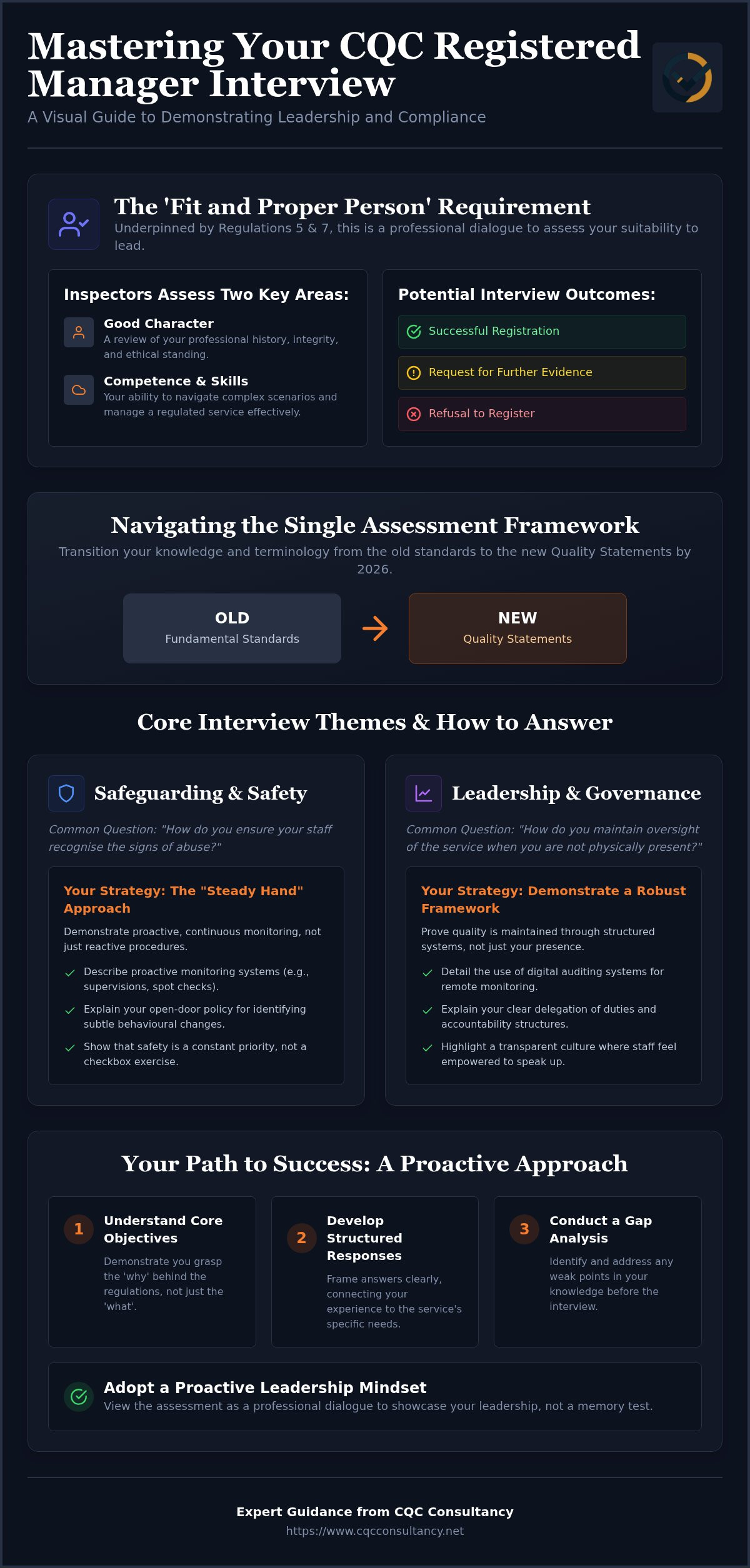
Registration is underpinned by Regulation 5 and Regulation 7 of the Health and Social Care Act 2008. These regulations mandate that individuals with managerial responsibility are suitable for their roles. Inspectors assess your "good character" by reviewing your professional history, whilst "competence" is evaluated through your ability to navigate complex scenarios. It is a professional dialogue designed to ensure you can handle the legal and ethical weight of the position.
The Consequences of the Interview Outcome
The stakes are high. If a manager fails to register, the provider may find itself in breach of legal requirements, which can halt operations for new services. An unsuccessful interview might lead to a "refusal to register," a formal legal notice that can impact your career. Alternatively, an inspector might request further evidence if they feel your knowledge in a specific area is underdeveloped. Mastering the common questions during registered manager interview stages helps you avoid these setbacks and secures your professional standing from the outset.
Core Interview Themes: Common Questions and How to Answer Them
Preparing for the CQC assessment requires more than a simple list of facts; it demands a strategic understanding of how to present your professional expertise. When considering common questions during registered manager interview stages, you must align your answers with the specific needs of your service type. Inspectors look for a narrative that connects your previous experience to the current CQC Registered Manager Requirements. They want to see that you aren't just a manager on paper, but a leader who understands the practical realities of high-quality care delivery.
Effective oversight is another recurring theme throughout the assessment. You'll likely be asked how you organise recruitment, training, and supervision to maintain high standards. Success here lies in demonstrating a meticulous approach to staffing suitability. It's about showing that your systems for continuous improvement are active and integrated into the daily routine of the service. If you feel unsure about how to articulate these complex processes, seeking expert compliance guidance can help refine your delivery and build your confidence.
Safeguarding and Safety Questions
One frequent question is: "How do you ensure your staff recognise the signs of abuse?" To answer this effectively, adopt a "Steady Hand" approach. Instead of merely listing reactive reporting procedures, describe your proactive monitoring. Explain how you use regular supervisions, spot checks, and open-door policies to identify subtle changes in service user behaviour or staff conduct before they escalate into significant risks. This demonstrates that safety is a constant priority rather than a checkbox exercise.
Leadership and Governance Questions
Inspectors often ask: "How do you maintain oversight of the service when you are not physically present?" Your response should focus on the robustness of your governance framework. Detail your use of digital auditing systems, clear delegation of duties, and the cultivation of a transparent culture where staff feel empowered to speak up. This proves that safety and quality are maintained through structured systems and professional accountability rather than just your physical attendance at the site.
Navigating the Single Assessment Framework in Your Interview
The transition to the Single Assessment Framework (SAF) has fundamentally altered the dialogue between candidates and inspectors. While the five key questions—Safe, Effective, Caring, Responsive, and Well-led—remain the bedrock of regulation, the way you provide evidence must now evolve. Inspectors are moving away from tick-box compliance and toward a more holistic view of service performance. Understanding how this framework influences the common questions during registered manager interview stages is vital for anyone seeking to prove their suitability in 2026.
Being "Well-led" is often the most scrutinised area for a prospective manager. It requires you to demonstrate a culture of transparency and continuous improvement rather than just a set of policies. You must show that you are a proactive leader who uses data and feedback to drive change. To ensure your service remains at the forefront of these regulatory shifts, you might consider booking expert-led mock interviews to refine your approach and settle any nerves.
Aligning Your Answers with Quality Statements
The SAF introduces "Quality Statements," often referred to as "we" statements. Using this specific language during your interview builds immediate rapport with the inspector. It signals that you are fully aligned with the CQC’s modern expectations. Instead of simply stating that you follow a policy, explain how "we" ensure safety or how "we" listen to service users. This subtle shift in phrasing demonstrates that the standards are embedded within your team’s daily practice and culture.
Proving Proactive Compliance
A modern management mindset is defined by the ability to learn from incidents and adopt best practices. When asked about challenges, focus on the "Learning from Incidents" evidence category. Describe how you identified a problem, implemented a solution, and monitored the outcome to prevent recurrence. This level of detail shows a sophisticated grasp of governance. For those navigating these complex changes, our CQC consultancy services provide the specialised guidance needed to maintain ongoing readiness and professional confidence.
Preparing for Success: Practical Steps and Expert Support
Achieving success in your registration assessment requires a methodical approach to preparation that goes beyond simply reviewing your notes. You must ensure absolute consistency between your written application and your verbal evidence. Begin by scrutinising your Statement of Purpose and initial application form; inspectors will often use these documents as the basis for common questions during registered manager interview sessions. Any discrepancy between what you have written and what you say can lead to further questioning, so your narrative must feel authentic and well-rehearsed.
Conducting a thorough gap analysis of your own knowledge is the next essential step. Compare your current understanding of the Single Assessment Framework against the latest official guidance to identify any areas where you feel less confident. On the day of a virtual interview, ensure you have key documents at your side for quick reference, such as your training matrix, recent audit summaries, and your business continuity plan. Having these resources within reach provides a sense of security and demonstrates your organised, professional approach to management.
The Value of Professional Mock Interviews
Simulating the pressure of a formal assessment is perhaps the most effective way to identify hidden weak points in your delivery. Our CQC mock inspection services are designed to prepare managers for the specific tone and rigour of a real inspector. Receiving feedback from a former inspector allows you to refine your communication style, ensuring you can navigate common questions during registered manager interview stages with clarity and professional poise.
Final Tips for Interview Day
Managing your nerves is often the final hurdle to clear. It helps to view the inspector as a partner in quality whose goal is to ensure the safety of the service, rather than as an adversary. Approach the conversation as a professional dialogue between two experts committed to high standards. For a structured lead-up to your assessment, explore our CQC Registered Manager interview tips, which offer a 30-day countdown to ensure you are fully prepared for success.
Securing Your Future as a Registered Manager
Navigating the CQC registration process is a significant professional milestone that requires meticulous preparation and a clear leadership vision. By mastering the Single Assessment Framework and understanding how to frame your evidence through Quality Statements, you can transform the interview from a source of anxiety into a platform for your expertise. We have explored how to handle the common questions during registered manager interview assessments, focusing on proactive oversight and the intrinsic tasks that define a well-led service.
Preparing for your interview? See my registered manager support.
Preparation is the bridge between uncertainty and success. With over 12 years of experience as a former CQC inspector, we provide the insider perspective necessary to navigate complex regulatory landscapes with ease. If you want to refine your narrative and approach your assessment with complete peace of mind, book a call with our former CQC inspectors to prepare for your interview. Our expertise in the Single Assessment Framework ensures you have a trusted, high-level advisor by your side throughout the process. You have the skills already; now it's time to demonstrate them with confidence.
Frequently Asked Questions
How long does a CQC Registered Manager interview usually last?
A CQC Registered Manager interview typically lasts between 60 and 90 minutes. This timeframe allows the inspector to explore your professional background, safeguarding knowledge, and leadership vision in sufficient depth. Whilst it might feel like a long duration, the methodical pace is designed to give you ample opportunity to provide comprehensive evidence of your competence and suitability for the role.
Can I have notes with me during the CQC interview?
You are permitted to have notes with you during the interview to use as prompts or for referencing specific data points. It's actually encouraged to have your Statement of Purpose and training matrix nearby for quick reference. However, you should avoid reading from them directly, as the inspector needs to see that your understanding of common questions during registered manager interview stages is deeply embedded rather than just recited from a script.
What happens if I fail the Registered Manager interview?
If you don't meet the required standards during the assessment, the CQC will issue a "Notice of Proposal" to refuse your registration. You have a 28-day window to submit a formal representation against this decision. Failing the interview doesn't just affect your career; it can also prevent the provider from legally operating a new service until a registered manager is successfully in post.
What are the most common reasons for a CQC manager registration to be refused?
Refusals often stem from a lack of specific knowledge regarding the Single Assessment Framework or poor responses to complex safeguarding scenarios. Inspectors frequently cite an inability to demonstrate proactive oversight or a failure to provide evidence-based answers as primary reasons for refusal. Preparing for common questions during registered manager interview assessments helps ensure your answers are precise, authoritative, and perfectly aligned with regulatory expectations.
Is the interview different for new registrations versus existing managers moving to a new service?
The interview process remains fundamentally the same, but the focus shifts toward your suitability for the specific service type and location. If you're an existing manager, the inspector may spend less time on your general history and more on how you'll adapt your leadership style to the new environment. You must still prove your "Fit and Proper" status relative to the unique risks and demographics of the new service location.
Related reading: Mastering the Registered Manager Fit Person Interview.


Comments