Caring Domain: A CQC Compliance Guide for 2026

Updated: 1 day ago
How do you provide tangible evidence of a smile, a gentle touch, or a moment of genuine human connection to a regulatory inspector? It is a challenge that many providers find daunting, particularly as the CQC transitions away from the Single Assessment Framework towards 24 new, sector-specific Key Lines of Enquiry by the end of 2026. You likely feel that your team provides exceptional care, yet the fear of a rating drop persists because kindness feels difficult to document in a way that satisfies an auditor.
We understand that this regulatory shift, including the removal of numerical scoring in favour of qualitative rating characteristics, can feel like moving goalposts. However, it is also an opportunity to showcase the heart of your service. This guide will show you exactly how to demonstrate caring domain CQC requirements by capturing the lived experience of those you support. You'll learn how to move beyond basic policies to create a culture where dignity and person-centred care are evidenced through meaningful I statements and staff observations. We will provide a clear roadmap to help you prepare for your next inspection with absolute composure and professional poise.
Table of Contents
Understanding the Caring Key Question in the Single Assessment Framework
The Caring domain represents the emotional pulse of any care service. Whilst safety focuses on risk mitigation and clinical accuracy, Caring examines the human element: kindness, empathy, and dignity. Under the Single Assessment Framework, the Care Quality Commission (CQC) has shifted its lens from rigid processes to the "lived experience" of service users. This means an inspector isn't just looking for a signed policy; they're looking for tangible proof that the person receiving care feels valued and respected in their daily life.
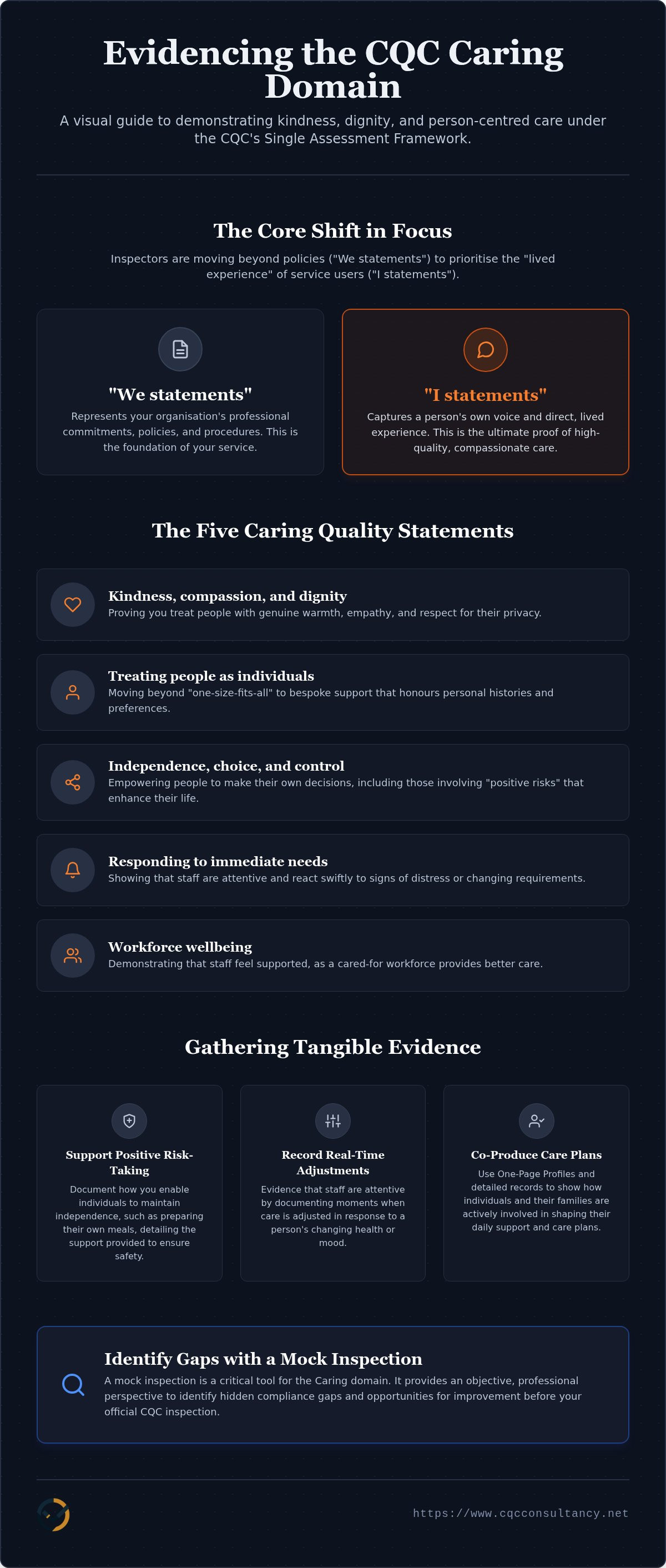
Understanding how to demonstrate caring domain CQC requirements in 2026 involves mastering the relationship between "We statements" and "I statements." The "We statements" represent your professional commitment to quality, but the "I statements" are the person's own voice. If a service user can confidently say, "I am treated with dignity and respect," that carries more weight than a thousand pages of procedural manuals. It's about moving beyond basic safety to provide meaningful emotional support that resonates with the individual.
The Five Caring Quality Statements Explained
The five Quality Statements under the Caring key question provide a structured way to measure compassion as a functional outcome. These statements require you to prove your service excels in the following areas:
Kindness, compassion, and dignity: Treating people with genuine warmth and respecting their privacy at all times.
Treating people as individuals: Moving away from "one-size-fits-all" care to bespoke, person-centred support that honours personal histories and cultural preferences.
Independence, choice, and control: Proving that you empower people to make their own decisions, even when those decisions involve "positive risks" that enhance their quality of life.
Responding to immediate needs: Showing that staff are attentive and react swiftly to signs of distress or changing requirements.
Workforce wellbeing: Demonstrating that staff are supported, as a cared-for workforce is far more likely to provide high-quality care to others.
Why "Caring" is the Heart of Your CQC Rating
A high rating in the Caring domain often acts as a catalyst for overall excellence. It's inextricably linked to the "Well-led" judgement; a leadership team that prioritises a caring culture inevitably fosters better staff retention and higher safety standards. For deeper insights into these regulatory shifts, explore our guide on Professional CQC Consultancy Services: Navigating the Single Assessment Framework in 2026. By focusing on the human connection, you build a service that is both compliant and truly exemplary.
Practical Evidence: Meeting the Five Caring Quality Statements
Translating the principles of the Single Assessment Framework into daily practice requires more than just policy updates. As we move through 2026, the focus remains on how these standards improve lives. When considering how to demonstrate caring domain CQC expectations, you must look beyond the static care plan. Inspectors seek evidence of positive risk-taking. If a service user wishes to maintain their independence by preparing their own meals despite physical frailty, your records should detail the specific support provided to make this safe. This approach demonstrates a profound respect for their autonomy and personal choice.
Agility is equally vital. Evidence of care delivery being adjusted in real-time, perhaps due to a sudden change in health or a person's mood, proves that staff are attentive. You should document these reactive moments as they happen. It shows the service is not merely following a schedule but is actively listening to the people it supports.
Treating People as Individuals
One-Page Profiles serve as excellent physical evidence. They distill complex histories into accessible snapshots of what matters most to the individual. To excel here, you must prove involvement. Keep detailed records of how people and their families co-produce care plans. This ensures that personal histories, cultural needs, and specific preferences are not just noted but are actively used to shape daily support. When a care plan reflects a person's specific cultural heritage or a lifelong hobby, it provides undeniable proof of person-centred care.
Supporting Workforce Wellbeing and Enablement
A team that feels cared for is naturally more inclined to care for others. This is a significant factor in achieving a high Caring rating. Shift your supervision focus from simple task completion to emotional resilience. Documentation should show that staff are empowered to advocate for the people they support, even if that means challenging established routines. Evidencing staff training in empathy and active listening provides the foundation for a compassionate culture. If you're unsure if your current documentation meets these shifting standards, our compliance guidance can help bridge the gap. We ensure your team has the tools to evidence their kindness with precision and confidence.
Collecting Robust Evidence Across the Six Categories
The CQC's transition to six evidence categories requires a multi-faceted approach to data collection that moves beyond simple digital logs. To understand how to demonstrate caring domain CQC standards effectively, you must gather evidence that reflects the lived reality of your service. Start with Category 1: People’s experience. Authentic, unprompted testimonials often provide the most compelling proof of kindness. Similarly, Category 2 involves staff and leader feedback. Surveys that reflect a genuine culture of compassion among your team are essential. Don't overlook Category 3, which focuses on partner feedback. What GPs or social workers say about your team's empathy and professional conduct is highly influential. Finally, Category 4 relies on direct observation. Preparing your team for the Short Observational Framework for Inspection (SOFI) ensures they remain composed and person-centred during an inspector's walk-around.
Mastering the Art of Feedback
Effective feedback systems are the backbone of a Caring rating. Organise regular resident and relative meetings, but ensure you produce actionable minutes that show clear follow-up. Using "You Said, We Did" boards provides a visible, transparent record of your responsiveness to those you support. It's also vital to capture feedback from diverse groups. If individuals face communication barriers, use pictorial tools or independent advocates to ensure their voices are heard and documented. This level of thoroughness proves that you value every person's input equally.
Documentary Evidence and Audits
While digital care records are helpful, they shouldn't be your only source of truth. Conduct regular internal Caring Audits to identify cultural or procedural gaps before an official visit. These audits should include environmental checks to evidence how privacy and dignity are maintained in physical spaces, such as during personal care or in communal areas. For those seeking a deeper, professional evaluation, Mock Inspections for Care Homes: Identifying Critical Gaps offer a simulated regulatory assessment that mirrors an inspector's scrutiny. If you want to ensure your evidence is robust enough for the 2026 landscape, our bespoke compliance guidance can help you secure your service's future with confidence.
Identifying Gaps: Why a Mock Inspection is Critical for the Caring Domain
Managers often face a "blind spot" when assessing their own service. Because you're immersed in the daily culture, subtle failings in dignity or person-centred care can become invisible over time. A mock inspection provides an objective, external lens, allowing you to see your service exactly as an auditor would. This is essential for understanding how to demonstrate caring domain CQC standards during a real site visit, where small, unnoticed habits can lead to an unexpected rating drop.
Simulating the inspector’s walk-around helps spot dignity issues in real-time. Perhaps a staff member forgets to knock before entering a room, or personal care items are left in plain sight. These are the red flags that signal a lack of caring to an inspector. Stress-testing staff interviews is equally vital. Many carers provide exceptional support but struggle to articulate their behaviour under the pressure of a formal interview. A mock audit gives them the practice needed to speak confidently about their values and the impact of their work.
The Value of a Former Inspector’s Perspective
With over 12 years of CQC inspection experience, our team understands the nuanced differences between "Good" and "Outstanding" care. While "Good" care is consistent and safe, "Outstanding" care is often defined by its innovative, person-led approach and exceptional responsiveness. We help you refine your evidence to reach that higher tier, offering a methodical review that provides peace of mind. Our simulated regulatory assessments remove the element of surprise, ensuring your documentation and culture are aligned with 2026 expectations.
Preparing for Your Site Visit
The transition from a mock audit to a real inspection should be handled with a clear, time-bound action plan. Identifying gaps is only the first step; closing them requires deliberate leadership and staff engagement. By addressing findings from a simulated assessment, you empower your Registered Manager with the confidence to lead the inspection process effectively. For more support on leadership preparation, see our CQC Registered Manager Interview Tips: Expert Guidance for 2026. This preparation ensures that when the regulator arrives, your team can show how to demonstrate caring domain CQC requirements with poise and professional authority.
Securing Your Service’s Future with Confidence
Success in the Caring domain is no longer about static policies; it’s about evidencing a culture where dignity and person-centred care are felt by every individual. You now have a strategic roadmap for how to demonstrate caring domain CQC standards by capturing authentic feedback and prioritising workforce wellbeing. By shifting your focus to the lived experience of those you support, you move beyond mere compliance toward true excellence.
Want an expert to check your compliance? See my CQC mock inspection service.
To ensure your evidence stands up to the highest level of scrutiny, book a professional CQC Mock Inspection to stress-test your Caring domain evidence. Our simulated assessments are led by a former CQC inspector with over 12 years of experience, offering specialised support for care homes, GP practices, and home care providers. We provide comprehensive reports that mirror real CQC findings, identifying critical gaps before an official visit occurs. With this level of meticulous preparation, you can approach your next inspection with absolute poise. Your commitment to high standards deserves to be recognised, and we're here to help you showcase the heart of your service with clarity and pride.
Frequently Asked Questions
How does the CQC assess the Caring domain under the new framework?
The CQC assesses the Caring domain by triangulating data across six specific evidence categories, with a primary focus on the "lived experience" of service users. They look for consistency between your stated policies and the actual feelings of the people you support. Understanding how to demonstrate caring domain CQC requirements involves proving that kindness is a constant cultural trait, evidenced through direct observation and authentic feedback rather than just static manuals.
What are some examples of evidence for the "Kindness, compassion and dignity" statement?
Tangible evidence includes unprompted testimonials, thank-you cards, and detailed records of staff-led advocacy for service users. Inspectors also value documented observations of staff respecting privacy, such as knocking on doors or using preferred names. These small, recorded interactions provide concrete proof that dignity is woven into the daily routine. Capturing these moments in real-time ensures your evidence folder reflects a genuine culture of respect.
Can I get an "Outstanding" in Caring if my paperwork is not perfect?
An "Outstanding" rating is achievable even with minor paperwork gaps if the culture of care is demonstrably exceptional and person-led. The CQC prioritises the quality of human interaction and the person's voice over administrative perfection. However, your records must still clearly evidence that care is bespoke and that you've acted on individual preferences. Consistency in your "I statements" from residents often outweighs minor clerical errors in the inspector's final judgement.
How do I prove that my staff are enabled and well-supported?
You can prove staff enablement through supervision records that prioritise emotional support and professional development over simple task completion. Showcasing staff surveys and evidence of internal advocacy, where carers have successfully influenced care plan changes, demonstrates a supported workforce. A cared-for team is fundamentally more capable of delivering the compassion required for a high Caring rating. This approach proves that leadership values the wellbeing of those delivering the care.
What happens if a resident gives negative feedback about staff attitudes during an inspection?
Negative feedback is treated as a potential risk that the CQC will investigate by triangulating it with staff interviews and direct observations. If this occurs, you should demonstrate your responsiveness by showing how you've addressed similar feedback previously through your "You Said, We Did" boards. This proves you have a transparent, learning culture. It shows the inspector that you don't ignore concerns but use them to drive professional improvement.
How often should I conduct a mock inspection to ensure Caring standards are maintained?
Conducting a mock inspection at least once a year is a prudent way to maintain high standards and identify cultural blind spots. It's particularly beneficial ahead of the 2026 regulatory changes or following a change in your Registered Manager. Regular simulated assessments ensure your team remains confident in how to demonstrate caring domain CQC expectations. These sessions provide the practice needed to articulate caring behaviours clearly under the pressure of a real audit.
Related reading: Free CQC Mock Inspection Checklist: 100 Checks and an Action Plan, What Are the CQC Fundamental Standards?.
Want to talk it through? Book a free 15-minute call


Comments