10 Things a Former CQC Inspector Looks For During Inspections

Updated: 1 day ago
As a former CQC inspector with over 12 years of regulatory experience, I understand the anxiety that builds when a site visit is imminent. The central question for every Registered Manager is, "What does an inspector actually look for when they walk through the door?" It’s a question that goes far beyond ticking boxes on a checklist.
The answer isn't about perfectly filed paperwork; it's about observing the 'golden thread' of a safe, effective, and caring culture that runs through every interaction and process. Under the Single Assessment Framework, this focus on continuous, demonstrable quality is more important than ever. An inspector's job is to find the evidence that proves your service lives its values, not just states them in a policy document.
This article provides an insider's perspective, moving past the theory and into the practical realities of an inspection. Here are the 10 critical areas I scrutinise to distinguish a truly 'Good' or 'Outstanding' service from one that merely meets the minimum standard.
Table of Contents
The 10 Things I Look For on an Inspection as a Former CQC Inspector
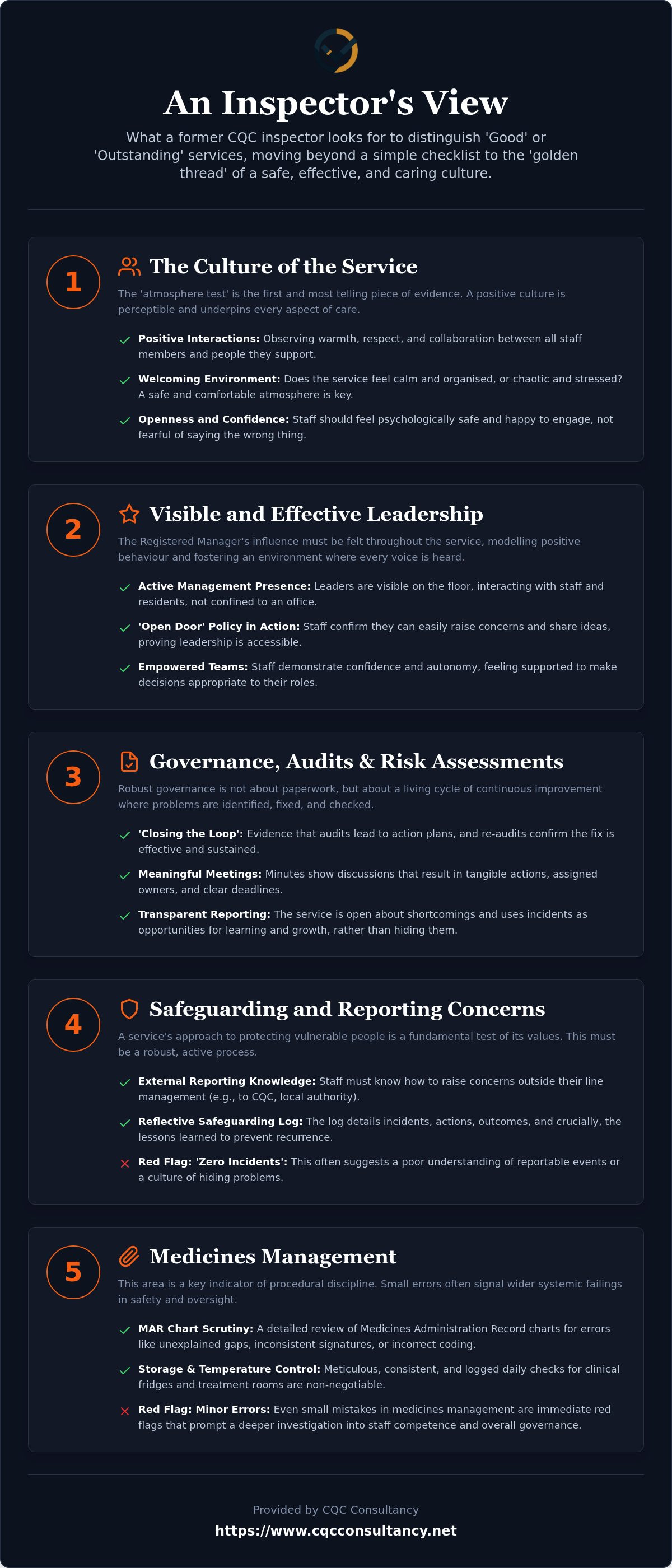
An inspection is a holistic assessment, but my focus always crystallises around these ten interconnected areas. They provide a comprehensive picture of a service's performance, from leadership and governance to the lived experience of the people in your care.
1. The Culture of the Service
Before I look at a single file, I perform what I call the 'atmosphere test'. Culture is the invisible evidence that tells me almost everything I need to know. It’s perceptible from the moment I enter the building.
Staff Interactions: How do staff speak to each other and to the people they support? Is there warmth, respect, and collaboration, or do I sense tension and a rigid hierarchy? Body language, tone of voice, and unprompted positive interactions are powerful indicators of a healthy workplace.
The Feel of the Environment: Does the service feel calm and organised, or chaotic and stressed? A positive culture translates into a welcoming environment where people feel safe and comfortable.
Engagement and Openness: Are staff members happy to engage with me, or do they seem hesitant or fearful? An open culture is one where the team feels psychologically safe and confident in their work, rather than worried about saying the wrong thing.
A toxic or fearful culture is a concern because it almost always correlates with poor outcomes in safety and care. It suggests that problems are hidden rather than addressed.
2. Visible and Effective Leadership
Strong leadership is the bedrock of a well-led service. A Registered Manager's influence should be felt throughout the service, not confined to an office.
Management Presence: Is the manager a visible, active presence, or just a name on a certificate? I look for leaders who are on the floor, interacting with staff and residents, and modelling the positive behaviour they expect from their team.
The 'Open Door' Policy in Action: It's one thing to have an open-door policy; it's another to see it working. During spontaneous conversations, I often ask junior staff members how they raise concerns or share ideas. Their answers reveal whether leadership is truly accessible and approachable. An effective leader fosters an environment where every voice is heard.
Empowerment, Not Micromanagement: I observe whether staff feel empowered to make decisions appropriate to their roles. A sign of excellent leadership is a team that demonstrates confidence and autonomy, secure in the knowledge that they have their manager's support. For more on this, see our guide on the key questions a Registered Manager must be prepared for.
Visible leadership directly correlates to the 'Well-Led' quality statement by demonstrating a clear line of sight from the service's vision to its frontline delivery.
3. Governance, Audits, and Risk Assessments
Robust governance isn’t about creating paperwork; it’s about creating a cycle of continuous improvement. I look for evidence that your systems are active, not static.
'Closing the Loop' in Audits: Showing me a completed audit is not enough. I want to see the complete cycle: you identified a problem, you created and implemented an action plan to fix it, and you re-audited to ensure the fix was effective and sustained. This demonstrates a learning culture. I will also want to know if your audits are considering evidence based guidelines such as the National Institute for Health and Care Excellence (NICE).
Meaningful Meetings: Governance meetings should be more than a talking shop. I scrutinise meeting minutes to see if discussions lead to tangible actions with assigned owners and deadlines. An audit trail that shows resolved issues is compelling evidence of effective governance.
Transparent Reporting: How does the service handle things when they go wrong? A well-led service is transparent about its shortcomings and uses them as opportunities for growth. Hiding or downplaying issues is a major concern.
4. Safeguarding and Reporting Concerns
Keeping people safe is the absolute priority. A service's approach to safeguarding reveals its fundamental values and its ability to protect the vulnerable.
Staff Knowledge and Confidence: I test staff understanding of safeguarding procedures. Crucially, I ask if they know how to raise a concern outside of their immediate line management, such as directly to the CQC, the local authority, or a whistleblowing charity. This tests whether the safeguarding culture is truly robust.
A Reflective Safeguarding Log: The safeguarding log must be up-to-date and meticulously maintained. It should not only document incidents but also detail the actions taken, the outcomes, and, most importantly, the lessons learned to prevent recurrence.
Learning from Incidents: A service that reports 'zero incidents' is often something for follow up. It can suggest a lack of understanding of what constitutes a reportable event or, worse, a culture of sweeping problems under the carpet. I look for evidence that lessons from incidents are shared across the entire team to improve practice collectively.
5. Medicines Management
Medicines management is a key indicator of procedural discipline and attention to detail. Small errors here often point to wider systemic failings in safety and governance.
Emergency Medicines and Equipment: I conduct a detailed review of the emergency medicines available in the practice. I will expect to see that the practice has considered the guidance on the Resuscitation Council UK website. For any drugs not stocked, then a clear risk assessment should be in place.
Storage and Temperature Control: Meticulous checking of temperature logs for clinical fridges and treatment rooms is non-negotiable. I look for consistent daily checks and evidence of action being taken if temperatures fall outside the required range. This simple check is a powerful proxy for the service's overall procedural reliability.
Competency and Training: I will ask to see staff training records for medicines administration and will often speak to staff to assess their understanding of protocols for controlled drugs, homely remedies, and medication refusal.
6. Infection Prevention and Control (IPC)
Effective IPC is a visual and practical assessment. It's about observing ingrained habits and a well-maintained environment, not just looking at a policy document.
Observed Practice: I watch staff during their daily routines. Are they using personal protective equipment (PPE) correctly? Is hand hygiene performed diligently between interactions? These moments of observation provide irrefutable evidence of whether IPC training has been embedded into everyday practice.
Environmental Cleanliness: I assess the general state of cleanliness and repair, paying close attention to high-touch areas, clinical rooms, and equipment. A clean and well-maintained environment is a prerequisite for effective infection control.
Knowledge of Policies: I may ask staff about specific IPC policies, such as the management of an infectious outbreak or the correct procedure for waste disposal, to confirm that knowledge underpins their practice.
7. Risk Management and People's Safety
This area focuses on how a service proactively identifies and mitigates risks to keep people safe from harm in their daily lives.
Matching Logs to Reality: I look at maintenance logs for essential equipment—such as hoists, fire alarms, or nurse call systems—and then I check the equipment on the floor. Do the dates match? Is the equipment in good working order? Discrepancies suggest that your safety systems are a paper exercise, not a practical reality.
Individual Risk Assessments: I review individual care plans to see how specific risks (e.g., falls, malnutrition, pressure sores) are identified, assessed, and managed. These assessments must be personalised, regularly reviewed, and updated when a person's needs change.
Environmental Safety: I walk through the premises looking for environmental hazards. This includes checking for clear fire exits, safe flooring, secure windows (where appropriate), and legionella testing records.
8. Person-Centred Care, Dignity, and Choice
This is where I assess the 'Caring' and 'Responsive' elements of your service. It's about looking beyond the clinical tasks to see the individual.
Genuine Choice and Control: I observe interactions to see if people are given genuine options or are simply being 'processed' according to a rigid staff schedule. This can be as simple as asking what they would like to eat, when they would like to get up, or what activities they wish to participate in.
The Small Things That Signal Dignity: Dignity is demonstrated in the details: staff knocking on bedroom doors and waiting for a response, using a person's preferred name, ensuring privacy during personal care, and speaking to people with respect and not condescension.
Personalised Care Plans: I look for care plans written in 'person-centred' language. They should reflect the individual's history, preferences, favourite activities, and what is important to them, not just their clinical needs. A truly exceptional service uses this information to shape the care it delivers. For a deeper dive, explore our guide to the CQC's Caring domain.
Mental Capacity Act (MCA): I check that 'best interests' decisions are specific to the decision being made, not generic, and that the process is properly documented with evidence of involving family or advocates.
9. Staff Knowledge, Competence, and Practice
A service is only as good as its staff. I need to see that your team is not only trained but is competent and supported to perform their roles effectively.
Linking Training to Practice: I review the staff training matrix, but more importantly, I look for evidence that this training translates into competent practice. I might ask a care worker how their recent dementia training has changed the way they support a resident.
Supervision and Appraisals: I will ask to see records of staff supervision and appraisals. These should be meaningful conversations that support professional development and address any performance issues, not just a tick-box exercise.
Confidence in Role: When I speak with staff, I am assessing their confidence and competence. Do they understand their responsibilities? Can they articulate the needs of the people they care for? A well-supported and knowledgeable workforce is one of your greatest assets.
10. People's Experience, Feedback, and Complaints
How a service listens and responds to the people it serves is a powerful indicator of its values and commitment to quality.
Accessible Complaints Process: Is the complaints policy easy to find and understand for people with different communication needs? I look for evidence that you make it simple and safe for people to raise concerns without fear of reprisal.
Learning from Feedback: How a service treats a disgruntled family member or responds to a minor complaint tells me everything. I look for specific examples where the service has changed a process or improved care based on a single piece of negative feedback.
Gathering Experience Proactively: Beyond complaints, I look for how you proactively gather feedback through surveys, resident meetings, or family forums. More importantly, I want to see how you analyse this feedback and use it to drive tangible improvements.
Turning These Insights into Action for Your Next Inspection
Understanding what an inspector looks for is the first step. The next is to use that knowledge to prepare your service, not just for a one-off visit, but for a state of continuous readiness under the Single Assessment Framework.
The Framework shifts the CQC's focus from 'snapshot' inspections to gathering evidence on an ongoing basis. This means the 10 points discussed above need to be embedded in your daily operations, ready to be evidenced at any time. Your internal audits and quality assurance processes should be viewed through the same lens an inspector would use.
The Role of Mock Inspections in Identifying Gaps
Internal audits are essential, but they often miss the subtle cultural cues or systemic weaknesses that a fresh, independent eye can see. An internal perspective can develop 'blind spots' to issues that have become normalised over time.
A mock inspection conducted by a former inspector simulates the pressure and methodology of a real CQC visit. It provides an objective, rigorous assessment of your service against the 10 key areas, identifying vulnerabilities before the regulator does. This process gives you a clear, actionable roadmap for improvement and builds the confidence of your entire team. Seeing your service through an inspector's eyes is the most effective way to prepare. Learn more about our comprehensive CQC mock inspection services and how they can ensure you are ready.
Navigating the Single Assessment Framework
The 10 points I've outlined map directly across the 34 new Quality Statements within the Single Assessment Framework. For example, 'Visible and Effective Leadership' provides evidence for the 'Governance, management and sustainability' quality statement, while 'Person-Centred Care' aligns with 'Equity in experience and outcomes'.
Want an expert to check your compliance? See my CQC mock inspection service.
Organising your evidence around these themes will make an inspector's job easier and their report more favourable. Understanding how your daily operations translate into evidence for each quality statement is key. If you need support in this area, our professional CQC consultancy services can help you align your practices with the new regulatory model, ensuring your registration remains robust.
Frequently Asked Questions
What are the most common 'red flags' a CQC inspector looks for? Common red flags include poor medicines management, a palpable negative atmosphere amongst staff, a lack of visible leadership, inconsistent or incomplete records (especially MAR charts and safeguarding logs), and a defensive response to feedback or questions.
How has the CQC Single Assessment Framework changed site visits? Site visits are now just one of several ways the CQC gathers evidence. They are more focused and are used to verify or follow up on evidence collected through other means (like provider submissions and feedback). The focus is less on a single 'inspection day' and more on a continuous assessment of quality.
Can a former CQC inspector help us improve our rating from 'Requires Improvement'? Absolutely. A former inspector can provide an objective and expert analysis of why your service received its rating. They can identify the root causes of non-compliance and help you create a robust, evidence-based action plan to drive sustainable improvement and prepare for re-inspection.
What should a Registered Manager prioritise on the morning of an inspection? On the morning of an inspection, the priority should be to remain calm and ensure the service runs as normally as possible. Brief your senior team, ensure key documents are accessible, but most importantly, be present and available to the inspector. Your main job is to facilitate their access to the evidence they need, not to stage a performance.
How much weight does the CQC give to staff interviews during a visit? Staff interviews are given significant weight. They are a primary method for triangulating evidence. What a manager says in an interview, what a policy document states, and what a staff member describes from their own experience should all align. Inconsistent accounts are a major red flag for an inspector.
Related reading: What Are the CQC Fundamental Standards?, CQC Inspection Compliance Checklist: Prepare with Confidence.
Want to talk it through? Book a free 15-minute call


Comments