Fire Safety Checks in Primary Care: A Compliance Guide
Updated: 1 day ago
Could a single administrative oversight in your fire logbook be the difference between an 'Outstanding' and a 'Requires Improvement' CQC rating? It's a common anxiety for practice managers who find themselves caught between demanding clinical duties and the complex requirements of the Regulatory Reform Order. You likely recognise that maintaining consistent records for fire risk assessments and fire safety checks in primary care is vital, yet finding the time to move beyond a simple tick-box exercise is often a significant challenge. This guide promises to clarify those confusing regulatory overlaps, helping you master the essential protocols required to secure your practice and satisfy CQC inspection criteria. We'll examine the specific duties of the 'Responsible Person', provide a framework for robust daily and weekly checks, and build the professional confidence you need to ensure your documentation stands up to the most rigorous scrutiny, leaving you prepared for any upcoming mock inspection.
Our FREE fire safety checklist below should help you remain compliant!
Table of Contents
Fire Safety Regulations in Primary Care: The CQC Connection
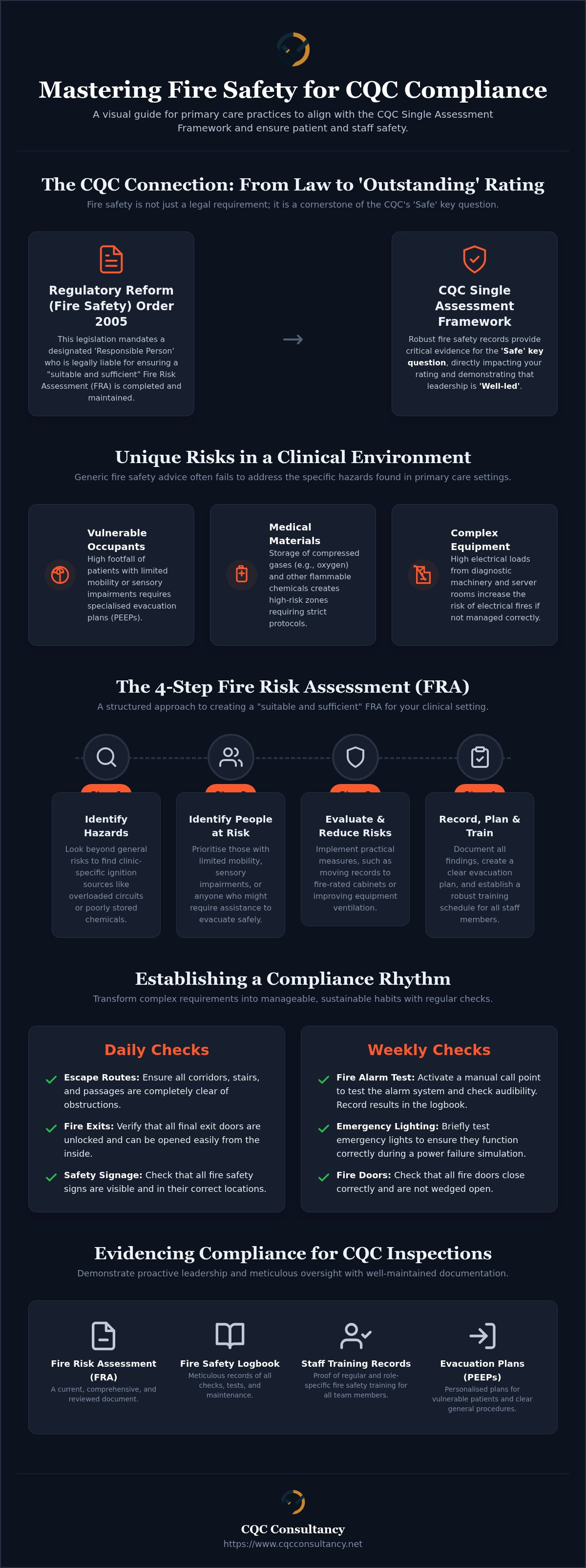
The legal landscape for GP practices is anchored by the Regulatory Reform (Fire Safety) Order 2005. This legislation mandates that every practice identifies a 'Responsible Person', typically a practice manager or senior partner, who holds legal liability for the building's safety. It's their duty to ensure that fire risk assessments and fire safety checks in primary care are comprehensive and current. Neglecting these duties doesn't just invite CQC warning notices; it can lead to legal prosecution and significant financial penalties.
The Single Assessment Framework and Fire Safety
Within the CQC's Single Assessment Framework, fire safety is a cornerstone of the 'Safe' key question. It provides vital evidence for the 'Safe Environments' quality statement, demonstrating that your premises are fit for purpose. Inspectors don't just want to see a dusty folder; they want proof of active oversight. Robust fire records serve as a proxy for 'Well-led' management, showing that leadership prioritises the physical security of both staff and patients.
Why General Fire Guidance Often Fails GP Practices
Standard commercial fire advice often misses the nuances of a clinical environment. Surgeries manage unique risks, such as:
High patient footfall including those with limited mobility or sensory impairments.
Storage of compressed medical gases, such as oxygen.
Complex layouts with multiple treatment rooms and restricted access areas.
Generic templates rarely account for these variables. This is where professional CQC consultancy services offer a distinct advantage. They move beyond basic compliance to provide a bespoke strategy that addresses the specific hazards found in primary care settings, ensuring your practice remains a safe haven for everyone who enters.
Conducting a Robust Fire Risk Assessment (FRA) in a Clinical Setting
A "suitable and sufficient" FRA is the bedrock of your safety strategy. According to government guidance on healthcare fire safety, the process must be bespoke to the clinical environment. When conducting fire risk assessments and fire safety checks in primary care, you should follow a structured four-step approach to ensure nothing is missed. This methodical progression moves from identifying hazards to documenting a living safety plan.
First, identify hazards. In a GP surgery, this means looking beyond generic risks to find clinic-specific ignition sources. Second, identify people at risk, specifically prioritising patients with limited mobility or sensory impairments who may be in the building. Third, evaluate and reduce these risks. For example, moving combustible medical records to fire-rated cabinets significantly lowers the fuel load. Finally, record your findings and establish a clear training schedule for all staff members to ensure everyone knows their role during an emergency. Alternatively, you may choose to appoint a professional company, such as Bison , to complete your fire risk assessment. This can give you confidence that potential fire risks have been properly identified and appropriate control measures recommended.
Identifying Clinical-Specific Fire Hazards
Clinical spaces present unique challenges that standard fire advice often ignores. Oxygen cylinders and flammable chemicals in treatment rooms create high-risk zones that require strict storage protocols. You also need to manage the substantial electrical load from diagnostic machinery and server rooms. Overloaded circuits or poorly ventilated equipment can easily lead to smouldering fires. If you're unsure about your current hazards, a compliance mock inspection can provide the clarity needed to rectify hidden issues before they become a risk.
Developing a Primary Care Evacuation Plan
Evacuation in primary care isn't a one-size-fits-all procedure. Many practices operate out of converted residential buildings with narrow corridors or non-standard escape routes. Your plan must include Personal Emergency Evacuation Plans (PEEPs) for known vulnerable patients who visit regularly. It's not just about getting people out; it's about ensuring the most vulnerable are supported through clear, unobstructed routes. Regular drills help staff internalise these paths, turning a complex procedure into a calm, instinctive response during a crisis.
Essential Fire Safety Checks: Establishing a Compliance Rhythm
Consistency is the heartbeat of compliance. To move beyond mere "box-ticking", your practice needs a rhythmic schedule of inspections that staff can follow instinctively. Daily checks must ensure that fire exits remain completely unobstructed and final exit doors operate smoothly without sticking. Each week, test your fire alarms from different call points on a rotating basis and verify that emergency lighting batteries are functional. Every month, the focus should shift to the physical condition of fire extinguishers, the integrity of fire door seals, and the completeness of first-aid kits. Finally, ensure annual professional servicing for all equipment and conduct a full review of your fire risk assessments and fire safety checks in primary care to account for any clinical or structural changes.
Maintaining the Fire Safety Logbook
A missing signature in a logbook is more than a minor administrative gap; to a CQC inspector, it's a red flag indicating a lack of oversight. Whether you use a paper-based system or a digital platform, transparency is paramount. Digital logbooks often provide better audit trails and automated reminders, ensuring that your records remain flawless even during busy clinical periods. The 'Responsible Person' must ensure these records are always accessible for immediate review. See our FREE fire safety logbook to help you manage this.
Staff Training and Fire Drills
Annual fire safety training is a mandatory requirement for every member of the team, from senior partners to part-time receptionists. While full evacuations are necessary, you can conduct meaningful drills without causing distress to patients by scheduling them during quieter periods or lunch hours. Clear communication is key to maintaining a calm environment. If you're concerned about how your documentation or training records might appear under scrutiny, our compliance guidance can help you refine your processes and build the necessary evidence for a successful inspection.
Beyond the Checklist: Evidencing Fire Safety for CQC Inspections
Presenting your documentation during a CQC site visit is an opportunity to showcase proactive leadership. It's about telling a story of continuous oversight rather than just proving existence. When discussing your fire risk assessments and fire safety checks in primary care, explain the "why" behind your processes. Your Statement of Purpose should explicitly reflect your commitment to a safe clinical environment, ensuring that your high-level strategy aligns perfectly with the granular records found in your logbooks. This consistency provides inspectors with the assurance that safety is woven into the fabric of your practice.
Common Pitfalls in GP Fire Safety
Many surgeries suffer from "compliance drift", where routine checks are inadvertently skipped during periods of high clinical demand. Simple errors, such as wedged-open fire doors or inadequate signage in shared healthcare centres, are frequent triggers for lower ratings. These administrative oversights suggest a lack of management oversight to an inspector. Maintaining a meticulous eye on these physical details is essential to prevent small habits from becoming significant regulatory risks.
The Role of Professional Mock Inspections
An expert audit acts as a steady hand, guiding you through the complexities of the Single Assessment Framework. By engaging CQC mock inspection services, you can identify hidden fire safety gaps before the regulator discovers them. This proactive approach simulates the CQC's own methodology, helping you move from reactive repairs to a sustainable safety culture. It builds the professional confidence needed to ensure your fire risk assessments and fire safety checks in primary care are robust, accurate, and ready for any level of scrutiny.
Securing Your Practice with Confidence
Transitioning from reactive safety measures to a proactive culture of compliance is the most effective way to protect your patients and your professional reputation. By integrating fire safety into your 'Safe' quality statement and addressing clinical-specific hazards like medical gases, you create a robust environment that naturally satisfies regulatory requirements. Maintaining a disciplined rhythm for fire risk assessments and fire safety checks in primary care ensures that your documentation remains an accurate reflection of your leadership's commitment to safety.
Want an expert to check your compliance? See my CQC mock inspection service.
If you're ready to move beyond administrative confusion and secure your peace of mind, book a call with CQC Consultancy to discuss your mock inspection and fire safety compliance. Led by a former CQC inspector with 12 years of experience, we provide bespoke audits tailored to the Single Assessment Framework and expert guidance on evidencing your 'Safe' quality statements. Let us help you transform complex regulations into a clear, manageable path forward.
Frequently Asked Questions
How often should a fire risk assessment be reviewed in a GP practice?
You should review your fire risk assessment annually to ensure it remains "suitable and sufficient" for your clinical environment. However, an immediate review is required if you undertake structural alterations, change the building's use, or introduce new medical equipment. Maintaining current fire risk assessments and fire safety checks in primary care demonstrates a proactive safety culture. Regular updates help identify emerging hazards before they compromise the security of your staff and patients.
Can a Practice Manager carry out the fire risk assessment themselves?
A Practice Manager can conduct the assessment if they are a "competent person" with the necessary training and experience. For complex clinical environments, many practices prefer to commission a professional assessor to ensure technical hazards like medical gas storage are correctly evaluated. If you choose to do it internally, you must be confident that your findings and documentation would withstand the rigorous scrutiny of a formal CQC inspection or a mock audit.
What are the specific CQC requirements for fire safety training for clinical staff?
The CQC expects all clinical and administrative staff to receive fire safety training at least once every year. This training must cover evacuation procedures, the use of fire-fighting equipment, and specific roles during an emergency. You must maintain clear records of this training in your personnel files. Inspectors look for evidence that staff don't just attend sessions but actually understand the practical steps required to keep the premises safe during a crisis.
Do we need a different fire risk assessment if we share a building with other providers?
If you share a building, you still need a specific fire risk assessment for your designated areas. You must also cooperate and coordinate with other "Responsible Persons" in the building to ensure a unified evacuation strategy. This includes sharing information about shared risks and participating in joint fire drills. A fragmented approach often leads to safety gaps that can negatively impact your individual CQC rating during a site visit.
What happens if a CQC inspector finds our fire safety logbook is incomplete?
An incomplete logbook is often viewed as a breach of Regulation 17 regarding good governance or Regulation 15 concerning premises and equipment. If an inspector finds significant gaps, they may issue a requirement notice or even a warning notice. This administrative failure suggests that fire risk assessments and fire safety checks in primary care aren't being managed with the necessary oversight. It's a common oversight that frequently leads to 'Requires Improvement' ratings.
Related reading: What Are the CQC Fundamental Standards?.
Want to talk it through? Book a free 15-minute call


Comments