How to Challenge a CQC Inspection Report: Factual Accuracy and Other Routes
Updated: 3 days ago
If you want to challenge a CQC report, the factual accuracy check on your draft report is usually your best opportunity. A successful CQC challenge is built on objective evidence and clinical precision, not emotive disagreement. It's deeply unsettling to receive a draft report that fails to reflect the reality of your service or misinterprets the dedication of your staff. We understand the weight of the 10-working-day response window and the anxiety that a potentially unfair rating can cause for your business. Mastering the art of challenging a CQC draft report and the factual accuracy process is your opportunity to correct the record and ensure the final publication is a fair, meticulous account of your care standards.
This guide provides the expert clarity you need to move from frustration to a definitive solution. We'll explore how to identify valid grounds for challenge, the types of evidence that carry weight, and the logical steps to take before the deadline passes. By following this structured approach, you can replace uncertainty with a sense of calm confidence, ensuring your final report truly reflects the quality of your organisation.
Table of Contents
Understanding the CQC Draft Report and the 10-Day Window
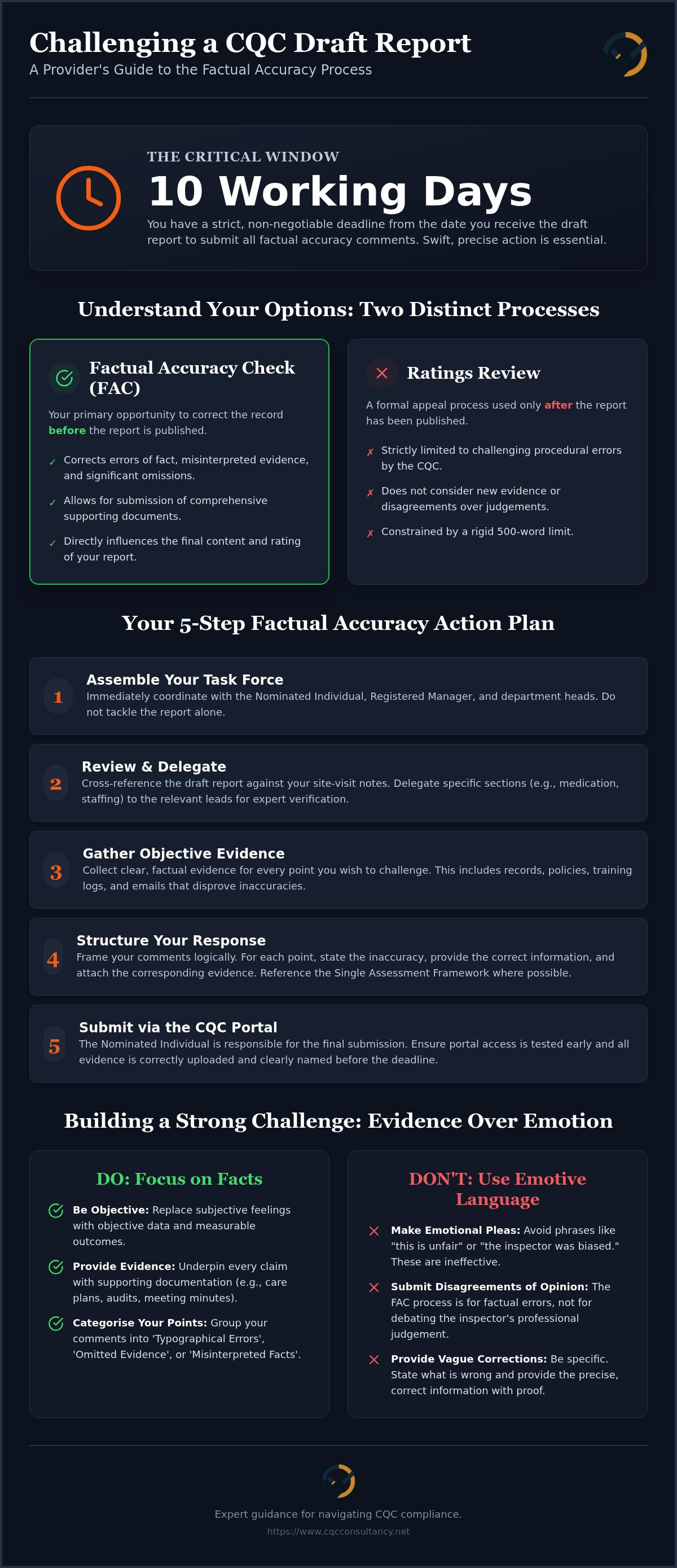
Receiving a draft report from the Care Quality Commission (CQC) marks a pivotal moment for any provider. This document isn't merely a courtesy; it's the final opportunity for you to ensure the narrative is accurate before it's published. You have exactly 10 working days from the date of receipt to submit your comments. This deadline is a strict procedural boundary, and extensions are rarely granted unless exceptional circumstances exist.
The Nominated Individual and Registered Manager must coordinate their efforts immediately. Speed is essential, but so is precision. It's vital to remember that challenging a CQC draft report and the factual accuracy process is distinct from a post-publication ratings review. While the latter is limited to procedural errors and a strict 500-word cap, the factual accuracy stage allows you to correct errors of fact or omitted evidence that could fundamentally alter your final rating.
The Significance of the Draft Stage in 2026
Under the Single Assessment Framework, the CQC relies heavily on evidence categories to form judgements. Correcting the narrative now is far more effective than trying to overturn a published rating later. Accuracy at this stage prevents the reputational damage that follows an unfair report. It's the most proactive way of challenging a CQC draft report and the factual accuracy process before the findings are finalised.
Immediate Actions Upon Receiving Your Draft
Don't tackle the report alone. Create a task force to review the draft against your site-visit notes. Focus on:
Quick wins: Correcting typos, wrong dates, or incorrect names.
Complex challenges: Addressing misinterpreted facts or omitted evidence.
Our Compliance Guidance highlights that mock inspections can prevent these hurdles, but a methodical review now ensures no detail is missed during this window.
Navigating the Factual Accuracy Check (FAC) Process
The CQC regulates all health and social care services in England, and their Single Assessment Framework has shifted the FAC process primarily to an online portal. Accessing this system requires registered credentials and a specific authentication code sent to the Nominated Individual. Successfully challenging a CQC draft report and the factual accuracy process depends on your ability to navigate this digital interface with precision and steady focus.
Once logged in, you'll find the draft findings organised by quality statements. We recommend delegating specific sections to relevant department heads for verification. For instance, your clinical lead should cross-reference medication records whilst the HR manager reviews staff training logs. This ensures that every correction is verified by those with direct internal knowledge. When uploading supporting documentation, ensure files are clearly named and relate directly to the finding in question. Technical limits on file sizes can cause delays, so prepare your evidence files well in advance of the deadline.
Portal vs. Word Form: Which One Do You Use?
Most providers now submit through the online portal. However, specific sectors, such as NHS acute trusts, may still utilise a manual Microsoft Word form. If you encounter technical barriers or accessibility issues, contact your inspector immediately to request an alternative submission method. Don't wait until the final hours to test your access; preparedness is the key to a stress-free submission.
The Role of the Nominated Individual (NI)
The NI holds the ultimate responsibility for the submission's accuracy and tone. They must ensure that all registered persons have received the necessary authentication codes for portal access. The NI's involvement is a critical part of challenging a CQC draft report and the factual accuracy process, as they provide the final seal of approval on the evidence. If the technical nature of the portal feels daunting, our Compliance Guidance can provide the support needed to ensure a seamless submission.
Strategic Approaches to Challenging CQC Findings
A successful submission requires more than just a list of grievances. You must view your draft through the "Inspector’s Lens", categorising your points into typographical errors, omitted evidence, or misinterpreted facts. When challenging a CQC draft report and the factual accuracy process, emotive language like "this is unfair" or "the inspector was biased" rarely yields results. Instead, replace subjective feelings with objective data. Every claim you make should be underpinned by CQC quality statement evidence to demonstrate exactly where the inspector's judgement diverges from the documented reality of your service.
Constructing a Robust Evidence Pack
Your evidence pack must be methodical. Map your internal audits, risk assessments, and care records directly to the specific paragraphs in the draft report. Contemporaneous notes taken by your team during the inspection visit are invaluable here; they provide a real-time account of what the inspector saw and heard. This level of detail makes it significantly harder for the CQC to dismiss your corrections. It transforms a disagreement into a factual clarification.
Common Pitfalls in the FAC Process
Avoid the "scattergun" approach of challenging every minor point. Focus your energy on high-impact corrections that directly influence your rating. Be cautious when providing new evidence created after the inspection; whilst it shows improvement, it often confirms that a compliance gap existed at the time of the visit. This can inadvertently reinforce a negative finding rather than overturn it. If you're unsure how to prioritise your response, our Compliance Guidance offers the expert insight needed to navigate these nuances. Our team, led by a former inspector with 12 years of experience, ensures your challenge is both professional and persuasive.
Beyond the Draft: Ratings Reviews and Professional Support
If the CQC rejects your factual accuracy comments, the draft report will proceed to publication. At this stage, your options narrow significantly. You can request a formal Ratings Review within 15 working days of publication, but the grounds are limited solely to procedural errors. You cannot challenge the inspector's judgement itself here; you must prove they failed to follow the correct process for making or aggregating ratings. With a strict 500-word limit for the entire submission, these appeals must be incredibly precise. This underscores why challenging a CQC draft report and the factual accuracy process is so vital; it remains your most flexible and impactful window for ensuring a fair outcome.
Other ways to challenge a CQC report
Factual accuracy is not the only route, and it helps to know which one fits your situation. Here is how the main options compare, based on CQC's published guidance.
Factual accuracy check (before publication). You have 10 working days from the date of CQC's email to comment on the draft report, and CQC will only extend this in exceptional circumstances. You can correct factual errors, challenge inaccurate information that contributed to a judgement (with supporting evidence) and add evidence that was missed, as long as it relates to the time of the assessment. CQC guidance on factual accuracy comments.
Rating review (after publication). The only grounds are that CQC did not follow its process for making ratings decisions. You cannot ask for a review simply because you disagree with the judgement. The nominated individual or registered manager (or the chief executive of an NHS trust) must submit it on CQC's online form within 15 working days of publication. There is a 500 word limit and only one request per report. Ratings can go down as well as up, and CQC aims to complete reviews within 50 working days. CQC guidance on requesting a rating review.
Complaints about CQC. If your concern is about how CQC or its staff behaved, that is a complaint, which is a separate process. CQC says it will pause a rating review until any complaint, or any challenge to enforcement action, is complete.
Enforcement action. If your report comes with enforcement action, different routes apply: representations about Warning Notices and Notices of Proposal (within 28 days for a Notice of Proposal), and an appeal to the First-tier Tribunal against a Notice of Decision within 28 days. If you have received a breach or Warning Notice, my breach response action plan service can help. CQC guidance on representations and appeals.
Judicial review. CQC describes the rating review as its final process for challenging a rating, but says you can challenge ratings elsewhere, such as by applying for judicial review. Take legal advice before going down this route.
If you need help with any of these, see my CQC factual accuracy support.
When to Seek Expert Consultancy
When a report threatens your registration or business reputation, professional oversight becomes essential. Leveraging the experience of a former CQC inspector provides a "steady hand" to review your response before you hit submit. They understand the internal benchmarks and aggregation rules that lead to rating decisions. This expert perspective ensures your challenge is framed correctly for the Single Assessment Framework, removing the uncertainty that often accompanies complex regulatory responses. Having a seasoned mentor review your evidence pack can be the difference between a rejected comment and a corrected rating.
Preparing for the Next Cycle
Use the feedback from your draft as a diagnostic tool for your next cycle. Update your Statement of Purpose and quality monitoring systems to address the inspector’s specific observations, ensuring your internal audits are more robust. Investing in CQC mock inspection services is the most effective way to prevent the need for future challenges. By identifying compliance gaps early, you ensure your next inspection is a true reflection of excellence. This proactive approach builds a culture of continuous improvement, giving you peace of mind that your service is always inspection-ready.
Securing Your Rating and Future Growth
Your draft report is the definitive moment to align the CQC’s findings with the high standards of care you provide every day. By treating the 10-working-day window as a strategic opportunity rather than a bureaucratic hurdle, you can ensure your final rating is both fair and accurate. We've explored how a meticulous, evidence-led approach is essential for successfully challenging a CQC draft report and the factual accuracy process. This isn't just about correcting minor errors; it's about protecting your reputation and the long-term viability of your service.
Need help challenging a draft report? See my factual accuracy support.
Navigating these complex regulatory requirements doesn't have to be a solitary burden. With over 12 years of regulatory experience and deep expertise in the Single Assessment Framework, our team provides the steady hand you need during this critical time. Book a consultation with our former CQC inspectors to review your draft report today and move forward with absolute confidence. You've built a service to be proud of; now is the time to ensure the official record reflects that excellence.
Frequently Asked Questions
Can the CQC lower my rating if I submit a factual accuracy challenge?
Yes, it's possible for a rating to be lowered during this stage, though it's relatively rare. If your response highlights a previously unknown risk or confirms a regulatory breach, the inspector may adjust the judgment downwards. This is why challenging a CQC draft report and the factual accuracy process requires a steady hand. You must ensure your evidence is precise and doesn't inadvertently confirm compliance gaps that were previously unidentified.
What is the difference between a factual accuracy check and a ratings review?
The factual accuracy check happens before the report is finalised and focuses on correcting errors of fact or omitted evidence. A ratings review is a post-publication process limited solely to procedural errors made by the CQC. Whilst the factual accuracy stage allows for extensive evidence, the ratings review has a strict 500-word limit. Understanding these distinctions is vital when challenging a CQC draft report and the factual accuracy process effectively.
Can I submit new evidence during the factual accuracy process that wasn’t available during the inspection?
Generally, you cannot submit evidence of improvements made after the inspection to change the findings. The CQC assesses the service as it was on the day of the visit. Any evidence you provide must have been available to the inspector at the time. Whilst showing that you've fixed an issue is positive for your next cycle, it won't typically result in the removal of a finding from the current draft.
What happens if I miss the 10-day deadline for my CQC draft report response?
The 10-working-day window is a hard deadline. If you fail to submit your response within this timeframe, the CQC will publish the report as it is, and it's then presumed to be factually accurate. Extensions are only granted in truly exceptional circumstances and must be requested in writing. Missing this window means losing your most flexible opportunity to correct the narrative before it reaches the public domain.
How long does the CQC take to respond to factual accuracy comments?
The CQC doesn't have a fixed statutory deadline for responding to factual accuracy comments. The inspector will review your submission and provide a written response to each point before the final report is published. This process ensures that the final document is a fair and accurate reflection of your service. If there are delays, your inspector should provide an update, but the priority is always meticulousness over speed. Related reading: CQC compliance support, What Are the CQC Fundamental Standards?, 10 Things a Former CQC Inspector Looks For During Inspections.
Want to talk it through? Book a free 15-minute call


Comments