Patient Safety & MHRA Alerts: Essential Compliance Guide
Updated: 2 days ago
The most dangerous safety alert is the one you received but failed to document correctly. Managing patient safety alerts and MHRA alerts is a constant challenge, and it’s completely natural to feel overwhelmed by the volume of notifications or the recent shift in terminology where Class 1 Recalls are now issued as National Patient Safety Alerts. You likely recognise the anxiety of wondering if a critical update has been missed or if your current audit trail would actually stand up to the scrutiny of a CQC inspector. It often feels like the administrative weight of compliance is pulling your focus away from what matters most: your patients.
This guide promises to replace that uncertainty with a streamlined governance system. You’ll learn how to effectively filter notifications and build a robust evidence folder that proves your service is proactive and safe. We will explore the implications of the 2026 regulatory framework and provide a step-by-step process for handling alerts with total confidence. By the end, you’ll have the tools to ensure your oversight is meticulous, your patients are protected, and your service is fully "CQC-ready."
Table of Contents
Understanding Patient Safety Alerts and MHRA Alerts in Healthcare Compliance
Patient safety alerts and MHRA alerts aren't merely administrative updates; they're critical safeguards designed to prevent serious harm or death. These high-priority notifications highlight risks that, if left unaddressed, could lead to catastrophic outcomes for those in your care. The Medicines and Healthcare products Regulatory Agency (MHRA) plays a pivotal role here, continuously monitoring the safety and efficacy of medical devices and medicines across the United Kingdom. Their oversight ensures that any emerging patterns of harm are identified and communicated to providers with total clarity.
Understanding the distinction between alert levels is vital for effective governance. Whilst standard safety notifications provide important updates, National Patient Safety Alerts (NatPSA) demand immediate, structured action. As of July 2026, the MHRA has streamlined this process, ensuring that Class 1 Medicines Recalls are issued as NatPSAs to highlight their urgency. Precision is non-negotiable. These alerts form a core component of patient safety culture, providing the technical foundation for clinical oversight and risk management.
The Link Between Safety Alerts and CQC Ratings
Within the CQC Single Assessment Framework, your management of these notifications is a direct indicator of the "Safe" key question. A failure to act on a single critical alert can trigger a "Requires Improvement" or "Inadequate" rating; it suggests a fundamental breakdown in your protective systems. Inspectors don't look for a simple tick-box exercise. They look for evidence of proactive safety behaviour amongst your clinical team, wanting to see that alerts are discussed, audited, and embedded into daily practice. The Central Alerting System (CAS) acts as the primary cascading mechanism for safety-critical information in the UK.
Navigating the Central Alerting System (CAS) and MHRA Notifications
The Central Alerting System (CAS) serves as the digital backbone for distributing patient safety alerts and MHRA alerts across the UK healthcare landscape. It effectively cascades high-stakes information from the Department of Health and Social Care and the MHRA directly to your organisation. Every provider is required to appoint a designated CAS liaison officer. This individual isn't just a recipient; they're the gatekeeper responsible for ensuring that critical data reaches the right clinical hands without delay. This role demands a keen eye for detail, as the speed of communication often dictates the speed of patient protection.
Effective management involves more than just reading an email; it requires discerning which notifications actually apply to your specific service. A care home might safely archive an Estates alert regarding high-voltage hospital equipment, but they must act instantly on medicines recalls or notifications. Identifying relevance involves categorising alerts into Drug Safety Updates, Medical Device Alerts, and Estates/Facilities alerts. If you're struggling to separate the signal from the noise, our compliance guidance can help you establish a more precise filtering protocol that ensures nothing vital is overlooked. You can sign up to MHRA medicine alerts here .
Types of Alerts You Must Monitor
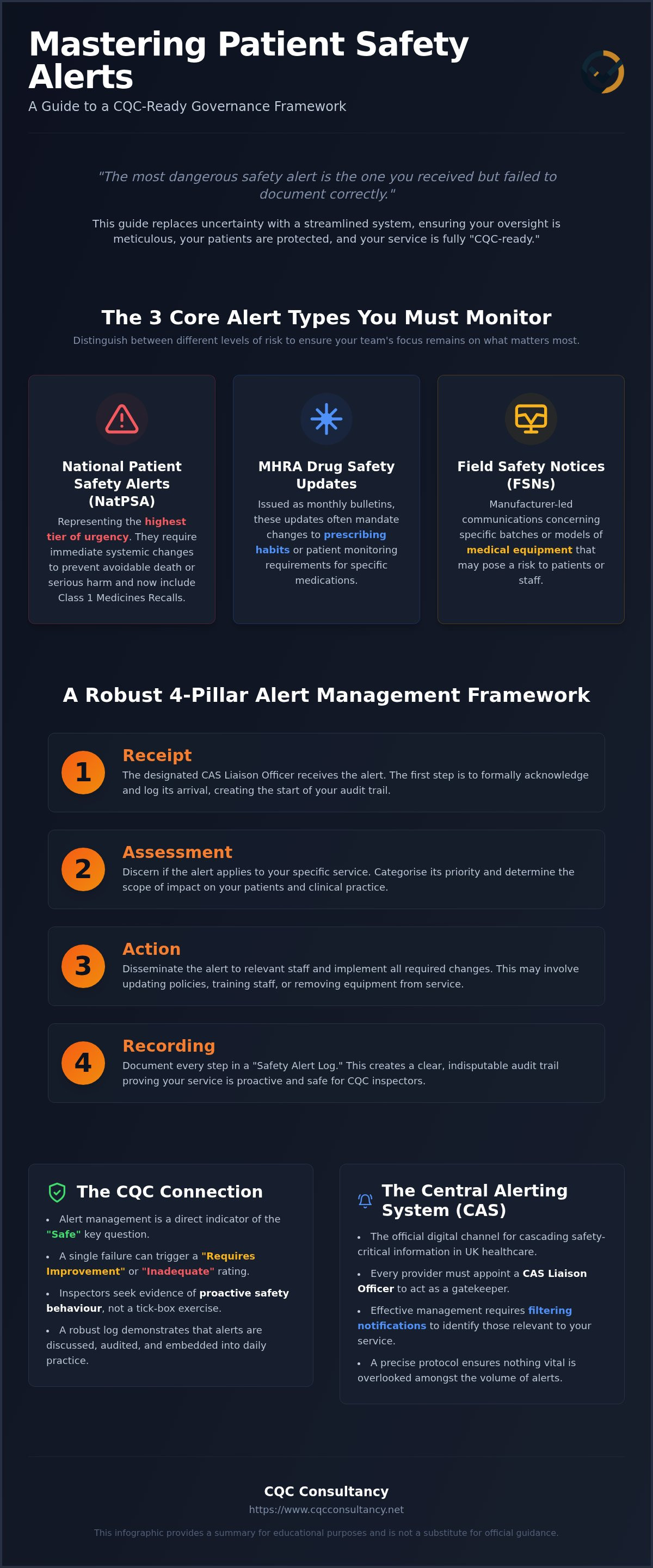
Your governance framework should distinguish between different levels of risk to ensure your team isn't overwhelmed by data. Focus on these three core areas:
National Patient Safety Alerts: These represent the highest tier of urgency and now include Class 1 Medicines Recalls. They require immediate systemic changes to prevent avoidable death or disability.
MHRA Drug Safety Updates: Issued as monthly bulletins, these updates often mandate changes to prescribing habits or patient monitoring requirements for specific medications.
Field Safety Notices (FSNs): These are manufacturer-led communications concerning specific batches or models of medical equipment that may pose a risk to patients or staff.
Implementing a Robust Alert Management Framework for CQC Readiness
Building a dependable governance structure for patient safety alerts and MHRA alerts requires more than just a filing system; it demands a live, breathing process. Your framework should be built upon four distinct pillars: Receipt, Assessment, Action, and Recording. This methodical approach ensures that every notification is accounted for, preventing critical risks from slipping through the gaps of a busy clinical schedule. To maintain this oversight, you must create a comprehensive "Safety Alert Log" that tracks every notification from its arrival via CAS to its final resolution.
Step-by-Step Response Protocol
A reliable system follows a predictable path. First, the designated CAS officer must formally receive and log the alert, ensuring the timestamp is recorded. Second, the Registered Manager or a clinical lead must conduct a formal assessment of relevance. This determines if the alert impacts your specific patient demographic, medication stock, or equipment inventory. Finally, the team must implement required actions, such as conducting equipment checks, reviewing patient records, or updating internal policies. If you need support refining these internal workflows, you can access our compliance guidance for tailored advice.
Closing the Loop: Documentation and Evidence
Documentation is your primary shield during a CQC inspection. It's a common mistake to ignore alerts that don't apply to your service, but "No action required" is a valid response that must be recorded with a clear rationale. An inspector expects to see a "Safe" evidence folder that contains not just the alerts themselves, but the tangible proof of your response. Linking these actions to your wider CQC consultancy services ensures that alert management is integrated into your holistic governance. A robust audit trail is the only way to satisfy the CQC Single Assessment Framework requirements for safety monitoring.
How Mock Inspections Verify Your Safety Alert Governance
Even the most diligent managers can develop blind spots when managing patient safety alerts and MHRA alerts over several years. It's easy to assume your CAS trail is complete, only to find that a specific medicines notification from months ago lacks a definitive final sign-off or an updated risk assessment. An external consultant provides the fresh, objective perspective needed to identify these procedural gaps before a formal inspection occurs. By meticulously verifying your audit trail against the latest 2026 standards, you ensure your governance is as robust as you believe it to be.
Stress-Testing Your Systems
A CQC mock inspection service serves as the ultimate rehearsal for your compliance systems. We simulate a real-world scenario, asking your team to retrieve evidence of action for a specific 2026 alert under time pressure. This process evaluates not just the physical paperwork, but the effectiveness of communication between leadership and frontline staff regarding safety changes. If your clinical team can't articulate how a recent safety notification has altered their practice, it signals a disconnect that could impact your overall rating.
Confidence during the inspection process is a byproduct of thorough preparation. Ensuring your CQC registered manager interview tips include strategies for discussing safety governance allows you to present your systems with professional poise. Moving from "compliant" to "outstanding" requires you to demonstrate a continuous culture of safety and learning. It’s about proving that every alert is used as a springboard for improvement rather than just a tick-box exercise. This proactive stance transforms a mandatory administrative task into a powerful tool for clinical excellence, offering you the peace of mind that your service is truly protected.
Securing Your Service Through Proactive Governance
Managing patient safety alerts and MHRA alerts shouldn't be a source of constant anxiety. By establishing a clear four-pillar framework and maintaining a meticulous audit trail, you transform a complex regulatory requirement into a reliable safety net for your patients. You've seen how documenting every decision, including those requiring no action, builds the evidence folder that CQC inspectors demand. However, the most robust systems are those that are regularly tested against real-world scrutiny.
Want an expert to check your compliance? See my CQC mock inspection service.
Our team, led by a former CQC inspector with over 12 years of regulatory experience, provides the bespoke guidance you need to navigate the Single Assessment Framework with total confidence. We specialise in identifying the subtle gaps in governance that others might miss. To ensure your service is fully prepared and your staff are ready for the next inspection, book a CQC Mock Inspection to verify your safety systems today. We’re here to provide the steady hand and expert insight that helps your service achieve excellence. You don't have to manage these complexities alone.
Frequently Asked Questions
How do I register for the Central Alerting System (CAS)?
You register online via the official CAS website at cas.mhra.gov.uk. Every healthcare organisation must appoint a dedicated contact point to receive these high-priority notifications. Once registered, you'll receive automated alerts from the Department of Health and Social Care and the MHRA. It’s essential to keep your contact details updated to ensure your service remains responsive to critical safety risks and regulatory changes.
What happens if we miss a National Patient Safety Alert?
Missing a National Patient Safety Alert (NatPSA) creates an immediate risk to patients and can lead to urgent regulatory intervention. As of 2026, these are considered the highest tier of urgency. If the CQC discovers a missed alert during an inspection, it typically results in a breach of Regulation 12 (Safe care and treatment), which frequently leads to a rating of "Requires Improvement" or "Inadequate."
Do care homes need to monitor MHRA medical device alerts?
Yes, care homes must monitor these alerts, particularly for equipment like hoists, profiling beds, and pressure-relieving mattresses. Whilst not every patient safety alerts and MHRA alerts notification will apply to social care, you must still document your assessment of each one. Proving that you've considered the impact on your specific residents is vital for maintaining a robust audit trail for inspectors.
How long should we keep records of our actions regarding safety alerts?
You should maintain records of safety alert actions for at least the duration of your current CQC inspection cycle. Under the 2026 regulations, there's an increased focus on documentation retention for medical device traceability. Keeping a permanent "Safety Alert Log" ensures you can always demonstrate your historical compliance and proactive governance. This level of thoroughness provides peace of mind during any future mock inspections.
Can the CQC issue a warning notice for poor alert management?
The CQC can and will issue a warning notice if they find a systemic failure in how you manage patient safety alerts and MHRA alerts. This usually occurs when there's no clear audit trail or when staff are unaware of critical safety changes. A warning notice is a formal escalation that requires you to prove you've rectified the governance gaps within a specific timeframe to avoid enforcement.
Related reading: What Are the CQC Fundamental Standards?.
Want to talk it through? Book a free 15-minute call


Comments