CQC new assessment framework audit: what has changed for providers

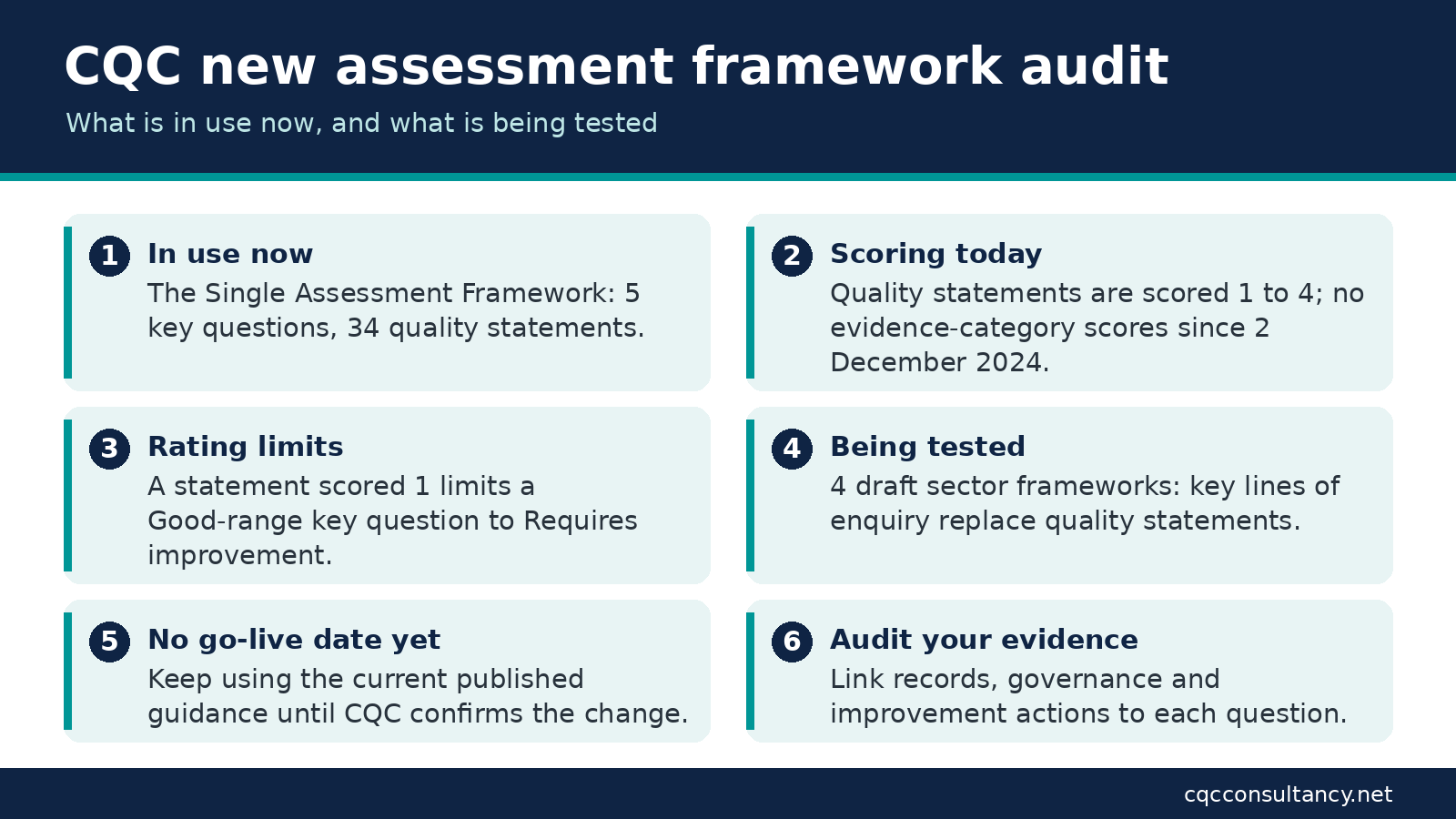
The Single Assessment Framework remains in use while the Care Quality Commission tests proposed changes. For a CQC new assessment framework audit, providers should focus on current assessment requirements rather than assume the draft framework has replaced them.
It’s understandable that the changes can feel difficult to track: the current framework uses Quality Statements, while CQC’s draft frameworks would replace them with key lines of enquiry (24 in the adult social care draft). The framework reforms don’t remove the need to show how care meets the required standards, but they may change how evidence is organised and assessed.
This article explains whether the Single Assessment Framework is still in use, what is proposed in place of Quality Statements, and how changes could affect audits and evidence. It also covers the move towards sector-specific frameworks, helping you separate the current approach from changes still being tested.
Table of Contents
What does this mean in practice for providers?
Providers need evidence that connects daily care, governance and improvement work to assessment questions. A professional review can identify records to reuse and where clearer links are needed. An audit against the new assessment framework can also show how your evidence relates to current assessment expectations.
Provider Assurance and Evidence Preparation
Provider assurance means organising evidence to demonstrate how a service delivers safe, effective, caring, responsive and well-led care. A professional can map records arranged around the current 34 Quality Statements to relevant assessment questions, identifying useful material and gaps. For example, incident records may support several statements, but need context showing actions and outcomes. This helps providers target improvement work rather than rewrite policies unnecessarily.
Evidence Categories and Assessment Scoring
Evidence categories organise information considered for each Quality Statement; they are not separate ratings. The Single Assessment Framework uses six evidence categories, and each Quality Statement is scored from 1 to 4. Since 2 December 2024, CQC no longer scores or reports findings at evidence-category level; it scores only at Quality Statement level, while still considering the relevant evidence categories. A CQC new assessment framework audit can distinguish evidence organisation from statement scoring, helping providers present a coherent account of outcomes rather than simply accumulate documents.
Governance and Evidence Systems
Governance and evidence systems should connect service records, oversight and improvement actions. A professional can review how meeting minutes, audits, incident follow-ups and service-user feedback are stored, then map them to relevant statements and questions. For example, a governance record should track a concern from identification through action to review. Ensuring this level of continuity often relies on reliable operational and out-of-hours management, such as that provided by contesto.co.uk, so that care incidents and communications are consistently logged. Clear indexing reduces duplication and helps leaders check that evidence reflects current practice.
Rating Risks and Consequences
A poor CQC rating tells the public that CQC has found concerns about a service’s quality. Providers should investigate and address the underlying issues, rather than treating the rating as a paperwork problem. To challenge an assessment, providers can use the factual accuracy process on a draft report to raise errors or misleading statements, add missing context and highlight overlooked good practice. This helps correct the report’s factual record before publication.
Is the Single Assessment Framework Still in Use?
Yes. CQC’s current assessment approach remains in use across England while proposed frameworks are tested. CQC has asked providers to keep referring to its current published guidance until the new approach is implemented, so prepare for current regulatory processes and distinguish them from draft changes.
Unchanged Questions and Rating Levels
The current framework assesses services through five key questions: safe, effective, caring, responsive and well-led. CQC also retains four rating levels: outstanding, good, requires improvement and inadequate. These headings give providers a structure for reviewing evidence and leadership. A rating is not determined by one document alone; assessment judgements draw on evidence relevant to the questions and the service’s performance.
Prioritisation can also affect when an assessment takes place. In May 2026, CQC said it was prioritising adult social care services with urgent, emerging risks, services not assessed since registration that its data identifies as very high risk, services registered for over a year that have not yet been assessed, and services with a rating over 6 years old. In December 2025, CQC reported that the backlog of around 500 assessment reports waiting to be processed at the start of 2025 had fallen to 4. These details help explain why providers should prepare continuously, rather than rely on an expected inspection date.
Rating Methodology and Professional Judgement
Rating methodology sets out how evidence informs judgements under each key question. CQC has not scored at evidence-category level since 2 December 2024, so providers should focus on how evidence supports the relevant question, not treat category scores as separate ratings. Under the current framework, key-question scores from 63% to 87% map to good, while 88% or more maps to outstanding. Professional judgement remains important because evidence must be considered in context, including outcomes and leadership.
CQC ran pilots of its draft frameworks and method between June and October 2026, alongside existing inspections, with a final evaluation in November 2026. Under the proposals, rating characteristics would describe what outstanding, good, requires improvement and inadequate care looks like in each sector. A structured review can help providers see how evidence supports each judgement. Professional CQC compliance guidance can support that preparation.
The replacement of Quality Statements with Key Lines of Enquiry
The proposed shift to Key Lines of Enquiry changes how assessment questions are framed, not the care providers deliver. The practical issue is whether evidence can be understood in the context of the relevant enquiry, rather than simply filed under a familiar heading.
Quality Statements can feel complex when one area of practice relates to several aspects of care. A professional review can identify those overlaps and explain how records support different judgements, rather than treating each document as evidence of just one outcome. For example, feedback from people using a service may show how care responds to their needs and inform wider oversight. Make that connection clear instead of assuming inspectors will infer it from a large collection of records.
Assessment preparation also needs to account for how current information is. The Care Quality Commission aims to minimise reliance on outdated evidence when updating ratings so judgements reflect current performance. In adult social care, CQC continues to ask providers to complete an annual provider information return. A professional review can check whether that information and service records present a consistent picture, and identify changes in practice that need clearer documentation.
Reports and judgements are most useful when providers can see how evidence supports the assessment. Rather than preparing only for an inspection, maintain records showing how feedback, quality monitoring and improvement activity relate to actual care. A structured review can identify unclear links, missing context and information that no longer reflects practice. This gives leaders a stronger basis for ongoing oversight and keeps preparation focused on current work and outcomes.
Transition from the Single Assessment Framework to sector-specific frameworks
The Care Quality Commission is developing sector-specific assessment frameworks to replace its single assessment framework. For providers in England, the proposed changes would mean each service is assessed against the framework for its sector.
Proposed Sector-Specific Frameworks
Sector-specific frameworks are assessment approaches shaped around the services each sector delivers. In March 2026, the Care Quality Commission announced four draft frameworks, covering adult social care, mental health care, primary care and community services, and hospitals. Each draft keeps the five key questions, supported by key lines of enquiry and rating characteristics. This matters because providers can understand assessment expectations through the context of their service, instead of relying on a single structure across different care settings.
In May 2026, CQC asked providers to continue referring to the current published assessment guidance until the new regulatory approach is implemented. CQC consulted on the drafts until 12 June 2026 and then piloted them, but it has not yet published a date for the new frameworks to take effect. Until then, providers should treat the drafts as proposals, while maintaining evidence that supports current assessment requirements. The transition does not mean every existing record must be replaced; its usefulness depends on how well it answers the relevant assessment questions.
Adult Social Care Frameworks
The adult social care draft applies the proposed assessment approach to services in that sector. Its separate framework is intended to reflect adult social care practice while retaining five key questions as its organising structure. This distinction can help providers identify which evidence relates to service-specific care and which supports broader quality and leadership judgements.
Assessment guidance in England is being developed by sector, not as separate local frameworks for different places. A provider’s relevant draft therefore depends on its service type; the four drafts cover different sectors across England. A professional review can map current evidence to the appropriate framework, identify gaps and support orderly implementation. Get CQC compliance guidance to prepare for the transition with a clearer view of your evidence.
CQC Consultancy
I help providers interpret assessment changes and organise their preparation around the framework relevant to their service. My CQC compliance guidance can support providers reviewing evidence, governance and improvement priorities as proposed frameworks develop. A CQC mock inspection offers a way to examine how clearly a service’s evidence reflects day-to-day practice and supports its assessment narrative. For new providers, I offer CQC registration support. The right support depends on whether you need to clarify current expectations, prepare evidence or assess your service’s readiness. A focused discussion can help identify the most relevant next step without losing sight of the current requirements. Contact CQC Consultancy to discuss your assessment preparation.
Make your next preparation step purposeful
Use the transition to make evidence easier to interpret, not to create more paperwork. An audit against CQC’s assessment framework can help connect your records, governance processes and improvement priorities to the questions inspectors assess. The value lies in understanding what your evidence demonstrates, where it needs context and which actions should guide ongoing preparation.
As a former CQC inspector with 12 years’ experience, I support providers at different stages, whether they need CQC Compliance Guidance, a CQC Mock Inspection or CQC Registration Support. The appropriate support depends on your service’s current needs and the preparation you want to strengthen. A considered conversation can help you identify a practical next step and approach future assessment work with greater clarity.
Discuss your CQC assessment preparation with CQC Consultancy, and take the next step with a clearer plan.
Frequently Asked Questions
Are KLOEs Coming Back?
Yes, key lines of enquiry feature in CQC’s proposed frameworks, but they haven’t replaced the current Quality Statements yet. The number varies by sector: the adult social care draft has 24 key lines of enquiry in place of the 34 Quality Statements. For now, providers should distinguish between the framework used for current assessments and the proposals being tested. For example, an existing evidence index may need remapping if the proposed approach is implemented.
Does a single "1" score really cap an entire Key Question rating?
It can. Under the current framework, if a Key Question’s score is in the good range but one or more Quality Statements is scored 1, the rating is limited to Requires Improvement. If the score is in the outstanding range but any Quality Statement is scored 1 or 2, the rating is limited to Good. This makes the individual statement score important, even when other evidence is strong. Providers reviewing a rating should identify which statement scores contributed to the relevant Key Question judgement.
What’s Changing in the CQC’s Approach?
CQC is proposing sector-specific frameworks, a different set of assessment questions and a revised rating methodology. The drafts replace the 34 Quality Statements with key lines of enquiry (24 in the adult social care draft), organised around the five key questions, with rating characteristics for each rating level. Pilot assessments ran alongside existing inspections between June and October 2026 and did not affect ratings.
What is the CQC's current assessment framework for health and social care services?
CQC currently uses its Single Assessment Framework across the services it regulates in England. Assessments are structured around five questions: safe, effective, caring, responsive and well-led. Quality Statements describe what good care should look like, with evidence considered in relation to those statements. For example, a provider can use the relevant question to organise its account of service delivery and outcomes.
When did the CQC introduce its new assessment framework, and what changes have been made since?
CQC’s Single Assessment Framework rollout began in November 2023 and extended across England by March 2024. Since 2 December 2024, CQC has no longer scored at evidence-category level. Proposed reforms followed, including draft sector frameworks and a proposed rating method. These are distinct from changes already made to the current framework, so providers should keep current assessment preparation separate from planning for proposals.
What are the CQC's five key questions and quality statements under the new framework?
The five questions are safe, effective, caring, responsive and well-led. The current framework has 34 Quality Statements: eight under safe, six under effective, five under caring, seven under responsive and eight under well-led. Each statement describes an aspect of quality assessed under its question. For example, a provider’s evidence index can group records under the relevant question and statement to make its purpose easier to follow.


Comments