How to Register a Diagnostic Laboratory with CQC

Updated: Nov 12
A laboratory’s name does not determine whether CQC registration is required; its activities do. In England, a provider must register if it carries out a regulated activity, including diagnostic and screening procedures, unless an exception applies. Understanding how to register a diagnostic and screening laboratory with CQC starts with identifying who performs each part of the service and what happens to samples and results.
It’s understandable that the boundary can feel unclear. A service may collect samples, analyse them, interpret results or use software to support a diagnosis, and these roles do not always have the same registration requirements. Assess the actual activity rather than relying on labels such as “wellness” or “testing”.
This guide explains which laboratory and screening activities fall within CQC’s scope in England, where exceptions may apply, and how the provider, locations and services shape an application. Use it to establish whether registration is needed before the service begins and what to prepare.
Table of Contents
What Are Regulated Activities?
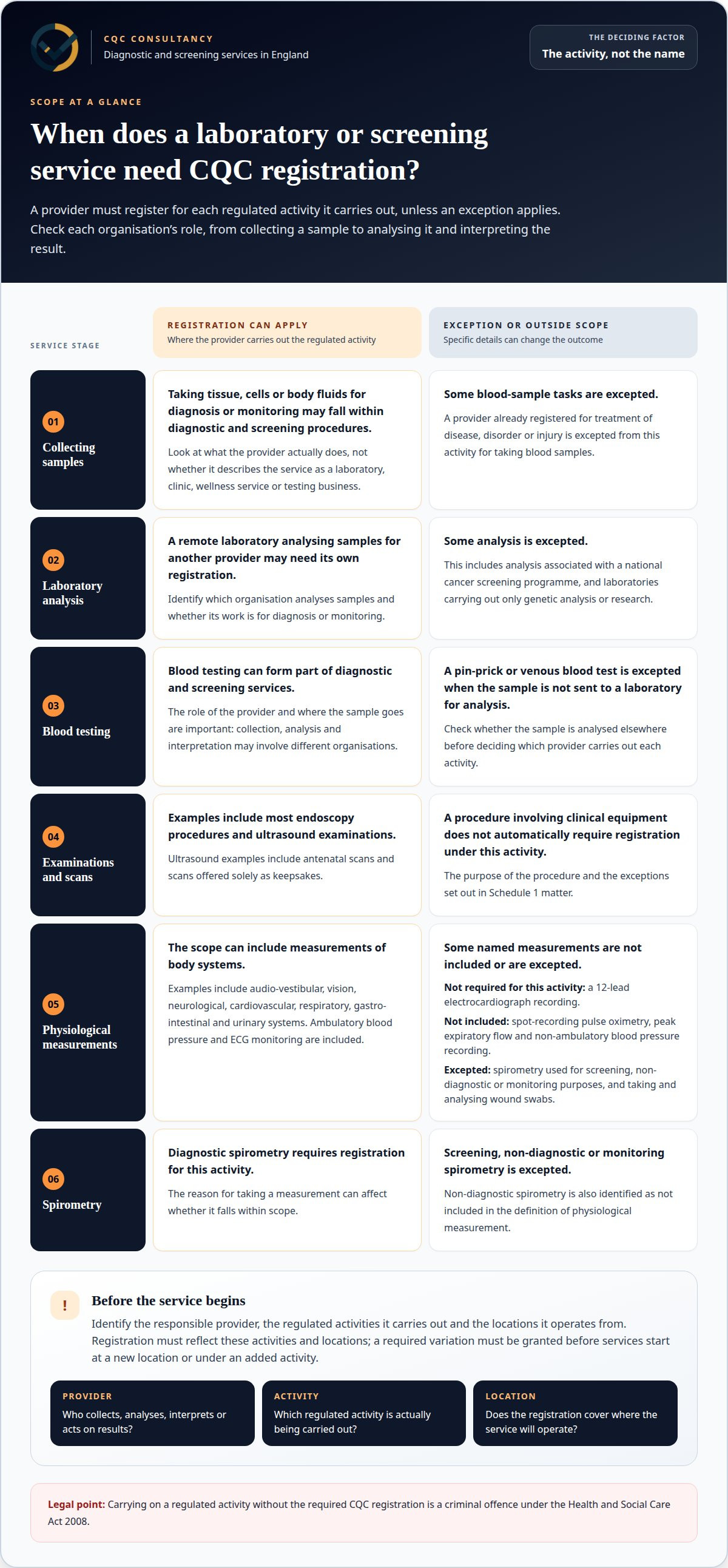
In England, regulated activities are defined in Schedule 1 of the Health and Social Care Act 2008 (Regulated Activities) Regulations 2014, according to UK legislation. CQC’s scope guidance sets out 14 regulated activities. A provider must register for each activity it carries out, unless an exception applies. The test is what the service does, not whether it calls itself a laboratory, clinic or screening business.
Diagnostic and screening procedures are one regulated activity. They can include ultrasound, physiological measurements and procedures using instruments to examine inside the body. A service may also provide treatment of disease, disorder or injury, which is a separate regulated activity. This distinction matters when a diagnostic visit includes clinical treatment as well as testing.
Assess the service from sample collection through to results. A provider taking tissue, cells or fluids for diagnosis or monitoring may fall within the diagnostic and screening activity. A laboratory analysing samples remotely for another provider may need its own registration. The provider’s role in reviewing results and acting on them also helps clarify which organisation carries out each activity.
Registration must reflect the activities and locations on which the provider relies. If a provider plans to add a regulated activity or a location requiring a variation, that variation must be granted before services start there. A service already covered by the provider’s registered activities and location does not need a variation, but must be described in its statement of purpose.
Carrying on a regulated activity without the required CQC registration is a criminal offence under the Health and Social Care Act 2008. Providing an activity outside the provider’s registration is treated like operating without registration; breaching registration conditions is also an offence. CQC registration is therefore a legal requirement, not a quality rating or a substitute for an inspection.
Which Service Types Require CQC Registration?
In England, the Care Quality Commission assesses the activity, the organisation responsible and any applicable exception. Sample collection, laboratory analysis and result interpretation may involve different providers, so clarify each organisation’s role.
Services requiring registration
Diagnostic and screening services require registration when they carry out a regulated activity and no exception applies. This can include examining tissue, cells or body fluids for disease, disorder or injury, as well as radiology and blood testing. Screening programmes are not automatically exempt: analysis associated with a national cancer screening programme is excepted, as are laboratories carrying out only genetic analysis or research. The service’s actual work determines whether an exception applies.
Checking registration requirements
Check each stage of the service, from taking a sample to analysing it and interpreting the result. Blood tests using a pin-prick or venous sample are excepted when the sample is not sent to a laboratory for analysis. A provider already registered for treatment of disease, disorder or injury is also excepted from diagnostic and screening procedures for taking blood samples. A remote laboratory analysing samples for another provider may need separate registration.
For a new application, identify the responsible provider, regulated activities and locations, then apply online to CQC. Applicants must demonstrate that services will be safe, effective, caring, responsive to people’s needs and well led. These standards guide the assessment. The provider must also show how its premises, equipment, staffing and governance support the proposed services. For healthcare organisations managing complex facility fit-outs or capital developments, consulting an owner's representative for construction Florida is an example of how independent project advisory ensures specialist premises are delivered on time and to specification. CQC may inspect registered services after registration.
There is no fee to apply to enter the registration system, but registered providers pay an annual registration fee. Registration typically takes between 8 to 12 weeks, although timing can vary. Carrying on a regulated activity without required registration is a criminal offence and may result in fines or prosecution. Structured application preparation can help organise the activity, provider and location details for submission.
CQC registration for diagnostic and screening procedures
The scope covers diagnostic or screening procedures carried out to examine the body or measure how its systems function. The type of equipment, the purpose of the test and whether it informs diagnosis can affect the decision. Schedule 1 also sets out exceptions, so a procedure involving clinical equipment does not automatically require registration under this activity.
Examples include most endoscopy procedures using instruments inserted into the body to view it or gather physiological data. Ultrasound examinations are included, including antenatal scans and scans offered solely as keepsakes. Physiological measurement can cover audio-vestibular, vision, neurological, cardiovascular, respiratory, gastro-intestinal and urinary systems. Ambulatory blood pressure and ECG monitoring are included. However, a 12-lead electrocardiograph recording does not require registration for this regulated activity.
The purpose of a measurement can change its status. Diagnostic spirometry requires registration for this activity, while spirometry used for screening, non-diagnostic or monitoring purposes is excepted. Spot-recording pulse oximetry, peak expiratory flow, non-diagnostic spirometry and non-ambulatory blood pressure recording are not included in the definition of physiological measurement. Taking and analysing wound swabs is also excepted.
Paragraph 7 of Schedule 1 identifies procedures that are not diagnostic and screening procedures. A provider registered for treatment of disease, disorder or injury is excepted from this activity for certain tasks, including taking blood or urine samples, urine or stool dipstick tests, and taking swabs or skin scrapings. This exception concerns the specified activity, not every diagnostic service the provider might deliver.
Keep distinct activities separate when reviewing the service model. For example, assessment or medical treatment for people detained under the Mental Health Act 1983 is a regulated activity in its own right. A laboratory’s clinical purpose, procedures and existing registration all matter when identifying its CQC scope.
CQC regulation of health and social care providers in England
The Care Quality Commission regulates health and social care providers in England. Its remit covers 14 regulated activities, from personal care to diagnostic and screening procedures. The Health and Social Care Act 2008 provides the legislative framework, while the activity definitions identify which services require registration. A laboratory’s commercial or clinical label does not determine whether CQC oversight applies.
This distinction matters because one organisation may deliver different kinds of care. A provider could offer diagnostic testing alongside treatment of disease, disorder or injury, or provide personal care as a separate service. Registration must reflect the activities actually carried out, rather than the provider’s broader business description. The relevant scope is England’s, so the service’s location also matters when determining which regulator applies.
Technology does not remove the need to assess who delivers the regulated activity. An organisation that only supplies AI technology to other providers does not need registration for diagnostic and screening procedures on that basis alone. By contrast, a company using AI to make diagnoses and sending results to a referrer who does not independently review them needs registration if it is not already registered for that activity. The division of responsibility is central.
CQC registration is not a quality rating or confirmation that every test is clinically useful for each person. It allows the provider to carry out regulated activities at its registered locations, and CQC can inspect services and publish findings. A provider’s registration listing shows its activities and addresses. These details help clarify whether the registered scope matches the provider’s current health or social care service.
If the provider’s activities or locations are changing, get support with CQC registration to prepare for the regulatory process.
CQC Consultancy
CQC Consultancy helps healthcare providers understand CQC requirements for diagnostic and screening services. If you’re assessing whether your laboratory’s activities require registration or preparing to apply, CQC Registration Support and CQC Compliance Guidance can help clarify the provider’s activities, locations and regulatory responsibilities.
For an established service, CQC Mock Inspections can help identify areas to address before a formal inspection. The right support depends on where you are in the process, from understanding your registration position to strengthening compliance arrangements. Contact CQC Consultancy to discuss the CQC requirements relevant to your diagnostic service.
Plan the next step with confidence
Before your laboratory service begins, turn your registration assessment into a clear operational plan. Set out who is responsible at each stage, from arranging the service to reviewing results and responding to concerns. This helps keep the application aligned with how the service will work in practice.
Understanding how to register a diagnostic and screening laboratory with CQC is one part of preparing to operate within the regulatory framework. Putting that understanding into practice means coordinating the provider’s responsibilities, governance arrangements and service delivery, then maintaining them as the service develops.
CQC Consultancy offers CQC Registration Support and CQC Compliance Guidance for providers preparing to register or strengthen their arrangements, alongside CQC Mock Inspections for services preparing for inspection. For support with your next steps, contact CQC Consultancy. A clear plan can help you approach the process with greater confidence.
Frequently Asked Questions
Who Needs CQC Registration?
In England, registration applies to the person or organisation carrying on the regulated activity, not automatically to every organisation involved in a service. For example, a laboratory analysing samples remotely may have different registration responsibilities from the clinic collecting them. To understand how to register a diagnostic and screening laboratory with CQC, map who provides each part of the service and who is accountable for delivery.
Which CQC regulated activities apply to diagnostic and screening laboratory services?
Diagnostic and screening procedures may apply where a service examines samples or carries out tests to identify or monitor a condition. Treatment of disease, disorder or injury is a separate regulated activity if the service also treats patients. Consider the service’s purpose and what happens after a result is produced. A diagnostic result that informs a clinical decision differs from a test used solely for research.
Can CQC register an independent diagnostic laboratory, and what service types are included?
Yes, an independent laboratory can register to carry on regulated activities in England. The scope can include diagnostic work on samples, imaging and other procedures, depending on what the service actually does. A laboratory associated with research or a national cancer screening programme may fall within an exception. The distinction depends on the work performed, not whether the laboratory is privately owned or describes itself as independent.
What are the CQC provider and registered manager requirements for a laboratory?
The provider is the person or organisation responsible for the service’s registration. Most providers need a registered manager, and a provider organisation also needs a Nominated Individual. These roles should match the organisation’s management structure and the services covered by its application. For a laboratory group, clarify which legal entity operates each location and who is responsible for the regulated service.
What documents and evidence are required for a CQC laboratory registration application?
Evidence should explain how the service handles samples and results in practice. For blood testing, set out the registered provider, the laboratory analysing each sample, who reviews results and how urgent findings are escalated. Include a route for people to raise concerns. Clear, consistent information helps show how the proposed service will manage patient safety across the testing pathway.
How do you apply to register a diagnostic laboratory with CQC step by step?
To understand how to register a diagnostic and screening laboratory with CQC, first describe the service pathway and identify the organisation responsible at each stage. Then align the proposed activities and locations with the application, and prepare evidence about governance and results handling. Submit the application online to CQC and respond to its assessment. Wait until registration is granted before carrying out an activity that requires it.


Comments