How to earn an Outstanding CQC rating through strong practice

Updated: Nov 11
An Outstanding CQC rating is not earned by preparing for inspection alone. Understanding how to get an outstanding CQC rating means knowing how CQC assesses evidence of good care, effective leadership and continuous improvement.
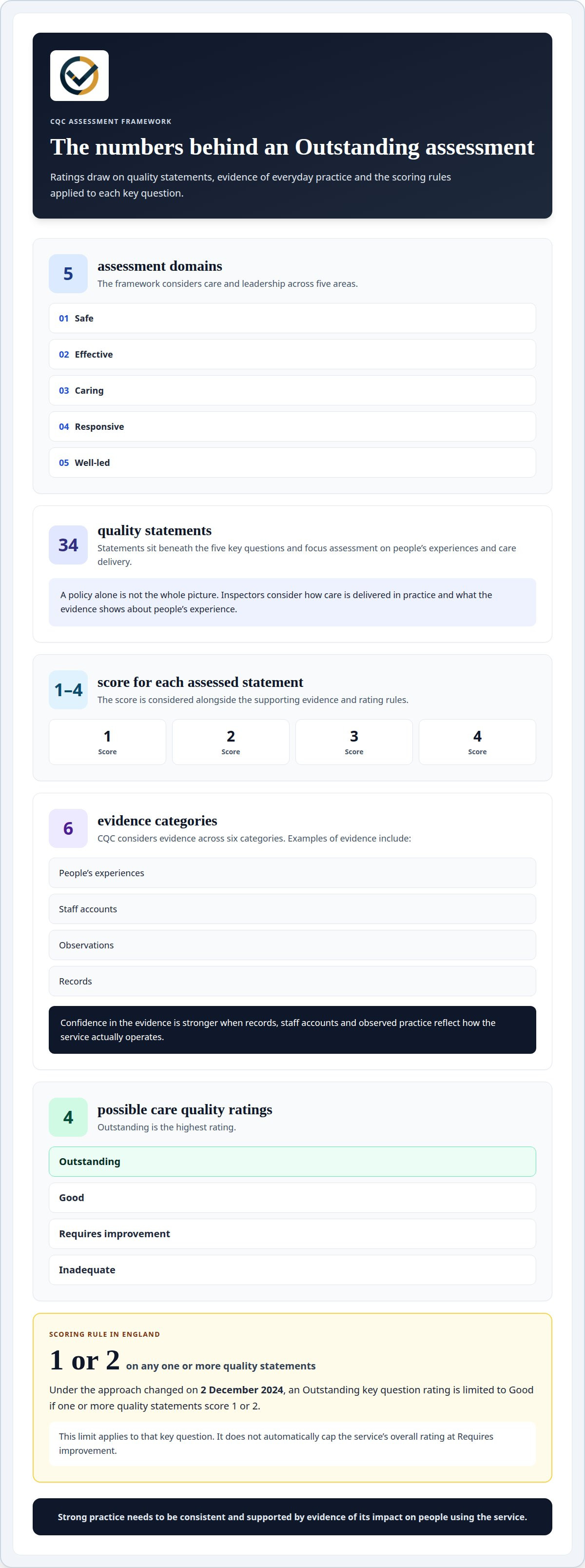
It’s understandable to focus on inspection day, but ratings reflect more than what inspectors see during a visit. The CQC assesses providers across five domains and 34 quality statements, scoring each assessed statement from 1 to 4. Strong practice needs to be consistent and supported by evidence that shows how it benefits people using the service.
This article explains how the assessment framework shapes ratings, what distinguishes Outstanding from Good, and how to turn findings into meaningful improvements. It also explores the evidence that demonstrates the quality of care in everyday practice, helping you approach improvement and inspection with greater clarity.
Table of Contents
1. CQC assessment framework and quality statements
The CQC’s Single Assessment Framework considers five domains: safe, effective, caring, responsive and well-led. These sit beneath five key questions, which are supported by 34 quality statements under the current assessment approach. The statements help focus assessment on what people experience and how providers deliver care, rather than on policies alone.
For each assessed quality statement, the CQC uses a score from 1 to 4 and considers evidence across six categories. Evidence can include people’s experiences, staff accounts, observations and records. A manager should be able to explain how these sources reflect actual practice. For example, a policy describing a process is more meaningful when staff can explain how they use it.
The CQC rates care quality as outstanding, good, requires improvement or inadequate, with Outstanding as the highest rating. Ratings help people make informed decisions about care providers, while inspection reports explain the evidence behind them. Use reports to understand how CQC reaches its findings, not to copy another service’s approach: its setting and people’s needs may differ.
To receive an Outstanding assessment, providers need evidence that supports strong practice across the relevant statements. The CQC changed how it applies scores in assessments in England on 2 December 2024. Under the current approach, an outstanding key question rating is limited to good if one or more quality statements score 1 or 2. The score therefore needs to be understood alongside the evidence and rating rules.
Misleading inspectors can make it harder to assess care accurately, while records that conflict with staff accounts may weaken confidence in the evidence. A regulatory breach may affect the rating for the relevant key question. Where CQC’s rating rules provide for a limit, it applies to that key question and does not automatically cap the service’s overall rating at requires improvement. Regulation 12 concerns safe care and treatment, and Regulation 17 concerns good governance, according to The National Archives. Accurate records and candid explanations help inspectors see how the service operates.
2. Planning and implementing service improvements
A requires improvement rating should lead to a focused plan that addresses the findings and strengthens everyday care. The CQC schedules a follow-up in 12 months to check whether improvements have been implemented. Use the inspection report to identify the underlying issues, rather than responding only to the rating label.
Turn each finding into an action with a clear owner, practical steps and a way to monitor progress. For example, if an audit identifies gaps in medicine records, review recording practice, discuss expectations at a team meeting and check later records for consistency. This makes the change visible and helps managers assess whether it has improved care.
Regular, systematic audits across all five CQC domains help services spot patterns before they become established. Each audit should lead to an action plan, with a named person responsible for every task and progress monitored. Review results at management meetings, then adjust the plan if evidence shows an action has not worked. Collecting feedback consistently over time can also give a more accurate picture of people’s experiences.
Improvement depends on staff involvement as well as written procedures. Supervision, team meetings and open conversations give staff opportunities to raise concerns and suggest practical changes. Policies should be accessible, followed in practice and updated when procedures change. Training records can help managers identify where staff need further support to meet agreed standards.
Care planning should connect each person’s needs and preferences with the support they receive. Review plans when circumstances or feedback change, and record how agreed actions shape day-to-day support. This helps the organisation assess whether changes are improving outcomes, not merely completing tasks. A structured mock inspection can help identify gaps in evidence and staff understanding before a formal inspection, without scripting responses.
3. Communicating strengths during an inspection
Clear communication helps inspectors connect what they observe with how care is delivered every day. Prepare a concise account of practice across the five domains: safe, effective, caring, responsive and well-led. For each strength, identify supporting evidence, such as a care record, staff training record or feedback from someone using the service.
Care homes, home care and healthcare services are assessed through the CQC framework, but relevant evidence should reflect each service’s setting and the people it supports. A care home might explain how staff respond to a resident’s changing needs; a home care provider could show how care plans guide visits. Similarly, where residential settings accommodate companion animals or therapy pets to support resident wellbeing, evidencing sound health arrangements with clinical practices such as Streatham Hill Veterinary Surgery demonstrates thorough day-to-day governance. Examples should describe actual practice, not rely on exceptional claims.
Leadership and governance are reflected in how managers explain decisions, staff understand their responsibilities, and the service learns from concerns. Connect each identified issue to the action taken and evidence of follow-up. Training records, supervision discussions and audit findings can show how improvement is embedded across the team.
CQC carries out comprehensive, focused and combined inspections. Focused inspections are usually unannounced. Use the CQC assessment framework to practise tracing a quality statement from written policy to staff knowledge and observed care. A mock inspection can reveal gaps in evidence or confidence. It should help staff prepare to answer honestly, not rehearse scripted responses.
There is no single inspection timetable that applies to every service in the available assessment information. Inspection activity and any rating change depend on the assessment and evidence considered. Providers can find CQC guidance and published inspection reports through the CQC website; reports offer examples of findings and ratings. Local support can help teams act on those findings, while practical exercises can build staff readiness without turning inspection day into a performance.
4. Differences between Good and Outstanding ratings
Good means a service delivers care that meets expectations; Outstanding requires stronger performance, consistently supported by evidence. The distinction is about more than polished paperwork. Evidence should show how care improves people’s experiences and outcomes, and how leaders learn when practice falls short. For providers asking how to get an outstanding CQC rating, the practical focus is sustained impact in everyday care.
The Care Quality Commission’s key question percentage thresholds are 63 to 87% for Good and 88% and above for Outstanding. They are 39 to 62% for Requires improvement and 25 to 38% for Inadequate. These thresholds help explain how statement scores inform key question ratings. A strong result in one area cannot, by itself, demonstrate outstanding care across the service.
For an overall location rating of Outstanding, the usual rating pattern is at least two key questions rated Outstanding and three rated Good. Providers therefore need strength in some areas and reliable standards throughout the rest. A caring team may deliver excellent support, for example, but weak governance can affect the overall picture. Leaders need assurance that effective practice is consistent across teams and shifts.
Good compliance is essential, but Outstanding practice goes further by showing how the organisation responds to people’s needs and improves care. Support a quality statement with evidence of impact, such as feedback prompting a change in support, followed by a review of whether it helped. Leaders should be able to explain the decision, the action and its effect.
A practical answer to how to get an outstanding CQC rating is to test each statement: does the evidence show requirements are met, and does it demonstrate a sustained benefit for people? Match records, staff understanding and people’s experiences to build sound assurance. To translate assessment findings into practical compliance improvements, review your compliance approach.
CQC Consultancy
CQC Consultancy helps providers turn assessment findings into practical steps towards stronger, more consistent care. If you are preparing for inspection, a Mock CQC Inspection can identify gaps in evidence and staff understanding. CQC Compliance Guidance supports services reviewing standards and improvement priorities, while CQC Registration Support helps new providers understand the registration process.
This support is useful when you need a clearer view of how current practice aligns with CQC expectations or how to address areas for improvement. The focus is on building sound practice and presenting evidence accurately, not promising a particular rating.
For support with your CQC requirements, contact CQC Consultancy.
Make strong practice part of everyday care
A clear approach to how to get an outstanding CQC rating starts with making quality part of everyday decisions, not a separate inspection task. Keep improvement connected to people’s changing needs, and make sure staff understand how their roles contribute. This creates a stronger foundation for consistent care and gives leaders a meaningful way to assess progress.
Choose a practical next step: identify where your service most needs clarity, then agree who will lead the work and how you will review its impact. Steady progress is more useful than last-minute preparation because it supports lasting changes in practice. Keep the focus on people’s experiences, and use each review to decide what should continue or change.
If you’d value tailored support with your service’s next steps, discuss your service with CQC Consultancy. With a clear plan and shared commitment, your team can keep strengthening the care it delivers.
Frequently Asked Questions
How Does The CQC Calculate Ratings?
The CQC uses scores for assessed quality statements to reach ratings for its key questions, then determines the overall location rating. The five key questions carry equal weight in the overall calculation. This means a strong result in one area cannot automatically compensate for weaker findings elsewhere. Read the report’s reasoning to understand how the evidence affected each rating.
What steps should a care provider take to prepare for a CQC inspection?
Start by reviewing the latest inspection report and turning its findings into clear actions. Make sure staff can explain how they support people in practice rather than memorising prepared answers. Organise relevant records so managers can find them promptly, including training evidence and examples of actions taken after concerns. A mock inspection can help identify gaps and build staff confidence.
How can providers demonstrate outstanding performance across CQC’s quality statements?
Connect each quality statement to evidence of what people experience and how the service responds. For example, if feedback highlights a difficulty with a care arrangement, show how the provider considered it, changed its approach and reviewed the effect. Evidence is more persuasive when records, staff accounts and people’s experiences present a consistent picture of thoughtful, effective practice.
How can care providers improve patient safety, outcomes and people’s experience for CQC?
Use safety records and feedback to identify risks, respond to concerns and learn from recurring issues. Medication records, for example, can help a service identify administration errors, investigate patterns and follow up actions. Review care plans when a person’s needs or preferences change, then assess whether the support remains appropriate. These steps connect day-to-day practice with safer care and better experiences.
Are there differences in Outstanding CQC criteria for care homes, home care and healthcare services?
The same CQC framework applies, but relevant evidence should reflect each service’s setting and the people it supports. Care homes, for example, may show how staff respond to residents’ changing needs, while home care providers may show how care plans guide visits.



Comments