Creating Effective Practice Induction Packs for Compliance

A strong induction doesn’t depend on a prescribed pack: the CQC doesn’t require GP practices to use a specific induction-pack tool. Practice induction packs should give new starters clear, practical information about health and safety, their role and the people who will support them, while reflecting how the practice works.
It’s understandable to want one complete document covering every requirement. A more useful approach is to make essential information easy to find, relevant to each person’s responsibilities and supported by an induction plan that develops as they gain confidence and competence.
This guide explains what health and safety information to include, who to introduce, what to send before day one and what an induction plan should cover. You’ll also learn how to make the pack a practical resource for new staff, rather than a folder of information they’re expected to absorb all at once.
Table of Contents
Health and safety information for new starters
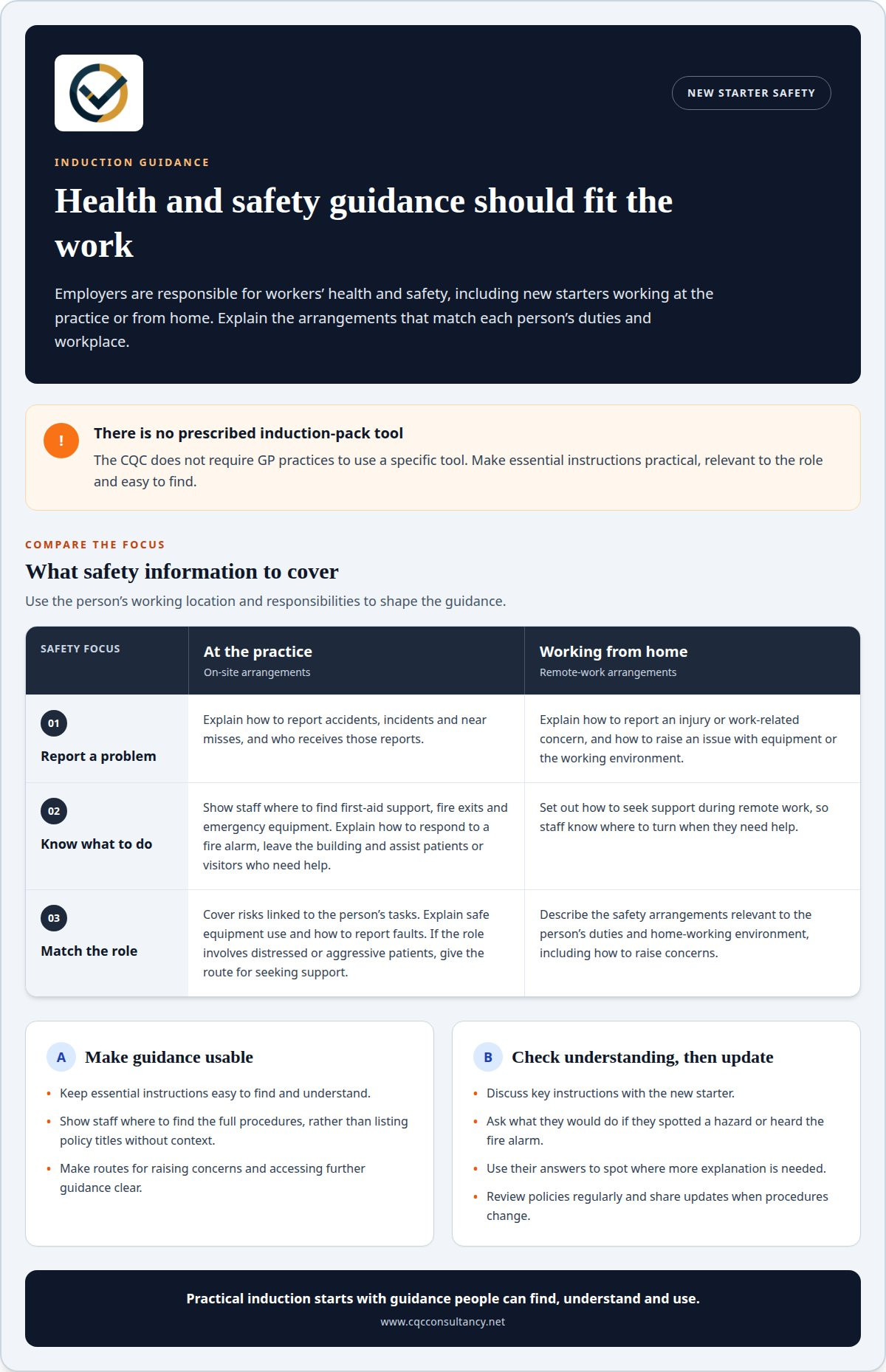
Employers have a legal responsibility for workers’ health and safety, including new starters working on-site or from home. An induction pack should explain the safety arrangements relevant to each person’s duties and workplace. Keep essential instructions easy to find, with clear routes for raising concerns and accessing further guidance.
For staff working at a practice, explain how to report accidents, incidents and near misses, and who receives those reports. Show new starters where to find first-aid support, fire exits and emergency equipment. Give practical instructions for responding to a fire alarm, leaving the building and helping patients or visitors who need assistance.
Cover risks linked to the worker’s tasks. For example, explain the safe-use instructions for equipment they’ll handle and how to report a fault. If a role involves contact with distressed or aggressive patients, describe the practice’s route for seeking support. Make these procedures specific enough to guide action, rather than listing policy titles without context.
Home-based workers also need relevant safety information. Explain how to report an injury or work-related concern, and how to raise an issue with equipment or the working environment. Set out how to seek support during remote work. This ensures induction reflects where each person works, not just the main premises.
Discuss essential instructions with the new starter and show them where to find full procedures. Ask them what they would do if they spotted a hazard or heard the fire alarm. Their answers can reveal where further explanation is needed. Keep policies clear, review them regularly and share updates when procedures change, so staff can follow current guidance.
Introducing new workers to managers, buddies and teams
Myth: a welcome email and staff directory are enough to introduce someone to a practice. Reality: new workers need direct contact with the people who guide their role. They should ideally meet their manager on the first day, and meet a mentor or buddy if they have one.
The manager can explain the worker’s responsibilities, how priorities are agreed and who handles day-to-day questions. For example, a new receptionist should know who to approach about appointment processes, while a nurse needs clear routes to clinical supervision and role-specific guidance. These conversations help prevent uncertainty from becoming a routine problem at work.
A buddy or mentor gives the new starter a practical point of contact as they learn how the team works. Agree what support they can provide, such as showing where shared resources are kept or explaining how colleagues communicate during a busy session. Clarify which questions should go to a manager or another qualified colleague.
Introductions work best when they are planned around the role. Include the people the worker will rely on, such as:
The line manager, who explains responsibilities and reviews progress.
A buddy or mentor, who helps with everyday team routines.
Colleagues whose work connects with the new starter’s tasks.
Relevant leads, who explain how to raise role-specific questions.
When several workers start in the same role, a group induction can provide consistent information and help them build relationships. Set aside time for individual conversations too, so each person can raise questions linked to their experience and duties.
Introductions shouldn’t end after day one. Managers should speak with new workers regularly, listen to questions and offer feedback and guidance. If someone isn’t meeting the expected standard, discuss the issue and consider whether the induction programme, further training or additional support should change. This makes support an active part of joining the team.
Sending an induction pack before the first day
Myth: a new starter can wait until day one to learn how the practice works. Reality: employers should plan induction before work begins and send important information in advance. A central pack also helps trainees and locum clinicians who may be unfamiliar with local processes.
Review the pack regularly and update it whenever relevant processes or practice information change. Assign responsibility for updates to relevant team members, so content stays accurate without relying on one person’s memory.
Give the new starter practical details to help them prepare, rather than sending every policy at once. Useful material may include:
The role, key responsibilities and first-day expectations.
Arrival arrangements, where to go and who to ask for.
Equipment arrangements and any access details needed for work.
Organisation information and a staff handbook, if available.
Employment particulars, if these haven’t already been provided.
Keep the pack focused on information the person can use before starting. Explain what they should bring, how their first day is arranged and where to find role-specific guidance. Save detailed training for the induction itself, when a manager can explain procedures and answer questions.
Choose a format staff can search and use when they need it. An unindexed paper copy or overfilled folder makes essential information hard to find. A well-organised digital resource helps staff locate the right procedure, while a clear contents page guides anyone using printed material. Make it straightforward for relevant team members to maintain and update the pack.
Before sending the pack, check that it fits the worker’s role and contains current practice information. A locum clinician, trainee and permanent receptionist may need different operational details. Send relevant sections before the start date, then use the first day to clarify priorities and discuss anything that needs explanation. This prepares new workers without expecting them to absorb every procedure in advance.
Deciding what an induction plan should cover
Myth: one standard timetable suits every new starter. Reality: plan around the person’s role, experience, learning needs and workplace. A dentist, nurse, receptionist and manager need different role-specific tasks, systems and guidance, alongside shared practice information.
Nurses should undertake clinical work in line with appropriate training and an assessment of competence. Receptionists may need to learn appointment and communication processes, while managers need clear information about oversight responsibilities. Use the worker’s confidence and competence to guide progression, rather than relying on a fixed timetable.
An induction pack explains the organisation, role and relevant procedures. A staff handbook sets out broader workplace information and policies; a training checklist records learning, practice and review. Keep frequently used or safety-critical guidance easy to find, and don’t rely on locally written pathways alone if they omit practice-specific steps, such as safe referral processes.
Common risks include overwhelming a new starter with too much information on day one, using outdated procedures and assuming a signed checklist proves understanding. Include practical learning, such as IT systems, customer service, role-specific tasks and mandatory organisational training. These can be taught formally or through shadowing experienced colleagues.
Build in regular conversations to review progress, answer questions and give feedback. The induction schedule should include a 4-6 week review and a 3-month review, while remaining responsive to competence and confidence. If expected standards aren’t being met, discuss the difficulty and consider changes to the programme, further training or additional support.
Effective planning links role requirements, learning and review into a process staff can follow. Get support with practice compliance when you need to strengthen how your induction arrangements align with wider compliance expectations.
After the first day, cover role expectations, relevant tasks, training, reviews and introductions to people across the organisation. Adapt the plan to the worker’s experience and workplace.
CQC Consultancy
CQC Consultancy can help you assess whether your induction arrangements support wider practice compliance. If staff guidance, role-specific procedures or oversight processes need strengthening, CQC Compliance Guidance can help identify practical improvements. A CQC Mock Inspection can also highlight areas that may need attention before a formal inspection.
Support can be useful when creating induction arrangements for a new service, reviewing existing processes or addressing gaps in staff understanding of practice procedures. The focus is practical compliance guidance, helping induction planning support the organisation’s broader responsibilities rather than becoming a standalone document exercise.
For support with your practice’s compliance arrangements, contact CQC Consultancy to discuss your needs.
Make induction part of ongoing compliance
Well-designed practice induction packs can support consistent ways of working, but they’re most useful when they remain connected to the practice’s wider compliance approach. As roles, procedures and service needs change, consider how staff learning and oversight fit together. This turns induction from a one-off document into part of how the organisation maintains clarity and supports its team.
If you’re reviewing how induction fits your compliance arrangements, CQC Consultancy offers CQC Compliance Guidance, CQC Mock Inspections and CQC Registration Support. The right support depends on what your practice needs to address, whether you’re strengthening existing processes or preparing for registration.
Contact CQC Consultancy for support with your next steps, and move forward with a clearer plan for practice compliance.
Frequently Asked Questions
What are practice induction packs?
A practice induction pack brings together resources that help a new starter understand how their workplace operates. It provides relevant guidance, contacts and role information in an accessible format. For example, a new administrator might use it to learn how appointment queries are routed, while a clinician receives information relevant to their responsibilities. The contents should reflect the practice and the individual’s role.
What is included in a dental practice induction pack?
A dental practice pack can include role expectations, staff contacts, patient communication processes and guidance on where to find practice resources. For example, reception staff may need to know how to route a clinical query, while a dental nurse may need role-specific information about equipment and team workflows. Provide material relevant to each person’s work, rather than expecting every starter to use identical documents.
How do I create an induction pack for a UK dental practice?
Start by mapping the roles in the practice and identifying what each person needs to work safely and confidently. Gather current procedures, practical details and role guidance, then organise them under clear titles with a contents page. Assign responsibility for maintaining each document. Before issuing the pack, check whether a new starter could find key information, such as how to escalate a patient query.
What policies and procedures should a practice induction pack include?
Include the policies and procedures staff need to carry out their duties and respond to common situations. Depending on the role, these may cover confidentiality, patient concerns, clinical escalation, equipment use and emergency arrangements. Explain where to find the full procedure and who can clarify it. Avoid putting every organisational policy in the main pack if that makes essential, frequently used guidance harder to locate.



Comments