Guide to Immunising Healthcare Staff for CQC Compliance

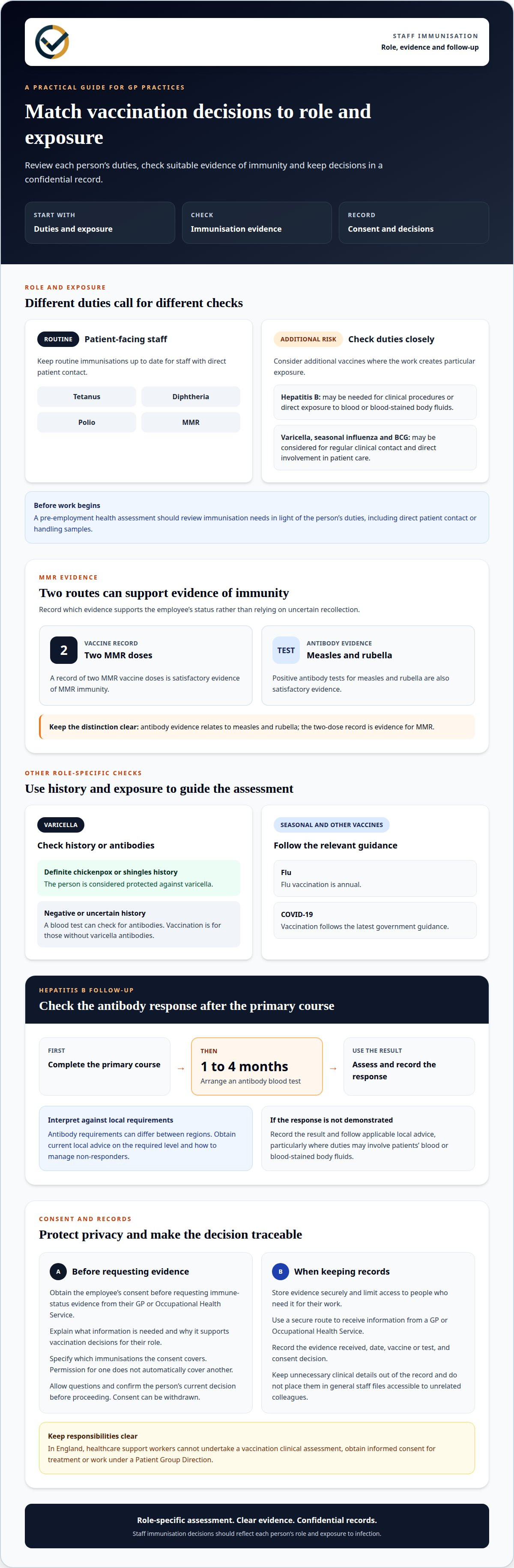
Yes, a GP practice can arrange an immunisation programme for its own staff, but protection should reflect each person’s role and exposure to infection. A sound approach to immunising healthcare staff includes keeping staff with direct patient contact up to date with routine tetanus, diphtheria, polio and MMR immunisations. It also considers additional vaccines where duties create particular risks.
It’s understandable to want a clear answer about what staff need and how to show your practice has taken a considered approach. This guide explains how to assess immunity, handle health records confidentially and address consent, while keeping infection prevention central to decisions. It also outlines how role-specific risks shape vaccination needs, what evidence can support immunity, and how clear policies and records can demonstrate an organised approach.
Table of Contents
Consent and confidential handling of immune-status records
Before requesting an employee’s immune-status evidence from their GP or Occupational Health Service, obtain their consent. Explain what information you need and why it supports vaccination decisions for their role. For example, a practice may need evidence of a relevant vaccine history or test result before assessing protection. Keep the request focused on that purpose. The Health and Safety at Work Act (HSWA) 1974 is listed by the UK legislation register as a legal requirement relevant to protecting staff and patients through appropriate vaccination.
Consent applies to the specific immunisation discussed. Permission for one vaccine does not automatically cover another unless the employee has explicitly consented to a full course. If vaccination involves several separate immunisations, specify which ones the consent covers. Record the employee’s decision and the scope of their permission to avoid assumptions about different vaccines or later doses.
Consent is an ongoing process, not a one-off signature. An employee can withdraw consent at any time, so staff involved in vaccination should allow questions and confirm the person’s current decision before proceeding. Local Vaccine Group Directives published on 1st September 2026 specify that nursing associates cannot obtain consent under that legal mechanism. Practices should therefore ensure the person seeking consent is authorised to do so under the applicable process.
Treat evidence as confidential health information. Store it securely, limit access to people who need it for their work, and keep details out of general staff files accessible to unrelated colleagues. A record can note the evidence received, date, vaccine or test, and consent decision, without including unnecessary clinical details. Use a secure route to receive information from a GP or Occupational Health Service. Clear access arrangements protect privacy while allowing appropriate staff to review records when assessing infection risks.
In England, healthcare support workers cannot undertake a vaccination clinical assessment, obtain informed consent for treatment or work under a Patient Group Direction.
Evidence of immunity to measles, mumps and rubella
Before starting work, each new employee should have a pre-employment health assessment to review their immunisation needs. For UK healthcare workers, recommended vaccines depend on duties and exposure. Patient-facing staff should be up to date with routine immunisations, while clinical contact may mean additional vaccines need consideration.
Proof of MMR immunity
For healthcare staff in general practice, satisfactory evidence of MMR immunity is two MMR vaccine doses or positive antibody tests for measles and rubella. This gives practices a clear basis for recording protection instead of relying on an employee’s uncertain recollection of vaccination.
The distinction matters: antibody evidence relates to measles and rubella, while the two-dose record is evidence for MMR. The Green Book, Chapter 18, provides guidance on immunisations to protect healthcare staff. A record should show which evidence supports the employee’s status, so the basis for the assessment remains clear.
Vaccination before starting work
A pre-employment health assessment reviews an employee’s immunisation needs before they begin work. It should consider their duties, including whether they have direct patient contact or handle samples. This makes the assessment specific to the role rather than treating every post as having the same exposure.
In the UK, patient-facing staff should be up to date with tetanus, diphtheria, polio and MMR immunisations. Hepatitis B vaccination may be needed for staff involved in clinical procedures or directly exposed to blood or blood-stained body fluids. Varicella, seasonal influenza and BCG may also be considered for staff with regular clinical contact and direct involvement in patient care.
For example, a staff member with regular clinical contact may need a different assessment from a non-clinical employee, whose routine immunisations are recommended according to risk. Staff with a definite history of chickenpox or shingles are considered protected against varicella. If their history is negative or uncertain, a blood test can identify whether antibodies are present. Vaccination is for those without varicella antibodies.
A structured review of CQC compliance preparation can help practices connect these records and role assessments with their wider compliance approach.
Hepatitis B antibody levels and non-responders
Staff who decline vaccination or cannot be vaccinated need an appropriate risk assessment and a clear recorded rationale. For hepatitis B, check antibody levels one to four months after completing the primary course; flu vaccination is annual, while COVID-19 vaccination follows the latest government guidance.
Hepatitis B antibody levels
An antibody test measures an employee’s response after the hepatitis B primary course. The result helps determine whether the course has produced evidence of immunity and whether further assessment is needed.
Arrange the blood test one to four months after completing the primary course. This provides a consistent point to assess the result and record it alongside the vaccination history. Keep the result and its interpretation with the employee’s confidential occupational health information, so decisions about exposure risks have a clear basis.
Hepatitis B antibody requirements can differ between regions. Practices should obtain current local advice on the required level and how to manage non-responders. Interpret results against the applicable local requirements rather than an assumed national threshold.
Staff who do not respond to vaccination
A non-responder is someone whose antibody result after a hepatitis B primary course does not demonstrate the required response. Identifying this status matters for staff whose duties may involve contact with patients’ blood or blood-stained body fluids.
Follow current local advice on further assessment and management, as regional antibody requirements and non-responder pathways can vary. Record the test result, the advice applied and the rationale for decisions. This provides a clear account of how the practice considered the employee’s potential exposure, without treating an incomplete response as proof of protection.
If staff decline vaccination or have a medical condition affecting vaccination, document the individual rationale and an appropriate risk assessment. Employees with underlying medical conditions should receive a personalised assessment and personal risk assessment. These records show how the practice considered both the employee’s circumstances and risks to patients.
Booster timing is vaccine-specific. The hepatitis B antibody check follows the primary course, flu vaccination is annual, and COVID-19 vaccination should align with the latest government guidance. Routine recommendations for other immunisations may vary over time and by location, so local advice informs the relevant schedule. Record the vaccine, date and any follow-up decision clearly.
Why healthcare staff immunisation matters
Immunising healthcare staff is part of managing infection risks associated with particular duties. The practical task is to turn the risk assessment into clear workplace decisions and support.
Reasons for staff immunisation
Recommendations vary according to role and workplace exposure. Clinical procedures, direct patient contact, handling samples and cleaning bodily fluids involve different risks from non-clinical work. An assessment should link the employee’s actual duties to relevant immunisation needs instead of applying the same approach to every post.
Immunisation can help protect employees, patients, their families and continuity of services. Before vaccination, give staff the opportunity to discuss the vaccine and potential side effects with the healthcare professional involved. This supports informed decisions without assuming that every vaccine or employee involves the same considerations.
Responsibility and payment for vaccinations
The employer arranges and pays for an effective immunisation programme for healthcare and laboratory staff, as recommended in the Green Book. Clear ownership matters: staff need to understand how workplace vaccination arrangements operate and how to raise questions about their circumstances.
A documented policy can define responsibilities, referral routes and how decisions are recorded. If an employee declines vaccination or cannot receive it, retain the rationale and an appropriate risk assessment. This gives the practice a considered record of how it addressed the employee’s circumstances and workplace exposure.
Accessing occupational health vaccinations
Employees should be able to access an occupational health assessment, and new starters should have a pre-employment health assessment to review their needs. These assessments provide a route to discuss role-related risks and arrange appropriate follow-up. They also give staff a clear opportunity to raise relevant health concerns confidentially.
After a needlestick injury or exposure to blood or body fluids, follow the practice’s local exposure procedures promptly and record the incident through the established process. Staff should know where to find those procedures before an exposure occurs. A CQC compliance review can help practices consider how these arrangements sit within their wider governance.
CQC Consultancy
CQC Consultancy can help connect staff immunisation arrangements with wider CQC compliance work. Whether your practice is in Liverpool, Manchester, London, Chester, Leeds, Sheffield, Birmingham, Portsmouth, Cornwall, Devon, Lancaster or Carlisle, CQC Compliance Guidance can clarify how risk assessments, records and procedures fit together. A CQC Mock Inspection can identify areas to strengthen before an inspection, while CQC Registration Support can assist with establishing a new regulated service.
Immunisation decisions remain your practice’s responsibility, including appropriate clinical and occupational health processes. Contact CQC Consultancy to discuss support that fits your compliance needs.
Make staff protection part of ongoing practice
A dependable approach to immunising healthcare staff is part of everyday governance, not a one-off administrative task. Assign a named team member to keep the policy, staff records and review process aligned. Include immunisation needs when roles change or new employees join, and make sure staff know how to raise questions confidentially.
Schedule regular reviews to check that your arrangements still reflect current duties and local advice. This turns individual decisions into a consistent process that supports staff and patient safety. Clear ownership also makes it easier to identify gaps and decide what needs attention next.
If you’d value guidance on strengthening your wider CQC approach, contact CQC Consultancy for support. With a considered process in place, you can move forward with greater clarity and confidence.
Frequently Asked Questions
Can I vaccinate my own staff?
Yes, a practice can arrange an immunisation programme for staff, but arranging it and administering vaccines are separate responsibilities. Vaccination should involve appropriate clinical assessment, informed consent and administration by suitably trained and authorised personnel. A healthcare support worker’s role may be limited, so define who handles each part before a clinic begins. This helps staff understand the process and where clinical accountability lies.
What evidence of vaccination or immunity must healthcare staff provide?
Evidence requirements vary by vaccine and role. The appropriate records depend on the employee’s duties and the infection being assessed. For example, MMR evidence may be a vaccination record or relevant antibody test results; hepatitis B assessment uses an antibody test after the primary course. Keep evidence relevant to the assessment, record the basis for decisions and handle health information confidentially.



Comments