How to avoid vague details in a CQC statement of purpose

Clear aims matter more than polished wording. In England, a CQC statement of purpose sets out the service a provider delivers, who it supports and where it operates. Providers must keep it accurate and up to date under Regulation 12, according to UK Legislation. If you need CQC statement of purpose help, focus on making each detail specific, realistic and consistent with the service in practice.
It’s easy to treat the document as a form to complete, but vague or outdated descriptions can leave people unsure what your service actually does. Your aims should explain what people can expect, how their needs shape the support and how the service works towards safe, effective and caring outcomes.
This guide explains what the statement covers and how to write aims that reflect your day-to-day service. You’ll also learn how to make details clear, keep the document aligned with your registration and approach inspection readiness with greater confidence.
Table of Contents
Why are the aims and objectives so important?
Clear aims explain what your care service intends to provide and how its objectives support that purpose. The statement appears on the organisation’s CQC profile page. Keep the current document accessible to people using the service and ready for inspection.
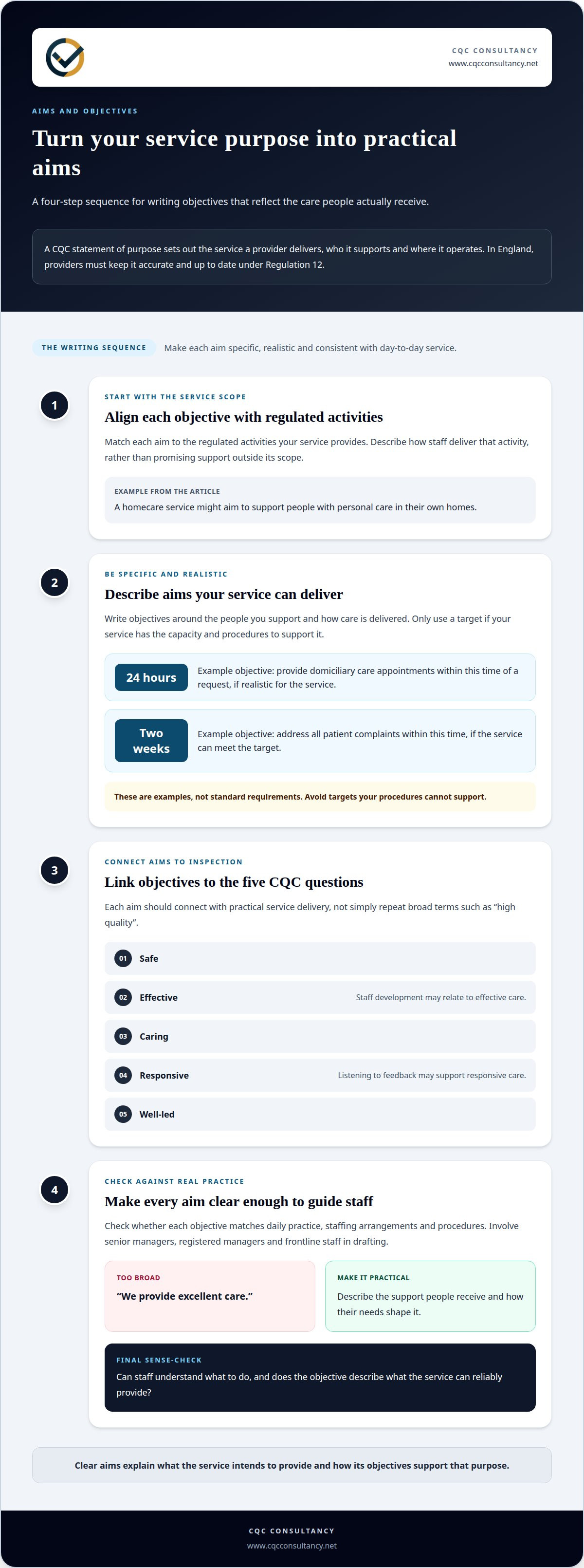
Align objectives with regulated activitiesStart by matching each aim to the regulated activities your service provides. For a homecare service, an aim might be to support people with personal care in their own homes. Describe how staff will deliver that activity, rather than promising services outside its scope. This helps show that your written purpose reflects the health and social care you actually provide.
Draft service-specific aims and objectivesWrite aims that reflect the people your service supports and how care is delivered. A domiciliary care objective could be to provide appointments within 24 hours of a request, if that is realistic for your service. Another example is addressing all patient complaints within two weeks. Treat these as examples, not standard requirements, and avoid targets your procedures cannot support.
Connect objectives to the five CQC inspection questions: safe, effective, caring, responsive and well-led. For example, an objective about listening to feedback can support responsive care, while one about staff development may relate to effective care. Each aim should link to practical service delivery, rather than simply repeat broad terms such as “high quality”.
Check whether each objective is specific enough to guide staff. Replace “we provide excellent care” with a clear description of the support people receive and how their needs shape it. Involve senior managers, registered managers and frontline staff in drafting. Their input can show whether the objectives match daily practice, staffing arrangements and procedures.
What Is a CQC Statement of Purpose?
A statement of purpose describes a provider’s care services, the people they support and where services operate. In England, UK Legislation requires all registered providers to keep an accurate, up-to-date statement under Regulation 12: Statement of purpose.
Set out the provider’s identity and structure. Include the business name, legal status, business address, telephone number and email address, plus any business partners. UK Legislation identifies the Health and Social Care Act 2008 as relevant to CQC compliance. Make sure the details identify the organisation responsible for the service, not only a trading name.
Describe the service and the people it supports. State what care you provide, where it is delivered and the needs of the people using it. Include the regulated activities and explain how the service is organised. For each location, give its address, describe the service and name its registered manager. These details help the statement accurately describe the service being registered.
Draft in a clear sequence: gather accurate provider and location details, describe the services and service-user groups, then identify the registered manager and regulated activities. Compare the draft with the registration application and actual service arrangements. CQC templates can help organise the information, but you can adapt the wording to describe your service. CQC’s template has four parts.
Submit the statement with a new CQC registration application in England. If the service changes, update the document to reflect its current arrangements, notify CQC of the changes and send the revised statement with that notification. A new registered manager or a change of location may affect the details. Keep the current version accessible to staff and people using the service.
If you’re preparing a new application or revising an existing document, CQC registration support can help you work through the information and structure.
Avoiding vague, incomplete or unrealistic information
Replace general promises with wording that shows what people can expect in practice. “We offer flexible support” does not explain what flexibility means. Say what can change, such as visit timing or how agreed support is delivered, and what stays consistent. CQC statement of purpose help can clarify where claims need practical detail. Keep promises within your service’s actual capacity, rather than describing an ideal staff cannot reliably deliver.
Make each location description distinguish the setting from the service itself. For example, a building used for administration may not be where people receive care. Explain how the named place relates to the service’s operations, so readers understand how support is arranged. Avoid relying on a broad phrase such as “community-based” without explaining what it means for people using the service.
Use wording that staff and people receiving support can interpret consistently. Terms such as “promptly”, “regularly” or “where appropriate” can mean different things to different readers. Replace them with a clear description of the action or decision. For example, explain how a person’s changing needs inform a review of their support, without promising a fixed response your service cannot sustain.
Read the draft as someone unfamiliar with the organisation would. Check whether each claim explains what the service does, rather than relying on internal shorthand or broad assurances. CQC statement of purpose help can provide a focused review when wording is difficult to make precise. Inaccurate or unrealistic descriptions may confuse people, weaken confidence in the document and create a gap between its claims and everyday experience.
Regulatory compliance and inspection readiness
Keep the statement aligned with your registration and current operations. For each location, identify the service, regulated activities and registered manager.
Set out how the provider meets the applicable requirements. In England, a provider’s statement of purpose must show how it will meet Schedule 3 of the Care Quality Commission (Registration) Regulations 2009, as amended in 2012, according to UK Legislation. Connect the provider’s mission to practical arrangements, such as care planning, safeguarding and quality monitoring. Make sure these descriptions reflect how the service actually operates.
Record the regulated activities provided at each location. Describe the service type and care delivered there, then name the registered manager responsible. Include the location’s address and contact details, the needs of the people supported and the activities carried out. This makes it easier to see how each service fits the provider’s CQC registration.
Compare the statement with the registration application and operational records. Confirm that the services and regulated activities match the provider’s registration, and that manager details reflect current arrangements. For each registered manager, include contact details, notice address, managed locations and time allocation, regulated activities and any job-share arrangements. These details help present a clear picture of accountability.
Prepare for inspection by keeping the statement current and accessible. Adding a service, moving or closing a location, or appointing a new registered manager may mean the statement needs updating. A location address change involving regulated activity requires the appropriate application, not just a revised statement. Consistency across the statement, application and daily operations helps inspectors understand the service accurately.
For focused help aligning registration details and service operations, explore CQC compliance guidance.
CQC Consultancy
Professional regulatory support helps providers clarify their statement of purpose through expert CQC Registration Support and CQC Compliance Guidance. This assistance can prove invaluable when drafting documentation for a new application, updating service details, or checking that the document accurately reflects current operational practices.
If you want to understand how your written aims and service arrangements may be viewed during a regulatory review, a CQC Mock Inspection offers a structured evaluation of inspection readiness. The right support depends on the specific task at hand, whether you are clarifying the regulated scope of a service or aligning official documents with day-to-day care delivery.
For considered guidance on your statement of purpose and ongoing compliance needs, get in touch with our specialist team today.
Make your next review purposeful
Treat your statement as a working reference for decisions about how the service is described and delivered. When plans change, bring the people responsible for care and oversight into the same conversation. This helps connect written commitments with people’s experience, instead of leaving the document as an isolated registration form.
A useful next step is to identify wording staff interpret differently, then agree on language that describes the service clearly. If you’re unsure how to strengthen a draft or prepare for scrutiny, seek tailored CQC statement of purpose help before revising it further. Use the review to decide what needs clarification and who is responsible for the next steps.
To discuss a practical way forward, contact CQC Consultancy. Each considered revision can help your team communicate the service’s purpose with greater confidence.
Frequently Asked Questions
Why Is It Required?
It gives the Care Quality Commission and people using a service an authoritative account of what the provider does. In England, UK Legislation makes keeping an accurate, up-to-date statement a legal requirement for registered providers under Regulation 12. It also helps prevent confusion when the service’s actual arrangements differ from its public description, such as offering a different type of support than people expect.
What is a CQC statement of purpose and who must have one?
It is a formal description of a provider’s services, service users, locations and management arrangements. Registered providers in England must maintain one, whether they run a care home, homecare service or another regulated service. For example, a provider operating from several sites should make clear which services run at each site, rather than treating the organisation as one undifferentiated service.
Where can I find a CQC statement of purpose template or example?
CQC provides a statement of purpose template, arranged in four parts, to help organise the information. Providers can use it as a starting point and adapt it to describe their service; using the template is not a legal requirement. A useful example shows how a provider explains its particular care model, rather than offering generic wording to copy without tailoring.
How do you update a statement of purpose with the CQC?
Notify CQC of a change and send the updated statement with that notification. Registered providers must do this within 28 days of making changes. For example, if a provider changes its manager or adds a service at a Manchester location, the revised document should reflect the new arrangements. A change to a location address where regulated activity takes place requires the appropriate application, not just a revised statement.
What common mistakes cause a CQC statement of purpose to be rejected or need correction?
Common problems include inconsistent details across documents, missing location information and wording that does not explain the actual service. For example, an application might describe a homecare service while the statement refers broadly to residential care. Do not describe an activity the provider is not registered to deliver. Before submission, check names, addresses, manager responsibilities and service descriptions against current arrangements.
What are the risks and penalties for having an inaccurate or out-of-date CQC statement of purpose?
An inaccurate statement can misrepresent a provider’s services and may lead to compliance concerns. In England, non-compliance can result in enforcement action, including fines or service closure. These are possible consequences, not automatic outcomes. For example, outdated location or manager details could make it harder to establish who is accountable for a service during regulatory scrutiny.


Comments